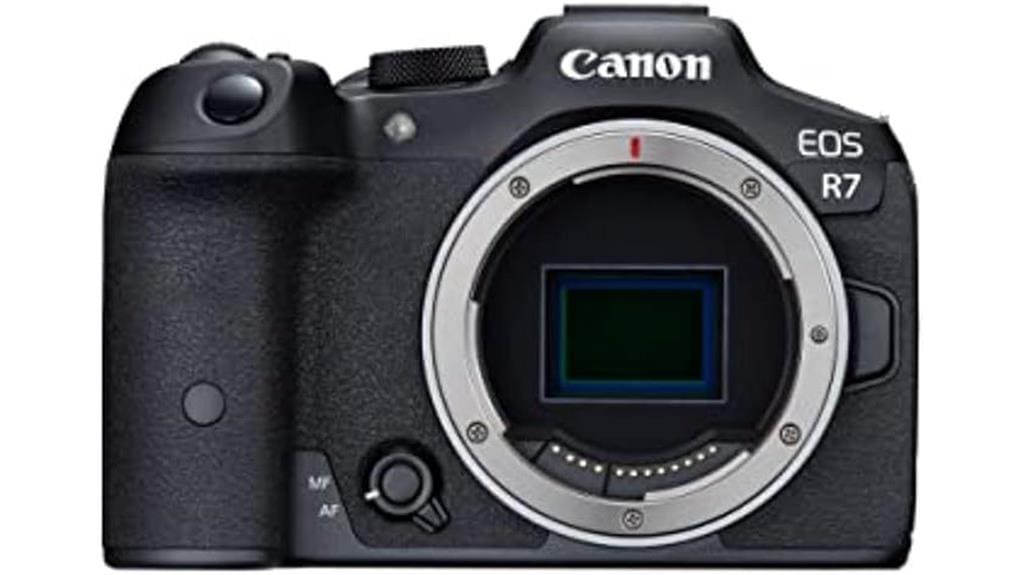

You’ll get a 32.5MP APS‑C sensor, DIGIC X processing, and Dual Pixel CMOS AF II that locks fast across nearly the whole frame, so you can track sports or wildlife with confidence. The 5‑axis IBIS (up to seven stops) and 15/30 fps burst modes deliver sharper telephoto and action shots than most crop rivals, while 4K60 video and compact build suit travel and hybrid work. Keep going to see detailed comparisons, workflows, and kit recommendations.
Some Key Takeaways
- 32.5MP APS-C sensor with DIGIC X delivers high-resolution images and tight crops suitable for wildlife, sports, and hybrid shooters.
- Dual Pixel CMOS AF II covers nearly 100% with 651 zones for fast, reliable subject detection and smooth tracking in high-speed sequences.
- 5-axis IBIS (up to 7 stops with coordinated IS) plus fast shutters enables better low-light handheld performance than most APS-C rivals.
- High burst rates—15 fps mechanical and 30 fps electronic—paired with robust AF make the R7 ideal for action and wildlife photography.
- 4K/60p video with Movie Servo AF offers strong hybrid capability, though extended 60p clips can show heat and rolling-shutter limitations.
Quick Verdict: Who the Canon EOS R7 Is Best For and Why
Because it pairs a high-resolution 32.5 MP APS-C sensor with fast processing and pro-grade autofocus, the EOS R7 is ideal for photographers who need a compact, high-performance body for action and hybrid work. You’ll appreciate its responsive AF and high frame rates when tracking fast subjects, and its size makes it unobtrusive for travel photographers and street shooters. Visually, you’ll see crisp detail and tight subject isolation compared with typical APS-C rivals. Mechanically, the rugged grip and responsive controls outpace many mirrorless competitors, so you can shoot longer, react faster, and carry less without sacrificing capability. It’s a great match for enthusiasts who also want access to a wide range of mirrorless accessories tailored to APS-C systems.
Key Specs That Matter: Sensor, AF, IBIS, and Shooting Speed
While the EOS R7’s 32.5 MP APS-C sensor and DIGIC X engine work together to deliver detailed, high-resolution images, the camera really shines when you combine that resolution with its advanced AF, IBIS, and burst performance. You’ll see APS C dynamics translate into tighter field of view and higher pixel density, letting you frame sports or wildlife more aggressively. Dual Pixel CMOS AF II covers nearly 100% with 651 zones, locking fast on people, animals, and vehicles. IBIS offers up to seven stops with coordinated IS, and shooting speed—15 fps mechanical, 30 fps electronic—demands disciplined Buffer management. Using the right lens adapter can expand the R7’s versatility by enabling compatibility with a wider range of lenses, including legacy glass and specialty optics like tilt-shifts, improving creative options and reach with lens adapters.
Real-World Performance: Image Quality, Autofocus, and Video in Typical Use Cases
Having established how sensor resolution, AF coverage, IBIS, and burst rates set the R7’s capabilities, let’s look at how that hardware performs in real shooting scenarios. You’ll notice 32.5MP detail holds up for tight crops; RAW retains highlight and shadow texture with predictable color reproduction. Dual Pixel CMOS AF II tracks subjects smoothly in high-speed sequences, outperforming many APS-C rivals in lock stability. IBIS plus fast shutters delivers usable low light performance at higher ISOs with minimal blur. Video at 4K/60p shows clean edges and reliable Movie Servo AF, though rolling shutter and heat appear in extended 60p clips. The R7’s combination of telephoto-ready autofocus and sensor detail makes it especially well-suited for wildlife and sports photography.
How the EOS R7 Compares: R7 vs. Competitors and vs. Canon’s Lineup
When you line the EOS R7 up against mirrorless APS-C rivals and Canon’s own RF lineup, its combination of 32.5MP sensor, DIGIC X processing, and 5-axis IBIS makes it a clear performance-focused hybrid: it delivers higher resolution and better stabilization than most crop-sensor competitors, matches or exceeds burst and AF responsiveness in action scenarios, and slots between Canon’s entry-level RP/RC-series and full-frame R6/R5 bodies by offering many pro features in a lighter, more affordable package. You’ll see Canon R7 vs. XT5 differences in resolution and IBIS, while Nikon Z50 comparison highlights the R7’s superior AF zones, higher fps, and richer video tools. Many photographers pair the R7 with wide-angle lenses to fully exploit its high-resolution sensor and stabilization.
Buying Checklist: Accessories, Cards, Batteries, and Final Recommendation
Now that you’ve seen how the R7 stacks up against rivals and Canon’s own lineup, it’s time to look at what you’ll actually need in the kit bag to get the most out of it: accessories that match its action-ready specs, memory cards and batteries that keep up with high-frame-rate RAW and 4K60 recording, and practical add-ons for stabilization and protection. Pack UHS-II V30 or faster SDXC (300–500 MB/s recommended) across two cards, a USB 3.0 Memory readers hub, at least two Extra batteries (LP‑E6NH), a protective Camera bag, compact gimbal or tripod, and lens cleaning kit. Final recommendation: prioritize speed and power for reliability in the field. Consider adding a dedicated USB 3.0 hub to manage multiple high-speed card readers and transfers.
Some Questions Answered
Does the R7 Support In-Camera Focus Stacking for Macro Photography?
Yes — you’ll get in camera stacking via Focus bracketing on the R7. You can set focus bracketing parameters, capture a sequence, and the camera will combine images to produce a stacked macro JPG in-camera or save the frames for external stacking. Visually it’s efficient for deep DOF macro work; compared to manual stacking, it’s faster and more consistent, though external stacking software can offer finer control and artifact removal.
Can I Use EF and EF-S Lenses Without Loss of Functionality?
Yes — you can use EF and EF‑S lenses via an EF compatibility Mount adapter, but expect some differences. You’ll retain AF performance with Dual Pixel AF II for most lenses, though older EF‑S optics may autofocus slower. Optical stabilization in lenses still works, and the R7’s IBIS coordinates with lens IS for improved correction. Visually, adapted EF glass keeps full framing behavior on APS‑C, but check specific lens firmware for best results.
How Long Does the Lp‑E6nh Battery Last Shooting 4K Video Continuously?
You’ll get just over 30 minutes of continuous 4K recording on a single LP‑E6NH under nominal conditions — that’s the practical battery runtime. Thermals play a role: in hot environments Thermal limits can cut sessions shorter as the camera throttles or stops to cool. Visually, expect a steady 30+ minute clip in moderate temps; comparatively, colder conditions extend runtime slightly, while high heat can force premature shutdowns.
Is the Camera Weather-Sealed for Shooting in Light Rain or Dusty Conditions?
Yes — the body offers robust weather sealing, so you can shoot in light rain and dusty conditions with confidence. You’ll see moisture protection seals around buttons, compartments and the lens mount, giving practical dust resistance compared with unsealed cameras. Visually inspect seals and avoid sustained downpours; it’s not fully submersible. For extreme wet or sandy environments, you’ll want added rain covers or protective housing for reliable long-term use.
Can the R7 Record RAW Video or Output Clean 10‑Bit HDMI for External Recorders?
Yes — you can get 10‑bit output and RAW options. You’ll record internal 10‑bit 4K up to 60p and use RAW output over HDMI passthrough to an external recorder for higher flexibility. HDMI passthrough supplies clean, 10‑bit video (depending on recorder compatibility), while RAW output gives uncompressed frames for grading. Compared to internal codecs, RAW + external recording yields greater dynamic range and edit latitude for professional workflows.