You’ll get an affordable, no‑frills DSLR that’s easy to use, handles like other Canons, and delivers clean 18MP stills at ISO 100–800 with modest dynamic range. The 18–55 kit lens limits shallow depth of field, AF is fine for static subjects but slow in Live View, and video is 1080p with conservative bitrates. Low‑light noise rises sharply above ISO 1600. It’s a practical starter body—keep scrolling to see detailed tests and comparisons.
Some Key Takeaways
- Affordable entry-level DSLR delivering 18MP APS-C stills and basic Full HD 1080p video, ideal for beginners.
- Good image quality at ISO 100–800; noticeable noise reduction and softening above ISO 1600.
- 19-point phase-detect AF for viewfinder use is reliable for static subjects; Live View AF is slower.
- 3 fps continuous shooting, simple controls, long battery life, and compact, familiar Canon handling.
- Bundles with battery, charger, 64GB SD card, and accessories add value; recommended add-ons include 50mm f/1.8 and external mic.
Who Should Buy the Canon EOS Rebel T100/4000D and Why
If you’re just getting into DSLR photography or want an affordable, no-nonsense camera for basic vlogging and stills, the Canon EOS Rebel T100/4000D is worth considering: it pairs an 18MP APS-C sensor and a standard 18–55mm kit lens with straightforward exposure automation, 19-point AF, and Full HD video, giving you solid image quality and familiar Canon handling without a steep learning curve. You’ll appreciate its low cost, simple menus, and included kit for beginners’ learning; sensor performance and autofocus suit casual stills and entry-level budget filmmaking. It’s practical, portable, and lets you focus on technique rather than settings. For mirrorless camera enthusiasts, having the right essential gear can significantly improve your shooting experience and results.
Canon T100 Key Specs That Matter for Photos and Video
Having covered who gets the most from the T100, let’s look at the specific specs that shape image and video outcomes. You get an 18MP APS-C sensor, 18–55mm f/3.5–5.6 kit lens and basic aperture control via the lens; depth-of-field flexibility is limited compared with faster glass. Autofocus modes include 19-point phase AF in viewfinder and contrast-detect in Live View (AF-S, AF-C, manual), adequate for everyday subjects but not high-speed action. Video is Full HD 1080p MP4—expect conservative video bitrate and limited codec options. ISO range to 25600 helps exposure but constrains low light performance. This camera pairs well with essential DSLR accessories like lenses and tripods that expand creative possibilities.
Real-World Image and Video Performance at Different ISOs
Typically you’ll see clean, detailed results at ISO 100–800 on the T100’s 18MP APS-C sensor, with good color and fine shadow detail preserved for prints and web use; push beyond ISO 1600 and noise reduction starts smoothing texture and blotching fine detail, while ISO 3200–25600 (expanded) becomes increasingly usable only for small web crops or when you accept softer detail and muted colors. You’ll get usable 1080p video to ISO 800–1600; above that high ISO grain and luminance noise dominate. Watch for dynamic range clipping in shadows when you lift exposure; recoverable highlight detail is limited. For best sustained photo and video performance, pair the camera with high-speed memory cards to avoid buffer slowdowns and ensure smooth recording high-speed cards.
Autofocus, Shooting Speed, and Handling for Everyday Use
Expect the T100’s autofocus to be competent but conservative: its 19-point phase-detection AF performs well for static subjects and casual street shooting, while Live View relies on slower contrast-detect AF that lags for moving targets. You’ll get usable autofocus responsiveness for portraits and landscapes, but tracking fast action is limited. Continuous shooting tops out at 3 fps, adequate for candid sequences but not sports. Handling ergonomics favor light travel and simple operation: the grip is basic, controls are sparse, and menu responses are predictable. Overall, it’s a straightforward, entry-level setup for everyday shooters prioritizing ease over speed. If you plan to shoot on the go, consider pairing the T100 with a lightweight tripod for more stable shots and easier composition, especially when using travel-friendly tripods.
What’s Included in the Advanced Accessory Bundle and Value Analysis
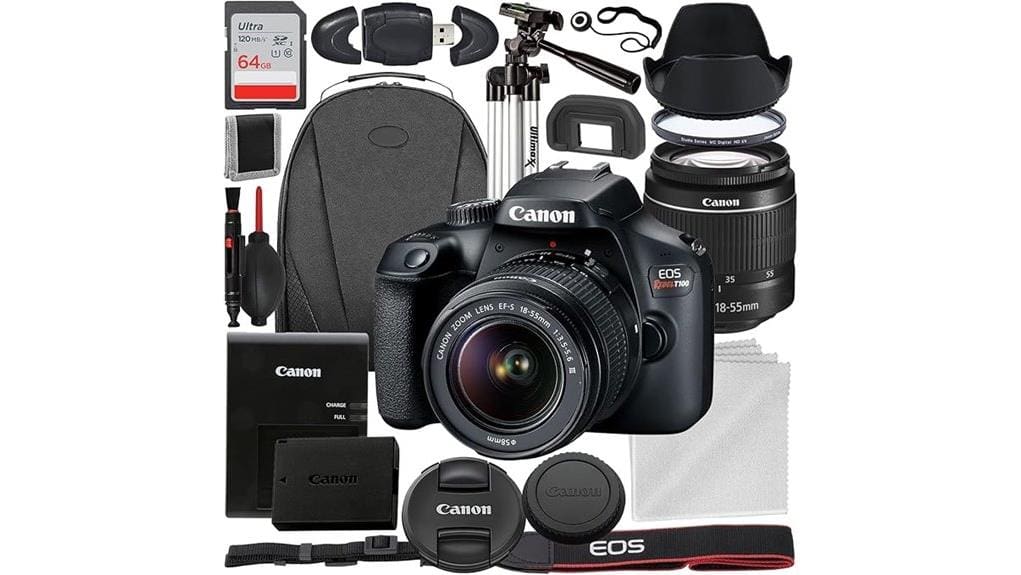
While the T100 kit centers on the camera and 18–55mm lens, the Advanced Accessory Bundle packs practical extras that save you buying common items separately. You get canonical essentials: LP‑EN10 battery, LC‑EN10 charger, eye cup, neck strap, body/lens caps, plus SanDisk 64GB SDXC (100 MB/s), camera backpack, 58mm UV filter and tulip hood, 50″ tripod, card reader, card wallet, cleaning kit and lens cap keeper. The bundle contents address immediate needs for shooting, storage and transport. Value breakdown: bundled retail often undercuts buying each item standalone, improving out‑of‑box readiness and reducing total cost of ownership. Many photographers also prefer using a camera bag insert to organize and protect their gear when using a backpack or larger bag.
How the T100 Compares to Other Beginner DSLRs and Mirrorless Options
Although the T100 doesn’t reinvent entry-level imaging, it delivers a straightforward DSLR experience that you’ll compare directly against other beginner DSLRs and budget mirrorless models. You’ll find the T100 strong on value in a price comparison: it pairs proven EF/EF‑S mount compatibility with an extensive lens ecosystem, saving you upgrade costs. Autofocus improvements versus older Rebels are modest; 19 AF points and contrast‑detect Live View trail many mirrorless hybrids. Battery life remains a DSLR advantage for extended shoots. If you need compact bodies or faster AF, mirrorless rivals offer clearer performance gains. The site focuses on gear for enthusiasts, including lenses, accessories, and camera bodies that complement cameras like the T100.
Practical Buying Tips: Best Uses, Limitations, and Recommended Add-Ons
Because the T100 balances affordability with DSLR basics, it’s best for beginners who want solid stills, basic 1080p video, and access to Canon’s EF/EF‑S lenses without a steep learning curve. You should use it for travel, portraits, student work, and starter vlogging where controlled lighting is possible. Be aware of low light limitations: high ISO yields noise and limited dynamic range, so prioritize fast primes or good lighting. Recommended add-ons: a fast 50mm f/1.8, spare LP‑EN10 battery, tripod from the bundle, 58mm UV filter, and external microphones for cleaner sound in video. Consider carrying a spare battery and related accessories for uninterrupted shooting and longer outings with your camera, especially when using power-hungry features like live view or video, and learn about spare camera batteries to extend your shooting time.
Some Questions Answered
Does the T100 Support External Microphones for Better Audio Quality?
No — the T100 doesn’t have a dedicated external mic jack, so you can’t plug an external mic directly. You’ll need to use external mic solutions like a separate recorder or camera-mounted adapter and then sync audio in post; some users employ audio adapters (USB or wireless) with the camera’s USB or use a hot-shoe-mounted recorder. This adds flexibility but increases workflow complexity and gear requirements for improved audio.
Can I Use Canon EF Cinema Lenses With This Camera Body?
Yes — you can mount Canon EF Cinema lenses on the T100 because it accepts Canon EF/EF‑S mounts, but watch mount limitations and functionality. Autofocus, electronic aperture control and full CMOS communication may be limited compared with EOS Cinema bodies. If you need added features or adapter compensation, use manual adapters to control focus and iris mechanically; expect manual exposure control, possible loss of electronic stabilization, and limited metadata transmission.
Is the Battery Compatible With Newer Canon Rebel Models?
Yes — the LP‑EN10 battery is compatible with some newer Canon Rebel models, but you’ll want to verify battery compatibility and consider modern replacements. You’ll find LP‑EN10 fits certain entry‑level Rebels, yet newer bodies may use LP‑E10, LP‑E12 or LP‑E17 variants. Technically, check voltage, capacity and contact layout; optional modern replacements offer higher mAh and better cycle life. Always confirm model compatibility before buying.
Does the Camera Record Clean HDMI Output for External Recorders?
No — you won’t get a clean HDMI feed from this camera. The T100/4000D outputs HDMI with on-screen overlays and lacks a clean HDMI mode, so feeding an external recorder will capture menus, info, and overlays. You can still record 1080p internally or use HDMI for live monitoring, but don’t expect unembedded, overlay-free HDMI for professional external recorder workflows without workarounds or firmware hacks.
Are Firmware Updates User-Installable via SD Card or PC Software?
Yes — you can install firmware updates via SD card after downloading Canon’s firmware file and copying it to the card; PC software isn’t used to flash the camera directly. For firmware installation, follow Canon’s steps precisely and charge the LP‑EN10 fully. Update precautions: back up settings and files, use a formatted card, avoid power loss or removing the battery, and verify firmware version post‑update to guarantee success.