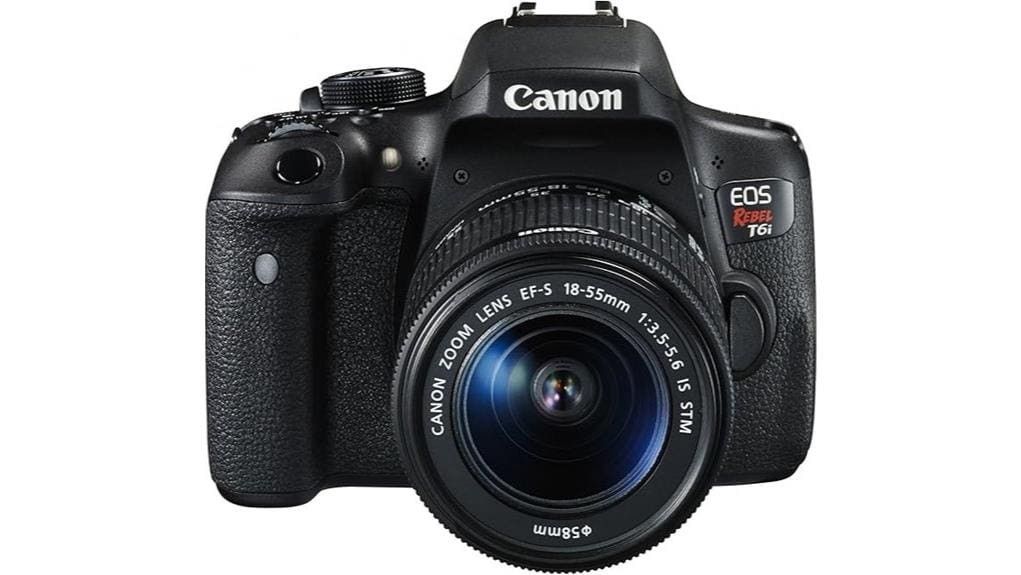

You’ll find the Canon EOS Rebel T6i gives you a 24.2MP APS‑C sensor, 19 cross‑type AF points, and Hybrid CMOS AF III for improved Live View and video focus. It shoots 5 fps, records 1080p with clean HDMI output, and delivers 14‑bit RAW plus punchy JPEGs. ISO is usable to about 1600 with careful work to 3200; highlights recover well from RAW. Ergonomics and touchscreen are strong—keep going to see detailed performance, pros, and trade‑offs.
Some Key Takeaways
- 24.2MP APS-C sensor delivers detailed 14-bit RAW files and punchy in-camera JPEGs with respectable dynamic range at base ISO.
- 19-point all cross-type AF and phase-detect viewfinder AF give reliable single-subject acquisition and improved focusing precision.
- Hybrid CMOS AF III and STM lenses improve Live View/video autofocus, with Full HD 1080p and HDMI clean output for external capture.
- Usable ISO up to 1600 (cautious at 3200); RAW helps recover highlights and manage noise for low-light shots.
- Comfortable ergonomics, articulating touchscreen, 5 fps burst, EF-S 18–55mm STM kit lens, and LP-E17 battery for general-purpose shooting.
Camera at a Glance: Key Specs and What You Get in the Kit
Looking for a capable entry-level DSLR that balances resolution, autofocus and connectivity? You get a 24.2MP APS-C CMOS sensor, 19-point all cross-type AF with Hybrid CMOS AF III, 5 fps continuous, Full HD 1080p video, Wi‑Fi/NFC and an articulating 3.0″ touchscreen. The kit pairs the EF-S 18-55mm f/3.5-5.6 IS STM lens and essential bundle accessories: battery, charger, strap, eyecup, interface cable, remote and software disc. You’ll appreciate the compact form factor, clear control layout and restrained aesthetic design. Compatibility with EF/EF-S lenses and UHS-I SD cards adds practical expandability. This package is well-suited for enthusiasts transitioning to mirrorless-style versatility and enjoying lens compatibility with a broad range of Canon optics.
Image Quality and Sensor Performance: RAW, JPEG, Dynamic Range, and ISO Handling
Digging into the T6i’s 24.2MP APS-C sensor, you’ll find a capable imager that delivers detailed RAW files (14-bit CR2) and flexible JPEGs suitable for most enthusiast workflows. You’ll appreciate RAW flexibility for highlight recovery and selective noise reduction; CR2 files hold tonal gradation well across midtones. In-camera JPEG sharpening and color processing produce punchy straight-out-of-camera results, though aggressive sharpening can obscure fine detail. Measured Dynamic range performs respectably at base ISO, with gradual roll-off into shadows. ISO resilience is good to ISO 1600, usable at 3200 with cautious noise control, limits apparent beyond 6400. For critical work and consistent results, consider color calibration to ensure accurate color reproduction across devices.
Autofocus, Continuous Shooting, and Real-World Focusing Speed
After examining the T6i’s sensor behavior and image handling, it’s worth evaluating how that data capture pairs with the camera’s focusing and burst capabilities for real-world shooting. You get a 19-point all cross-type AF system that uses phase detection for fast acquisition through the optical viewfinder; in practice lock times are brisk on single subjects. Hybrid CMOS AF III aids Live View and touch AF, improving low light tracking compared with older Rebels but not matching advanced models. Continuous shooting tops out at about 5 fps for sustained bursts; you’ll see slower AF-C tracking at higher frame rates, so plan accordingly. For those using prime lenses, pairing the T6i with a fast prime can noticeably improve subject isolation and low-light performance when shooting wide open, especially with prime lens sharpness enhancing perceived image quality.
Video Capabilities and Using the T6i as a Webcam
While the T6i doesn’t match flagship models for video, it delivers solid Full HD 1080p recording with practical controls and useful connectivity for creators and casual videographers. You’ll get reliable exposure, Hybrid CMOS AF III for smoother focusing in Live View, and usable bitrate options in MP4. Use the STM kit lens for quiet focusing and lens-based IS for steadier handheld clips. For desktop streaming, Canon’s EOS Webcam Utility or a capture device can provide HDMI cleanfeed or UVC compatibility depending on workflow; HDMI output is clean when using external capture, while UVC simplifies plug-and-play. External camera monitors can improve framing and focus accuracy when shooting video with the T6i, especially for monitoring exposure.
Handling, Controls, and the Articulating Touchscreen Experience
Although the T6i keeps a traditional DSLR layout, its grip and control placement make it easy for you to operate for extended shoots without fumbling, thanks to a comfortably deep molded grip and well-spaced buttons that fall naturally under the right-hand fingers. You’ll appreciate intentional hand placement for steady single-handed framing and quick access to the rear dial and multi-controller. The articulating 3.0-inch touchscreen responds accurately for AF point selection, touch-shutter and rapid menu navigation, reducing reliance on buttons. Controls have positive detents; mode dial indexing is clear. Overall ergonomics favor efficiency, predictable reach, and minimal hand repositioning during runs. The T6i is a solid option for enthusiast photographers looking for an accessible DSLR with useful features and a friendly price point.
Lens, Stabilization, Battery Life, and Connectivity Practical Notes
Because the bundled EF-S 18-55mm f/3.5–5.6 IS STM is the system workhorse, you’ll find its optical range and STM-driven autofocus well suited to everyday shooting, but you should factor in its limited maximum aperture and reliance on lens-based IS when planning low-light or motion work. You’ll notice occasional lens wobble at extremes of zoom or during rapid handheld pans; secure the mount and check autofocus calibration. Expect battery longevity typical of LP-E17 packs—around several hundred frames per charge depending on use, live view, and Wi‑Fi. Wi‑Fi/NFC and HDMI are reliable but conserve power during transfers. For adapting third-party glass, consider using quality lens adapters to maintain flange distance and autofocus compatibility.
Who Should Buy the Rebel T6i Now : Use Cases, Alternatives, and Value Assessment
Having covered lens behavior, stabilization limits, battery expectations and connectivity quirks, now assess who still benefits from picking up a Rebel T6i. You’ll appreciate its 24.2MP APS-C sensor, articulating touchscreen and reliable 19-point AF if you’re stepping up from smartphones or older compacts. Budget filmmakers can exploit the EF-S 18-55mm IS STM, Full HD recording and external mic options for controlled shoots. Photo learners gain durable ergonomics and Canon color science. Alternatives: used EOS M or modern entry-level mirrorless offer better autofocus/video. Vintage collectors might value its kit and Canon DSLR lineage, but expect limited futureproofing. Consider pairing the T6i with a sturdy tripod to maximize stability and image sharpness.
Some Questions Answered
Does the T6I Include In-Body Image Stabilization?
No — the T6i doesn’t include in body stabilization; it lacks sensor shift mechanics for stabilization. You’ll rely on lens-based IS (the kit EF‑S 18‑55mm has optical IS) or faster shutter speeds and higher ISO to control blur. Technically, the camera’s body offers no movable sensor assembly or gyroscopic stabilization, so evaluation shows stabilization performance depends entirely on compatible IS lenses and shooting technique rather than internal sensor-shift compensation.
Can the Battery Be Charged In-Camera via USB?
No — you can’t charge the battery in-camera via USB. The T6i lacks USB charging circuitry, so USB charging isn’t supported; you’ll need to use the supplied LC-E17 charger or third-party chargers. Technically, you can power the camera via USB only with specific battery adapters or external USB power rigs that emulate the battery, but those require compatible adapters and careful voltage/current management. Evaluate adapters for safety, warranty impact, and reliable charging.
Is Bluetooth Supported for Remote Control or Image Transfer?
No — the camera doesn’t support Bluetooth for wireless remote or file transfer. You’ll rely on built‑in Wi‑Fi (802.11b/g/n) and NFC for wireless remote control and file transfer, plus USB/HDMI for wired connections. Technically, Wi‑Fi provides remote shutter, image preview and transfer speeds suitable for JPEGs and Full HD clips; NFC eases pairing, but there’s no low‑power Bluetooth tethering or Bluetooth remote functionality.
Does the Kit Come With a Memory Card Included?
No, the kit doesn’t include a memory card. You get the camera body, EF‑S 18‑55mm IS STM lens, LP‑E17 battery and charger, cable, strap, remote and documentation, but no SD card. Technically, you’ll need to supply an SD/SDHC/SDXC card (UHS‑I compatible) to shoot. Consider card speed for sustained video and continuous shooting; also note battery life and lens compatibility when planning purchases for extended sessions.
Is the Camera Weather-Sealed or Splash Resistant?
No — the camera lacks weather sealing and isn’t rated for splash resistance. You’ll need to treat it as a standard consumer DSLR: seals and gaskets aren’t specified, so dust and moisture ingress are possible. For outdoor use you should add protective measures — rain covers, sealed housings, or an aftermarket weatherproofing service. If you require robust splash resistance or full weather sealing, consider a weather-rated body or mirrorless alternative designed for harsh conditions.