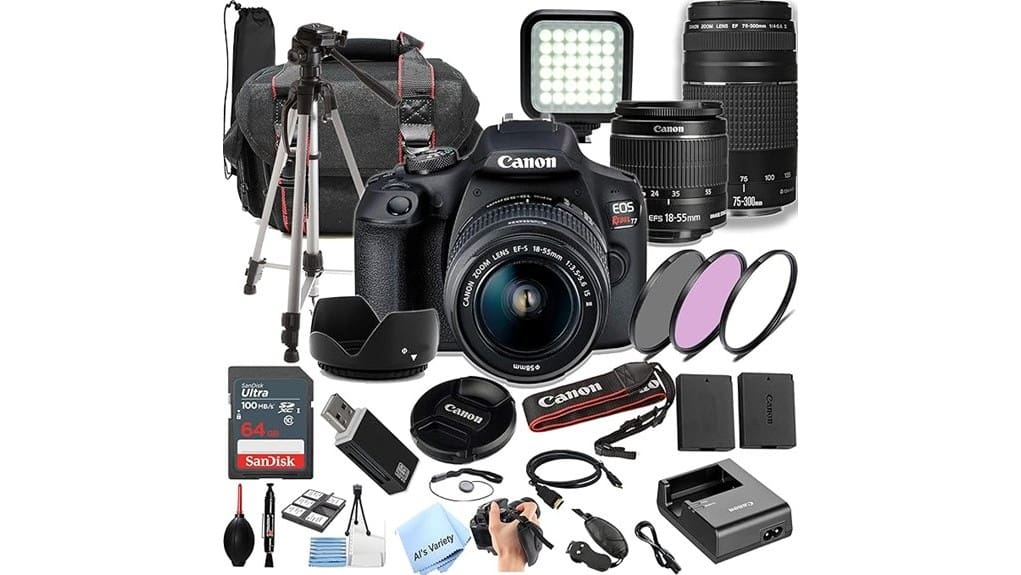
You’ll get a straightforward, budget DSLR that’s great for learning manual controls: a 24.1MP APS‑C sensor with DIGIC 4+, optical viewfinder, and two kit zooms (18–55mm IS, 75–300mm) covering common focal lengths. Autofocus is basic (9‑point PDAF) and burst speed is 3 fps, so it’s not ideal for fast action; ISO up to 6400 (expandable) gives usable low‑light shots with noise above 1600. Keep going to see detailed test findings and alternatives.
Some Key Takeaways
- Solid 24.1MP APS‑C sensor delivers good daylight detail and reliable JPEG/RAW color for beginners.
- Bundled 18–55mm IS and 75–300mm give versatile wide-to-tele coverage but show softness and CA at extremes.
- 9‑point AF and 3 fps burst limit fast-action performance and advanced autofocus needs.
- 1080p30 video and USB webcam mode are serviceable but lag behind modern mirrorless capabilities.
- Best suited for budget-conscious hobbyists wanting an EF/EF‑S DSLR platform and straightforward learning tool.
Who This Review Is For and Quick Verdict on the Canon EOS Rebel T7 2‑Lens Kit
Although aimed squarely at beginners and hobbyists, the Canon EOS Rebel T7 2‑Lens Kit also suits anyone who wants a straightforward DSLR platform with room to learn manual controls. You’ll find a competent stills toolset: 24.1MP APS‑C sensor, optical viewfinder, basic metering and 9 AF points support deliberate exposure and framing. The bundled 18‑55mm IS and 75‑300mm cover common focal needs; accessory compatibility with EF/EF‑S mount expands options for strobes, reflectors and portrait lighting setups. If you need fast action or advanced autofocus, look elsewhere; for controlled learning and versatile optics, it’s sensible and economical. This kit pairs well with essential DSLR gear for photographers building a practical, beginner-friendly setup.
Core Specs That Matter for Buyers: Sensor, AF, ISO, and Video
When you’re choosing a beginner DSLR, the sensor, autofocus system, ISO range, and video capabilities are the specs that most directly shape image quality and usability; the Rebel T7’s 24.1MP APS‑C CMOS sensor paired with Canon’s DIGIC 4+ processor delivers detailed stills with good dynamic range for the class, but its older processor and 3 fps burst limit the camera’s responsiveness for fast action. You’ll get ISO 100–6400 (expandable to 12800) adequate for casual low‑light shooting but with noticeable noise at high settings. The 9‑point phase‑detect AF is basic; limited autofocus customization restricts advanced workflows. Video is 1080p30 with reliable encoding and webcam utility. For enthusiasts looking to expand their kit, consider accessories like mirrorless camera lenses and adapters to broaden shooting options.
Real-World Image Quality: Daylight, Low Light, and Dynamic Range Tests
Having covered the T7’s core sensor, AF, ISO and video characteristics, we now examine how those specs translate to real-world output in daylight, low light and high‑contrast scenes. You’ll find daylight shots deliver crisp 24.1 MP detail with neutral white balance and reliable color accuracy across JPEG and RAW with minimal noise at ISO 100–800. In low light, usable exposure extends to ISO 3200 with softening and chroma noise; fine detail drops and shadow lift requires care. Dynamic range is modest—protect highlights, expose for midtones—and bokeh rendition from kit apertures is smooth but restrained, with limited background separation. For photographers shooting extended sessions or burst sequences, choosing high-capacity, durable memory cards like those designed for large capacity storage is important to avoid running out of space and to maintain write performance.
How the Bundled 18–55mm and 75–300mm Lenses Perform in Practice
Because these two kit lenses cover most everyday needs, they shape much of the T7’s practical versatility: the EF‑S 18–55mm IS II handles wide-to-normal shooting with decent sharpness at the center, mild corner softening at wider apertures, and useful optical stabilization for handheld low‑light work, while the EF 75–300mm III extends reach affordably but shows softer corners, reduced contrast and more pronounced chromatic aberration at long focal lengths and smaller apertures. You’ll find lens sharpness adequate for social and travel images, focus speed modest, bokeh quality acceptable at telephoto settings, and stabilization effectiveness helpful but not image‑stabilizer grade. These kit combinations also illustrate common considerations when mastering zoom lenses for everyday photography.
Usability and Features: Menus, Battery Life, Continuous Shooting, and Viewfinder
Although the T7’s menu system isn’t packed with advanced customization, you’ll find a straightforward, logically organized interface that lets you change exposure, autofocus, and connectivity settings with minimal digging. The menu layout groups shooting, playback, and setup logically, so you adjust ISO, metering, and Wi‑Fi quickly. Battery longevity with the LP‑E10 is adequate for a day of casual shooting; consider a spare for extended sessions. Continuous bursts top out at 3 fps (≈150 JPEGs / 11 RAW), suitable for slow action. The optical viewfinder offers solid viewfinder accuracy and clear phase‑detection AF framing for composed shots. Also consider pairing the camera with a dedicated camera shoulder bag to protect your gear and improve portability.
Pros, Cons, and Best Use Cases for Hobbyists, Travel, and Streaming
When you weigh the T7’s strengths and weaknesses, it becomes clear why it suits beginners and casual shooters: its 24.1 MP APS‑C sensor and DIGIC 4+ processor deliver good still image quality and usable low‑light performance for the price. You’ll appreciate solid image files, straightforward creative presets, and accessory compatibility with EF/EF‑S glass and common tripods. Limitations include 3 fps burst, basic 9‑point AF, and 1080/30p video. For hobbyists it’s a reliable, low‑cost platform if you follow lens maintenance and periodic firmware updates. Travel users get lightweight versatility; streamers can use USB webcam mode with minimal setup. The camera pairs well with sturdy support and accessories like tripods to get the most from its capabilities.
Should You Buy the Rebel T7 Kit in 2026? Alternatives and Buying Recommendations
If you’re comparing value, the Rebel T7 kit still makes sense only in narrow circumstances in 2026: it offers a 24.1 MP APS‑C sensor, basic but serviceable autofocus and full‑frame‑lens compatibility at a low price, but its dated DIGIC 4+ processor, 3 fps burst, limited 9‑point AF and 1080/30p video lag behind modern entry‑level mirrorless bodies and even some recent used DSLRs. Buy it only if you need an inexpensive DSLR platform, a robust accessory ecosystem or specific EF/EF‑S lenses. Check used camera condition, ask about firmware updates, factor resale value, and compare to mirrorless alternatives. Consider also whether you’ll benefit from lens adapter options to expand lens compatibility and adapt legacy glass.
Some Questions Answered
Does the Kit Include Lens Caps and Hoods for Both Lenses?
Yes — the kit includes protective covers: you’ll get the lens cap E-58 II for the 18–55mm and a lens dust cap E for the 75–300mm. In addition to those basic lens accessories, the bundle adds a 58 mm tulip hood (for the 18–55mm) plus filters (UV, CPL, FLD) and a lens cleaning cloth. These items offer front-element protection, stray-light control and routine maintenance capability.
Can the T7 Be Upgraded With Third-Party Batteries or Grips?
Yes — you can use third party batteries and aftermarket grips with the T7. You’ll swap the LP‑E10 for compatible third party batteries (check capacity, voltage, and cell type) and install an aftermarket battery grip designed for the T7’s body and battery shape. Verify electrical contacts, firmware compatibility, and build quality to avoid power issues. Choose reputable suppliers with return policies and safety certifications to guarantee reliable performance and safe charging.
Is There a Microphone Input or Support for External Mics?
No, the camera lacks a dedicated external microphone jack, so you can’t plug an external microphone directly into it. You can, however, record higher-quality audio externally with standalone recorders or microphones and sync in post, or use audio adapters that convert USB or wireless receivers to the camera-compatible input via the USB port, but functionality is limited. You’ll need separate gear or adapters and post-processing to achieve better audio.
How Compatible Is the Camera With Modern Canon RF Lenses via Adapter?
You can’t mount RF lenses directly; with a mount adapter you’ll physically attach RF glass to the EF/EF‑S T7 body, but electronic communication won’t be supported because the adapter’s direction is RF→EF and the T7 lacks RF protocols. You’ll rely on manual focus and aperture control if using passive adapters. For full autofocus, aperture control, and EXIF transmission you need an adapter that translates protocols, but such bidirectional electronic communication isn’t generally available.
Are Firmware Updates Provided and How Are They Installed?
Yes — firmware availability exists from Canon for the Rebel T7; you can download camera firmware updates from Canon’s support site. The update procedure is technical but straightforward: download the correct firmware file, copy it to a formatted SD card, insert the card, power the camera, enter the firmware update menu, and follow on-screen prompts. Make sure battery is fully charged and don’t interrupt power during the process to avoid corruption.