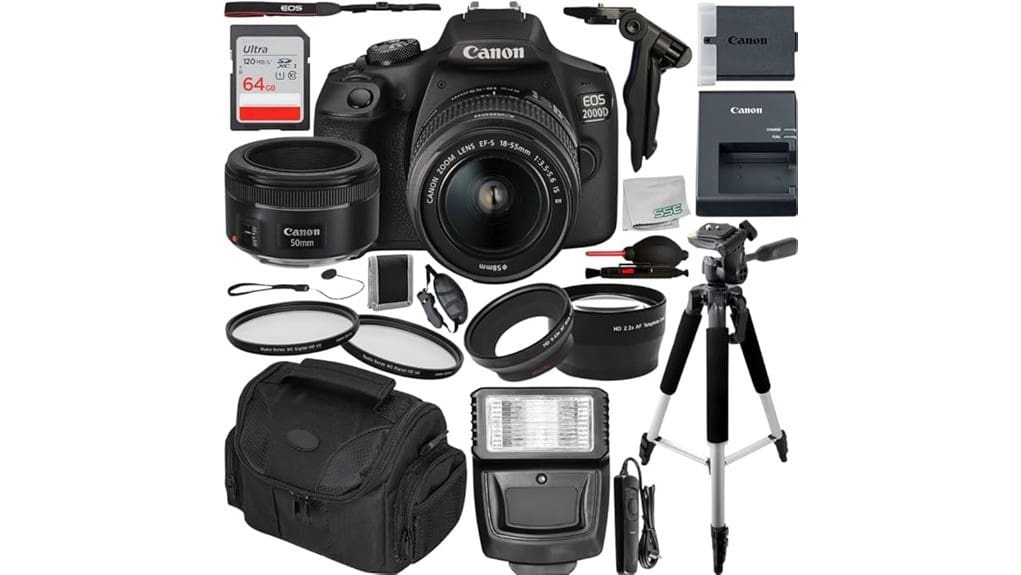
You’ll find the Canon EOS Rebel T7 (2000D) a straightforward, affordable APS‑C DSLR that’s good for learning and basic production. It uses a 24.1MP sensor with DIGIC 4+ for detailed stills, offers 1080p/30 video, and a 9‑point AF with predictable performance in decent light. The kit includes 18–55mm and 50mm f/1.8 lenses plus useful accessories, making setup and experimentation faster. Keep reading for full performance, limitations, and alternatives.
Some Key Takeaways
- Affordable, beginner-friendly DSLR with a 24.1MP APS-C sensor and DIGIC 4+ for high-resolution stills.
- Dual-lens kit (18–55mm zoom + 50mm f/1.8) and accessories accelerate learning and practical experimentation.
- 9-point AF and lens-based IS provide reliable focusing in good light but struggle with fast or low-contrast subjects.
- 1080p/30fps video is serviceable for budget filmmakers; internal mic only and external monitoring needs third-party gear.
- Good low-light capability with the f/1.8 prime and tripod use; noise rises past mid-range ISOs, but RAW recovers shadows.
Quick Verdict: Who Should Buy the Canon EOS Rebel T7 / 2000D
Who should buy the Canon EOS Rebel T7 / 2000D? You’ll choose it if you need an affordable, technically capable DSLR for basic production and learning. Its 24.1MP APS-C sensor, DIGIC 4+ processing, and EF-mount lens options suit budget filmmakers requiring clear stills and 1080p/30fps video. The 50mm f/1.8 prime aids low-light capture, making it viable for beginner astrophotography tests when paired with tripod support and manual exposure control. Autofocus with nine points and lens-based IS provide predictable results for trainees. It’s not for demanding pros, but it’s a precise entry-level toolset. Consider pairing it with essential DSLR accessories like camera bags to protect your gear and improve portability.
What You Get in the Kit and Why It Matters for Beginners
If you’ve decided the Rebel T7/2000D fits your learning curve and budget, the kit contents markedly shape how quickly you’ll progress. You get two lenses (18–55mm and 50mm f/1.8), battery, charger, 64GB SDXC, tripods, filters, cleaning tools, flash and case — a complete workflow-ready package. That breadth shortens setup time, supports focal-length experiments, and lets you practice lighting and composition without immediate purchases. Pay attention to accessory maintenance routines (cleaning pen, blower, filter storage) to preserve optics and avoid sensor dust that interrupts your learning workflow. The kit reduces friction so you can focus on technique. Mirrorless users often rely on essential gear to expand creative options and streamline shooting.
Image Quality and Low‑Light Performance With the 24MP Sensor and 50MM F/1.8
Because the Rebel T7/2000D pairs a 24.1 MP APS-C CMOS sensor with a fast 50mm f/1.8 prime, you’ll get high-resolution stills with strong subject separation and superior low-light capability compared with the kit zoom alone. You’ll notice improved bokeh control from the f/1.8 aperture, isolating subjects and rendering smooth defocused backgrounds. The DIGIC 4+ pipeline preserves fine detail while maintaining a modest noise floor up to mid-range ISOs; beyond that luminance noise rises predictably. Dynamic range is competent for shadow recovery in raw files, and color rendition stays accurate with neutral tones and saturated highlights handled conservatively. Serious photographers often rely on high-performance memory like CFexpress cards to handle large raw files and fast workflows.
Autofocus, Shooting Modes, and Video: Real‑World Performance at 1080p30
Although its 9-point AF system and DIGIC 4+ processor aren’t cutting-edge, the Rebel T7/2000D delivers reliable, predictable autofocus for everyday shooting and 1080p30 video, with autofocus modes covering single, continuous, and automatic (AF-A) operation and manual focus available when you need precision. You’ll get consistent subject acquisition in good light; low-contrast or fast action can tax focus tracking, so plan framing conservatively. Shooting modes include Program, Av, Tv, Manual, and dedicated Movie mode for exposure control. Video encoding is MP4 1080p30 with basic audio monitoring via the camera’s internal mic; external monitoring requires third-party recorders. It’s a solid choice for hobbyists and enthusiast photographers seeking affordable DSLR gear.
Lenses, Stabilization, and Expandability With the Canon EF Mount
When you mount lenses on the Canon EF‑mount Rebel T7/2000D, you get direct compatibility with Canon’s extensive EF lens lineup and third‑party optics, enabling focal lengths from ultra‑wide to super‑telephoto without adapters; the camera supports full electronic aperture control, autofocus communication, and lens‑based image stabilization (IS) where provided. You can use native EF lenses and many aftermarket lenses that implement Canon protocols for AF and aperture. Optical stabilization remains a lens responsibility—IS lenses deliver frame‑steadying benefits. Mount adapters exist for non‑EF glass but often limit AF performance. Overall expandability is strong given Lens compatibility and third‑party support. Mastering lens mount adapters can further extend creative options with Mount adapters.
Battery Life, Connectivity (Wi‑Fi/NFC), Storage, and Portability for Travel
Typically, you’ll get a modest runtime from the LP‑EN10 battery—sufficient for a half‑day of casual shooting but limited for extended travel sessions or heavy Wi‑Fi use—so planning to carry at least one spare cell or a power bank is advisable. You’ll monitor battery endurance closely when using wireless tethering; Wi‑Fi/NFC transfers and remote control increase draw. The kit’s 64GB SDXC gives immediate capacity, but expandable storage via additional cards is essential for multi‑day trips. Travel ergonomics favor the lightweight body and included backpack, though the DSLR form and accessories still occupy kit space and weight in checked or carry luggage. Consider shopping for reliable spare camera batteries and accessories from retailers that specialize in camera power solutions.
Pros, Cons, and Value Compared to Alternatives Under $500–$700
Having covered battery, connectivity and portability considerations, let’s assess how the T7/2000D stacks up in the $500–$700 range. You get a 24MP APS-C sensor, dual-lens kit (18–55mm and 50mm f/1.8), optical IS and Wi‑Fi/NFC—strong entry-level imaging and portrait capability. Downsides: DIGIC 4+ limits high-ISO performance and video is capped at 1080/30. Battery comparisons favor newer models with higher-capacity cells and faster charging. Warranty limitations (90 days) are short versus competitors offering year-long coverage. Overall value is solid if you prioritize optics and price; consider alternatives for better low-light and support. For photographers who shoot large file sizes or need extended storage on shoots, choosing large capacity memory cards is an important part of the kit.
Some Questions Answered
Does the Kit Include a Microphone Input for Improved Audio Recording?
No — you don’t get a dedicated external mic jack on this kit body. You’ll rely on the camera’s internal microphone for audio, though you can use external mic options via audio adapters that connect externally (hot shoe-mounted recorders or USB solutions) to capture higher-quality sound. If you need synchronized audio, you’ll use a separate recorder and timecode or manual sync in post. Check compatibility and latency when selecting audio adapters and external mic gear.
Can the T7 Shoot RAW Continuously for Extended Burst Sequences?
Yes — you can shoot RAW in continuous shooting, but it’s limited. You’ll get short bursts at the camera’s continuous shooting rate (around 3–5 fps) until the buffer fills; buffer depth in RAW is shallow on the T7/D2000D because of DIGIC 4+ processing and write speeds, so bursts will stop after a few frames. For extended burst sequences you’ll need to use JPEG or a faster card/workflow to clear the buffer.
Is the 58MM UV Filter Included Already Attached to Lenses?
No, the 58mm UV filter isn’t pre-attached; you’ll need to screw the filter onto any lens’s 58mm front thread for proper filter attachment. Check both the 18–55mm and 50mm lenses for a 58mm thread marking before fitting. The filter won’t interfere with polarizing compatibility, but stacking a polarizer plus the UV can reduce image quality and introduce vignetting on wide angles, so test combinations for your setup.
Are Firmware Updates User-Installable via Wi‑Fi or Require PC?
You’ll need a PC to install firmware updates; wireless updating from the camera isn’t supported. You can transfer images via Wi‑Fi/NFC, but firmware typically requires downloading Canon’s update file to a computer, connecting the camera via USB or writing to a memory card, then running the updater. That means mobile limitations apply: you can’t perform full firmware installs solely from a smartphone or tablet using the camera’s wireless features.
Is the Camera Compatible With Canon Ef‑S Specific Third‑Party Lenses?
Yes. You can use most third‑party EF‑S lenses directly on the camera body; EF‑S mount compatibility is native, but you should check compatibility testing for specific models. Some lenses may need firmware updates from the lens maker. If you try full‑frame EF lenses or non‑native mounts, you’ll need mount adapters; note adapters can affect aperture control and AF performance. Always verify adapter electronic pass‑through and tested aperture control results before purchase.