
You’ll like the Canon PowerShot G7 X Mark II if you want pocketable image quality that beats most phones: it pairs a 1‑inch 20MP sensor and DIGIC 7 with a fast 24–100mm f/1.8–2.8 stabilized zoom for solid low‑light shots and usable detail to ISO 3200. Autofocus is quick in good light but not top tier for tracking, video tops out at 1080p/60, and battery life is limited — keep a spare to shoot longer, and more specifics follow.
Some Key Takeaways
- 1‑inch 20MP sensor and DIGIC 7 deliver noticeably better image quality and low‑light performance than typical smartphone cameras.
- Fast 24–100mm f/1.8–2.8 stabilized zoom enables sharp handheld shots and usable low‑light shooting.
- Full HD 1080p/60 video with optical stabilization and a tilting touchscreen suits vlogging and travel clips.
- Hybrid AF (79 points) is quick in good light but can hunt in very dim or fast‑action scenarios.
- Compact, well‑built, good resale value, but single included NB‑13L battery limits extended shooting without spares.
Should You Buy the Canon PowerShot G7 X Mark II?
While it won’t replace a full-frame camera, the Canon PowerShot G7 X Mark II is a strong choice if you want a genuinely pocketable camera that delivers better image quality and low‑light performance than most smartphones. You’ll appreciate its 1‑inch sensor, fast f/1.8–2.8 lens, and DIGIC 7 processing for everyday travel, vlogging, or street work. Compared with entry-level compacts and flagship phones, it balances size and control. Consider long term reliability—Canon’s compact lineup is well-built—and watch resale value trends; well-maintained G7 X Mark IIs tend to hold reasonable secondhand value versus smartphones. For enthusiasts who value simplicity and fun, compact point-and-shoots like the G7 X Mark II help you rediscover joy in photography without extra bulk.
What’s in the Box and Key Specs at a Glance
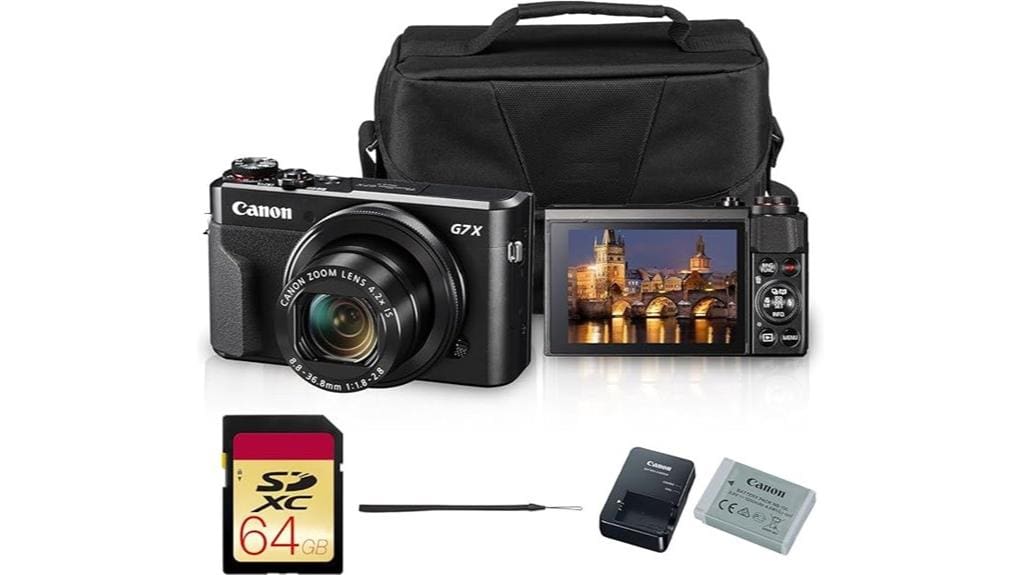
When you unbox the Canon PowerShot G7 X Mark II you’ll find everything needed to start shooting: the compact camera body, a Canon NB-13L lithium‑ion battery with CB-2LH charger, a WS-DC12 wrist strap, a small shoulder bag, and a 64 GB SD card—plus the usual manuals and warranty card. The box contents are straightforward and geared to travel shooters. Key specs at a glance: 1.0‑inch 20MP CMOS sensor, DIGIC 7 processor, 24–100mm f/1.8–2.8 zoom with stabilization, 3.0″ tilting touchscreen, Full HD 60p video, Wi‑Fi/NFC, hybrid AF, pocketable form factor and NB‑13L battery included. This model is ideal for DSLR enthusiasts looking for a portable secondary camera.
Image Quality, Low‑Light Performance, and Autofocus in Real Use
Although the G7 X Mark II’s 1.0‑inch, 20MP sensor and DIGIC 7 processor work together to push noise lower than you’d expect from a pocket camera, its real-world strengths show up most clearly in mid- to high-ISO shots and challenging indoor scenes. You’ll get clean files through ISO 1600–3200 with usable detail; shadow recovery is decent but dynamic range won’t match larger‑sensor rivals. The fast f/1.8–2.8 lens and stabilization aid low‑light handheld shooting. Hybrid AF with 79 points locks quickly in good light, and continuous AF provides serviceable subject tracking for street and event work, though it can hunt in very dim conditions. For photographers using variable exposure techniques, pairing the camera with ND filters can help achieve longer exposures and wider apertures in bright conditions.
Video, Screen, Connectivity, and Handling for Vloggers and Travelers
Because the G7 X Mark II pairs a fast f/1.8–2.8 lens and optical stabilization with Full HD 1080p up to 60 fps, you’ll get smooth, usable footage for vlogs and travel clips without hauling extra gear. Its 3.0-inch tilting touchscreen acts like a flip out screen for framing selfies and low-angle shots, though it’s not fully articulating. Stereo audio is fine for casual use; serious vloggers’ll want an external mic via workaround. Wi‑Fi and NFC with Canon Camera Connect simplify transfers and remote control, and the compact handling favors handheld travel use and rudimentary live streaming setup. The camera is a solid choice for enthusiast photographers and camera fans who want a capable compact for both stills and video, especially when traveling with limited luggage and compact gear.
Pros, Cons, and Who the G7 X Mark II Is Best For
If you liked the G7 X Mark II’s compact handling and reliable 1080p footage for vlogging and travel, here’s how it stacks up in strengths and trade-offs. You get great value from its 1-inch sensor, fast f/1.8–2.8 lens, DIGIC 7 processing and solid stabilization—ideal for low-light snaps and steady handheld video. Portability perks make it easy to carry everywhere, but battery life and single battery inclusion limit long shoots unless you buy spares. Autofocus is competent but not cutting-edge; upgrades like 4K or longer zooms are niche upgrades you’d seek elsewhere. Best for enthusiasts who prioritize size and image quality. For mirrorless camera fans looking for complementary accessories, consider essentials like spare batteries and protective cases to get the most from a compact kit.
Some Questions Answered
Does the Camera Support External Microphone Input?
No — you can’t plug in an external microphone. You’ll rely on the built-in stereo recording, which captures clearer audio than many compacts but can struggle with wind noise in outdoor shoots. Compared to cameras with a mic jack, you’ll need wind protection (small windscreens) or an external recorder synced in post to get cleaner sound and mitigate wind noise while retaining richer stereo recording for interviews or ambient scenes.
Can It Shoot Raw+Jpeg Simultaneously?
Yes — you can shoot RAW+JPEG simultaneously. You’ll capture 14-bit RAW files alongside ready-to-use JPEGs, which fits a flexible shooting workflow: keep JPEGs for quick sharing and use RAW for detailed color grading and exposure recovery. Compared with cameras that force single formats, this gives you both speed and post-processing control. You’ll appreciate the balance between immediacy and maximum image-quality latitude for editing and archival.
Is There Built-In Image Stabilization for Video?
Yes — you get optical stabilization for video using a sensor shift system. You’ll notice steadier footage compared with unstabilized compacts, especially at wider angles and walking shots. It’s not as aggressive as in-body stabilization on larger cameras, but the sensor-shift optical stabilization pairs well with the lens to reduce shake. For best results, combine it with careful handling or a small gimbal for fast pans or long telephoto clips.
What Is the Battery Life in Continuous Shooting?
You’ll get moderate battery endurance for continuous shooting: around 200–300 shots per charge in typical use, with burst longevity slightly lower when using high-speed modes or continuous AF. Compared to larger DSLRs, that’s limited but expected for a compact with a NB-13L cell. You’ll extend endurance by using single-shot, disabling Wi‑Fi, and minimizing LCD use; carrying a spare battery noticeably improves sustained burst longevity for longer sessions.
Does It Have a Hot Shoe or Accessory Shoe?
No, it doesn’t have a hot shoe; it lacks an accessory shoe too. You’ll rely on the built‑in flash and portable triggers via Wi‑Fi/NFC for remote control. Compared with larger DSLRs and some mirrorless models that include a hot shoe for external flashes, the compact design prioritizes portability over expandability. If you need an accessory shoe for strobes or viewfinders, you’ll want a different camera with dedicated hot shoe support.