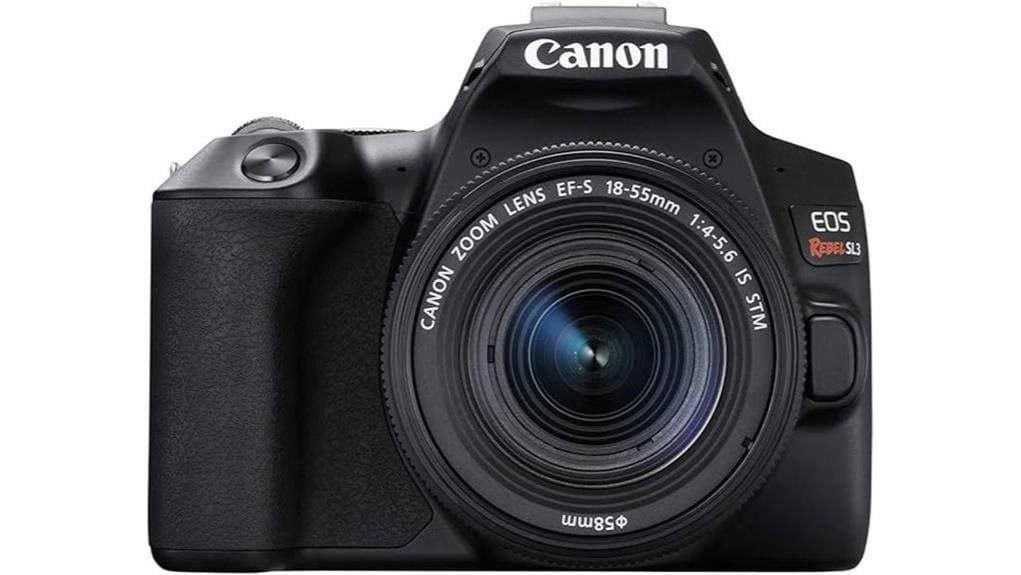
You’ll find the Canon Rebel SL3 with the 18–55mm kit lens is a compact, 24.1MP APS‑C system that delivers sharp stills, reliable Dual Pixel CMOS AF in Live View and Full HD video, and usable 4K at 24p with a crop and limited AF. Colors are neutral to vivid, RAWs hold adjustment latitude to about ISO 3200, and handling is lightweight with a vari‑angle touchscreen. Continue for a full breakdown of strengths and compromises.
Some Key Takeaways
- 24.1MP APS-C sensor and 18–55mm kit lens deliver sharp, detailed images suitable for enthusiasts and travel use.
- Dual Pixel CMOS AF with eye detection gives fast, reliable autofocus in Live View and Full HD video.
- 4K video is available but uses a heavy crop and lacks Dual Pixel AF, limiting professional video work.
- Lightweight, compact body and vari-angle touchscreen make it excellent for vlogging and handheld travel shooting.
- Good JPEG color and RAW flexibility, with usable noise control to about ISO 3200; bring a spare battery for video.
Review Goal and Quick Verdict : Who Should Buy the Canon Rebel SL3?
Although it’s compact and user-friendly, the Canon Rebel SL3 delivers the core features most enthusiast photographers and vloggers need: a 24.1MP APS-C sensor, Dual Pixel CMOS AF with eye detection, 4K video, and a vari-angle touchscreen. You’ll find it ideal if you’re a budget photographer or travel vlogger seeking a lightweight, versatile kit with reliable autofocus and straightforward operation. The DIGIC 8 processor and connectivity options support fast workflow and remote control. It’s not for professionals demanding top-tier low-light performance or pro-grade build, but it’s a precise, efficient choice for learning and content creation. It also makes a great addition to any mirrorless-focused kit for those expanding from entry-level DSLR systems with essential gear.
Image Quality and Performance With the 18–55mm Kit Lens
Moving from who the SL3 suits to what it produces, the 24.1MP APS-C sensor paired with the 18–55mm kit lens delivers sharp, detailed images across common shooting scenarios. You’ll see strong center resolution; sharpness tests show usable edge performance at f/5.6–f/8 with mild corner falloff wide open. Color rendition is neutral-to-vivid out of camera, accurate skin tones and reliable saturation for JPGs; RAW gives latitude for tweaks. Noise control remains acceptable to ISO 3200, with DIGIC 8 aiding processing. For general-purpose work this kit balances resolution, color fidelity and compact convenience without exceeding enthusiast-grade expectations. Perfect Tripods recommends matching the SL3 with a compact sturdy tripod to maximize sharpness in low light and longer exposures.
Autofocus, Viewfinder and Handling in Real Shooting Scenarios
When shooting in real-world conditions you’ll find the SL3’s Dual Pixel CMOS AF with eye-detection delivers fast, reliable subject acquisition in Live View and video, while the optical viewfinder relies on a 9-point AF system that performs adequately for quick framing and basic tracking; together they cover most casual and enthusiast needs without matching advanced multi-point systems. You’ll appreciate responsive touch tracking on the vari-angle screen for moving subjects and intuitive point selection. The body’s small grip and light weight aid handheld stability but limit extended comfort. Controls are logical; autofocus confirmation and focus point feedback are clear and consistent. If you plan to use a tripod for stability or specialized composition work, consider choosing the right tripod head to improve framing and ease of use with the SL3’s compact body and kit lenses tripod heads.
Video Features, 4K Limits and Creative Shooting Modes
Because the SL3 brings 4K recording and a vari-angle touchscreen, you’ll get compact, capable video tools for casual and creator use, but with practical limitations you need to know. You can record 4K at 24p for crisp framing, use Dual Pixel AF in Full HD, and compose on the 3.0-inch vari-angle screen. Expect 4K limitations: 1. significant crop factor reducing field of view, 2. no Dual Pixel AF in 4K, and 3. bitrate and rolling shutter constraints versus higher-end bodies. Creative modes include 4K time-lapse movie, scene modes, and basic picture styles for quick in-camera looks. Consider pairing the SL3 with an external monitor to improve framing and exposure when shooting video with limited 4K capabilities and cropped fields of view, especially if you rely on external camera monitors for critical focus and color.
Connectivity, Battery Life, Compatibility and Final Buying Considerations
Although compact, the SL3 gives you solid connectivity and straightforward power performance for casual shooting and travel. You get built-in Wi‑Fi and Bluetooth for remote control and auto image transfer; App interoperability with Canon Camera Connect supports a range of iOS and Android versions (data charges may apply). Battery longevity is adequate for day trips — expect moderate shot counts per LP‑E17 battery; carry a spare for extended use or video. Compatibility with EF‑S and EF lenses keeps kit flexibility high. In sum, the SL3 balances portability, simple wireless workflows, and reasonable power for hobbyists and travelers. Consider adding HDMI accessories to your kit for improved external monitoring and connectivity.
Some Questions Answered
Does the Kit Include a Memory Card or Extra Battery?
No, the kit doesn’t include a memory card or spare battery. You get the renewed Canon Rebel SL3 with the 18–55mm lens, but memory card and spare battery are sold separately. You should purchase at least one SD card (UHS‑I recommended for 4K) and consider a compatible LP‑E17 spare battery for extended shooting. Battery chargers and camera manuals are typically included; confirm exact bundle contents with the seller before buying.
Can I Use Canon EF Lenses Without an Adapter?
No — you can’t use Canon EF lenses without an adapter on that camera’s EF‑S/EF mount? Actually, the Rebel SL3 uses the Canon EF/EF‑S mount, so EF lenses are directly compatible without mount adapters. You can mount full‑frame EF lenses natively; no adapter required. Mount adapters are only needed for non‑Canon or alternative mount lenses. Check lens compatibility lists and confirm autofocus and metadata transfer for specific EF optics.
Is There In-Body Image Stabilization (IBIS)?
No — the camera doesn’t have in-body image stabilization (IBIS). You’ll rely on lens-based stabilization or electronic stabilization in video modes. Sensor stabilization isn’t present, so stills depend on optical IS in compatible lenses or higher ISO/fast shutter choices. For handheld 4K or time-lapse, electronic stabilization can help but may crop or reduce quality. Use stabilized lenses or a tripod for best sharpness and low-noise results.
What Accessories Are Included in the Renewed Package?
You typically get the renewed camera body, 18–55mm kit lens, battery, charger, strap, and USB cable; you might not get a battery grip or extensive extras. Sellers sometimes include a basic cleaning kit, spare battery, memory card, or third‑party battery grip as add‑ons. Check the specific listing for exact items and condition notes. Confirm whether a battery grip or cleaning kit is bundled before purchase to avoid surprises.
Does the Camera Come With a Warranty and Refund Policy?
Yes — you get coverage. You’ll receive a limited warranty; warranty duration varies by seller and renewed-item terms, so check the listing for exact length. Sellers often offer a short manufacturer or refurb warranty plus a seller guarantee. Refund timeframe also depends on the seller’s policy; typical refund timeframes range from 14 to 30 days after delivery if the item’s returned in specified condition. Keep proof of purchase and inspect on arrival.