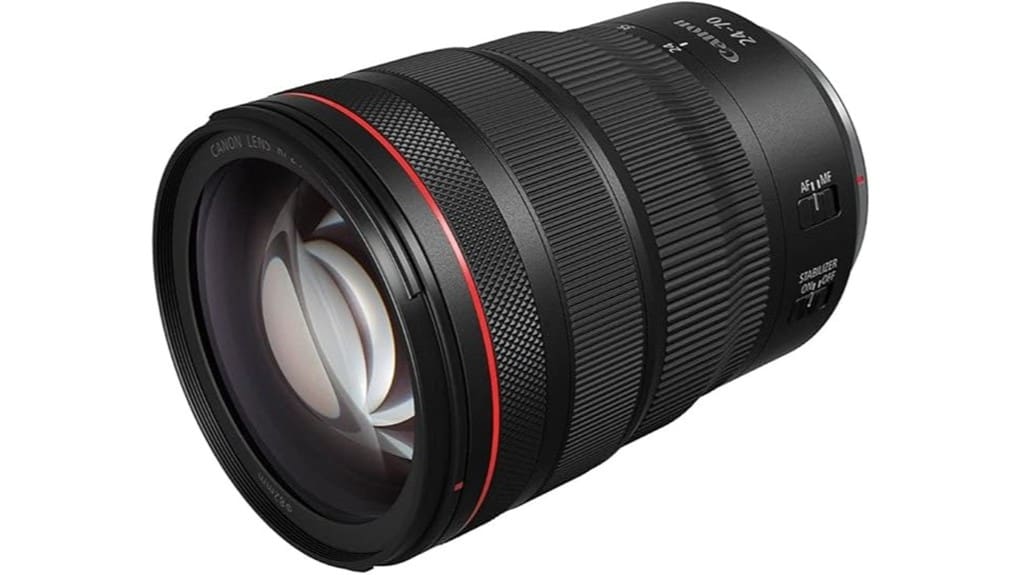
You’ll get a pro-grade 24–70mm f/2.8 zoom that keeps exposure constant and depth-of-field predictable across the range. It pairs fast, quiet Nano USM autofocus with around five stops of effective IS, making run-and-gun stills and video more reliable. Center sharpness is excellent at f/4–f/8, edges improve stopped down, and bokeh is smooth for portraits. It’s substantial but well-balanced on mirrorless bodies—keep going to see detailed performance, handling, and alternatives.
Some Key Takeaways
- Professional-grade 24–70mm f/2.8 zoom offering constant aperture, ideal for events, portraits, and run-and-gun work.
- Built-in image stabilization rated about 4–5 stops improves handheld low-light and video shooting.
- Nano USM autofocus is fast, quiet, and reliable for stills and smooth video tracking.
- Excellent center sharpness at f/4–f/8 with mild edge softness and vignetting wide open at 24mm.
- Robust build, weather sealing, and neutral color rendition make it a recommended versatile pro lens.
What This Lens Is and Who It’s For
While Canon’s RF24-70mm F2.8 L IS USM serves as a general-purpose standard zoom, it’s primarily aimed at professional photographers and serious enthusiasts who need a fast, versatile lens for run-and-gun shooting, event coverage, and commercial work. You’ll find a robust, weather-sealed build, constant f/2.8 aperture, and image stabilization that support demanding assignments. It’s overkill for many beginner photographers but remains usable for learning exposure and composition. You can also use it for travel weddings when weight and budget allow; its focal-range flexibility and low-light capability cover portraits, candids, and reception scenes with technical reliability. It pairs well with a sturdy tripod for improved stability and sharpness when needed, especially during long exposures or careful composition with Perfect Tripods.
Key Specs and Real-World Implications (24–70mm, F/2.8, IS, Nano USM)
Because the RF24-70mm f/2.8 L IS pairs a true 24–70mm focal range with a constant f/2.8 aperture, you get a highly versatile workhorse that covers wide environmental shots through short telephoto portraits without changing exposure settings or sacrificing depth-of-field control. The constant aperture impact means consistent exposure and predictable depth-of-field across the zoom. Built-in IS delivers up to five stops of stabilization, improving lowlight performance handheld and allowing slower shutter speeds. Nano USM provides fast, smooth AF for stills and video, reducing focus breathing. Focal compression at longer settings enhances portrait versatility while maintaining operational reliability. It’s a popular choice among photographers who value essential lens gear for consistent performance.
Image Quality, Sharpness, and Bokeh Across the Focal Range
When you stop the RF24-70mm f/2.8 L IS USM down to its sweet spots (typically f/4–f/8), center sharpness is excellent across the range and resolves fine detail reliably from 24mm to 70mm; wide-open at f/2.8 you’ll see slightly softer edges and mild vignetting, especially at 24mm, but contrast and microcontrast remain strong. You’ll get consistent edge sharpness at mid apertures, with corner falloff improving noticeably. Chromatic aberration is well controlled but can appear in high-contrast borders at wide apertures and tele settings. Color rendition is neutral and accurate. Bokeh is smooth with pleasing out-of-focus separation for subject isolation. Using teleconverters can extend reach while preserving much of the lens’s optical character when paired carefully.
Handling, Autofocus, Stabilization, and Video Performance
Although sizable, the RF24-70mm f/2.8 L IS USM handles predictably on a mirrorless body, with balanced weight distribution and a smooth zoom and focus ring feel that lets you compose steadily during extended shoots. You’ll notice few handling quirks: the control ring is firm, zoom creep is minimal, and weather sealing gives confidence in adverse conditions. Nano USM delivers rapid, quiet AF with rare focus hunting in low-contrast scenes; use AF+MF to micro-adjust. Stabilization limits are realistic—about 4–5 stops effective but not a substitute for fast shuttering on moving subjects. Video ergonomics are strong: reduced breathing and consistent tracking aid handheld capture. Consider adding a top handle for improved grip and comfort during extended handheld video sessions, especially when using heavier lenses top handle essentials.
Should You Buy It? Use Cases, Alternatives, and Final Verdict
If you prioritize a fast, versatile walkaround zoom with robust build and reliable stabilization, the Canon RF24-70mm f/2.8 L IS USM is a strong contender that suits professionals and serious enthusiasts shooting events, portraits, travel, and run-and-gun video. You’ll get consistent f/2.8 performance, up to 5 stops IS, weather sealing, and Nano USM AF—ideal for travel photography, portrait sessions, event coverage, and general-purpose landscape shooting. Alternatives include the lighter RF 24-105mm f/4 for range and value, or primes (35mm/50mm/85mm) for peak sharpness. Verdict: buy if you need pro-grade versatility; otherwise choose lighter or cheaper options. This lens is a great fit for mirrorless camera enthusiasts who need essential, reliable gear for varied shooting situations, including travel and events, and complements other mirrorless camera accessories.
Some Questions Answered
Is This Lens Compatible With Ef-Mount Cameras via Adapter?
No — you can’t directly mount this RF lens to EF-M bodies without an adapter, and even then it’s impractical. Using mount adapters designed for RF-to-EF-M isn’t a common option; flange compatibility prevents reliable AF and infinity focus unless the adapter corrects the RF-to-EF-M flange distance and electronic protocols. You’d need a specialized, rare adapter that preserves electronic communication and corrects flange compatibility; most users instead adapt EF lenses to RF bodies.
Can It Be Used on APS-C RF Cameras Without Vignetting?
Yes — you can use it on APS‑C RF bodies without vignetting. The lens projects a full‑frame image circle, so after applying the APS‑C crop factor you’ll get reduced field coverage and an effective focal length around 38–112mm (1.6x). You’ll retain full autofocus, IS and image quality across the cropped frame. Expect slightly different depth of field and composition due to the crop factor; no mechanical or optical vignetting occurs.
Does It Accept Third-Party 82MM Screw-On Filters?
Yes — you can use third-party 82mm screw-on filters on this lens. You’ll screw them onto the standard 82mm filter thread; 82mm adapters are available if you need step-up/down rings for different filter sizes. Be mindful of filter stacking: stacking multiple filters increases vignetting risk at 24mm and can degrade image quality or flare despite the Air Sphere Coating. Test combinations to confirm acceptable corner illumination and sharpness.
How Does the Lens Perform in Extreme Cold or Heat?
You’ll find cold performance and heat tolerance both solid: the lens’s weather-resistant seals and fluorine coating help maintain operation in cold temps and dusty, hot environments. Autofocus and IS keep functioning down to near-freezing, though battery life and LCD responsiveness will drop in extreme cold. In high heat, lubricants and electronics tolerate typical shooting ranges, but prolonged exposure can risk overheating; avoid direct sun and allow cooling breaks to guarantee reliability.
IS In-Body Stabilization Redundant With This Lens’s IS?
No — in-body stabilization isn’t redundant with the lens’s IS. You’ll get a stabilization interaction where lens IS and IBIS cooperate to maximize shake reduction, often improving image quality beyond either system alone. Canon bodies coordinate correction across axes, so enabling both usually yields better low-light handheld sharpness and smoother video. You should test combinations (lens IS on/off) for your specific camera and shooting conditions to confirm peak performance.