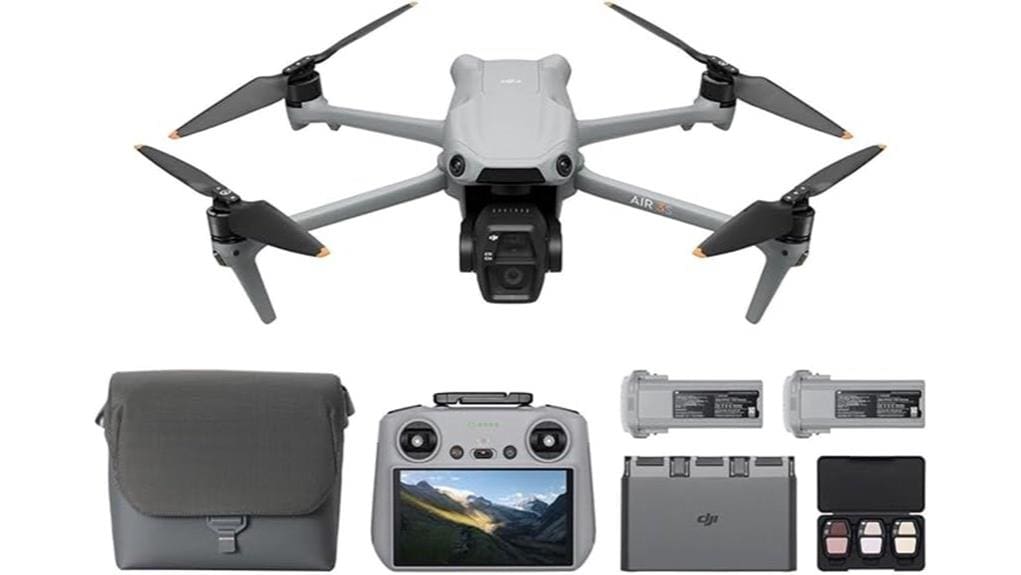

You’ll get pro-level 1″ dual sensors, sharp 48MP RAWs, and 4K/60 HDR video in a compact Fly More kit that’s built for travel creators, vloggers, and mapping pros. Expect reliable 30–38 minute real-world flights, a 20 km-rated link (practical range is often shorter), and a responsive RC 2 remote. Night LiDAR and omnidirectional sensing boost low-light safety. It’s premium-priced but well packaged; keep going to see tests, caveats, and accessory tips.
Some Key Takeaways
- Fly More Combo packs a dual 1″ CMOS drone, RC 2 remote, three batteries, ND filters, charger hub, and accessories for extended shoots.
- Real-world flight time is 30–38 minutes per battery (nominal up to 45 minutes) depending on payload, wind, and battery health.
- Dual sensors deliver 48MP stills, 4K/60 HDR video, improved low-light performance, and switchable wide/medium focal lengths without detail loss.
- RC 2 remote offers a responsive touchscreen and low-latency control; transmission range rated 20 km though legal limits usually reduce operational distance.
- Robust omnidirectional sensing with forward LiDAR improves night obstacle detection, smart RTH, and reduces side/rear blind spots.
Which Users Should Buy the DJI Air 3S Fly More Combo?
If you’re a travel creator or enthusiast who wants pro-level image quality without hauling a full cinema rig, the DJI Air 3S Fly More Combo fits that niche—its dual 1″ CMOS sensors, 48 MP stills and 4K/60 HDR video give you versatile wide-plus-medium framing in a compact package. You’ll appreciate its balance: travel vloggers get cinematic-looking footage and quick panoramas; mapping pros gain higher-resolution captures for detailed overlays. It’s lighter and more portable than cinema drones yet far more capable than basic consumer models. Choose it if you need image quality, sensor redundancy, and compact workflow for on-the-go production. The combo also includes extra batteries and accessories to extend flight time and convenience for extended shoots.
Real-World Flight Performance: Battery Life, Range, and Controls
You’ve seen why the Air 3S is a strong imaging platform—now look at how it performs in the air. You’ll get up to about 45 minutes nominal flight time; real-world missions typically land closer to 30–38 minutes depending on payload, wind, and battery degradation over cycles. Transmission range is impressive—DJI quotes 20 km—yet legal and RF limits usually keep you much closer. The RC 2’s responsive touchscreen and Wi‑Fi link feel modern, with minimal control latency compared with older models. For travel creators, predictable endurance, robust range, and low latency make the Air 3S a reliable, efficient tool. Consider pairing it with a purpose-built drone landing pad to protect takeoffs and landings on varied surfaces.
Camera and Image Quality Tested: 1 Sensors, 4K/60 HDR, and 48MP Photos
Because DJI packed dual 1″ CMOS sensors into the Air 3S, you’ll get noticeably better low‑light performance and dynamic range than most single‑sensor consumer drones—especially when shooting 4K/60 HDR or framing 48MP stills. You’ll appreciate how Dual Sensors let you switch focal lengths without losing detail; the medium tele complements the wide for tighter compositions. 4K/60 HDR footage captures usable latitude for Color Grading, and 48MP raws survive aggressive tweaks. High ISO Performance is solid—less noise above ISO 1600 than rivals. Autofocus Speed is snappy, locking reliably on contrasty subjects; tracking remains stable during panning. The Fly More Combo also includes extra batteries, propellers, and a carrying case, making it a convenient package for 360 camera gear enthusiasts on the go.
Safety, Night Flying, and Obstacle Sensing in Everyday Scenarios
While traversing urban rooftops or dim coastal cliffs, the Air 3S keeps you flying confidently with omnidirectional sensing and a forward-facing LiDAR that boosts nighttime obstacle detection. You’ll notice superior low light performance versus older consumer models: sensors and algorithms keep obstacle avoidance active when vision fades. LiDAR alert prompts feel immediate, reducing risky proximity on night landing approaches. Smart RTH picks safer routes in weak-GPS zones, and omnidirectional arrays mitigate side and rear blind spots during complex maneuvers. For travel creators who push dusk and dawn shoots, the Air 3S blends reliable safety tech with predictable, comparison-winning behavior. It also comes as part of a Fly More Combo offering extra batteries and accessories to extend your shooting sessions and convenience for travel creators.
What’s Included, Costs, and Final Value Verdict
If you want a ready-to-fly kit that covers most shooting scenarios, the Air 3S Fly More Combo delivers: the package includes the drone, DJI RC 2 remote with a bright built-in screen, three intelligent LiPo batteries plus a charging hub, ND filters (ND8/32/128), three spare low-noise propeller pairs, a gimbal protector, a shoulder bag, and a USB-C PD cable — with SDXC support for large files. Pricing is premium but competitive against similar 1″ sensor drones; expect added accessory costs if you want extra batteries or the DJI 65W charger. Given build, sensors, and likely resale value, it’s a strong buy. This combo is especially convenient for photographers who need reliable portable power options while shooting on the go.
Some Questions Answered
Does the RC 2 Controller Support External Monitor Output?
Yes — the RC 2 doesn’t natively output HDMI, so you can’t plug an external monitor directly. You’ll need an external monitor with a compatible Wi‑Fi stream or use a third‑party HDMI adapter solution that captures the RC 2 screen output (USB‑C capture or wireless transmitter). Compared to controllers with built‑in HDMI, this adds complexity and latency, but a proper HDMI adapter + capture monitor gives reliable monitoring for professional workflows.
Can I Use Third‑Party Batteries Safely With the Drone?
You can use third‑party batteries, but you shouldn’t assume they’ll match OEM safety or Battery warranties. Third‑party packs may save weight or cost, yet often lack the same cell quality, firmware integration, and overcurrent/temperature protections. That can affect flight time, Smart RTH behavior, and warranty claims. Use reputable brands that list compatibility, test on the ground, and pair with certified Charging adapters (USB‑PD/65W recommended). When in doubt, stick with DJI cells.
Is the Drone Compatible With Follow-Me via Bluetooth Devices?
Yes — you can use Bluetooth tracking for basic follow-me features, but it’s limited. You’ll pair a Bluetooth device (Device pairing) to the RC or app, then enable tracking; it’s useful for hands-free subjects at short range and low complexity. For robust, long-range or cinematic follow-me performance you’ll rely on GPS and visual tracking instead. Compared to dedicated GPS trackers, Bluetooth pairing is simpler but less precise and has shorter effective range.
How Long Does Firmware Take to Update Over Wi‑Fi?
Typically firmware updates over Wi‑Fi take 5–20 minutes, though large package or multiple-module updates can hit 30–45 minutes. You’ll want to factor in download speed, RC 2 syncing, and battery levels. For firmware timeframes, keep both drone and remote over 50% and use a stable connection. If it stalls, try update troubleshooting: reboot devices, switch networks, re-download the package, or use DJI Assistant/USB as a fallback.
Are Spare Propellers Model‑Specific or Universal?
They’re model-specific rather than universal. For proper propeller compatibility you’ll want DJI Air 3S–rated replacements (matching clockwise/counterclockwise pairings and spline mounts). Using generic props risks vibration, reduced efficiency, or gimbal interference. Replacement options: OEM spare pairs included in the Fly More Combo, DJI online store, or verified third‑party blades marketed specifically for the Air 3S with matching mount type and balance specs. Always check fit and balance before flight.