
You’ll get a pro-grade 600mm f/4 prime that gives extreme reach, fast AF, and creamy bokeh while staying surprisingly light for its class. It pairs optical OSS with dual XD motors for confident tracking at high burst rates, delivers pin-sharp centers at f/4 and improved edges stopped down, and uses XA elements and coatings to tame chromatic aberration and focus breathing. It’s built for serious sports and wildlife shooters — keep going to see how it performs in the field.
Some Key Takeaways
- Pro-grade 600mm f/4 prime delivering exceptional reach, subject isolation, and low-light performance for sports and wildlife professionals.
- Fast, quiet Dual XD linear motors and reliable tracking support high-speed bursts up to 20 fps with confident AF lock.
- Optical OSS, XA elements, and multicoatings yield pin-sharp centers, minimal chromatic aberration, and well-controlled edge performance when stopped down.
- Creamy 11-blade bokeh with minimized focus breathing produces smooth background rendering and consistent framing during focus shifts.
- World’s lightest 600mm f/4 at 6.71 lb with magnesium/carbon construction, robust sealing, removable foot, and comprehensive hard-case accessories.
What the FE 600mm F4 GM Actually Is and Who It’s For
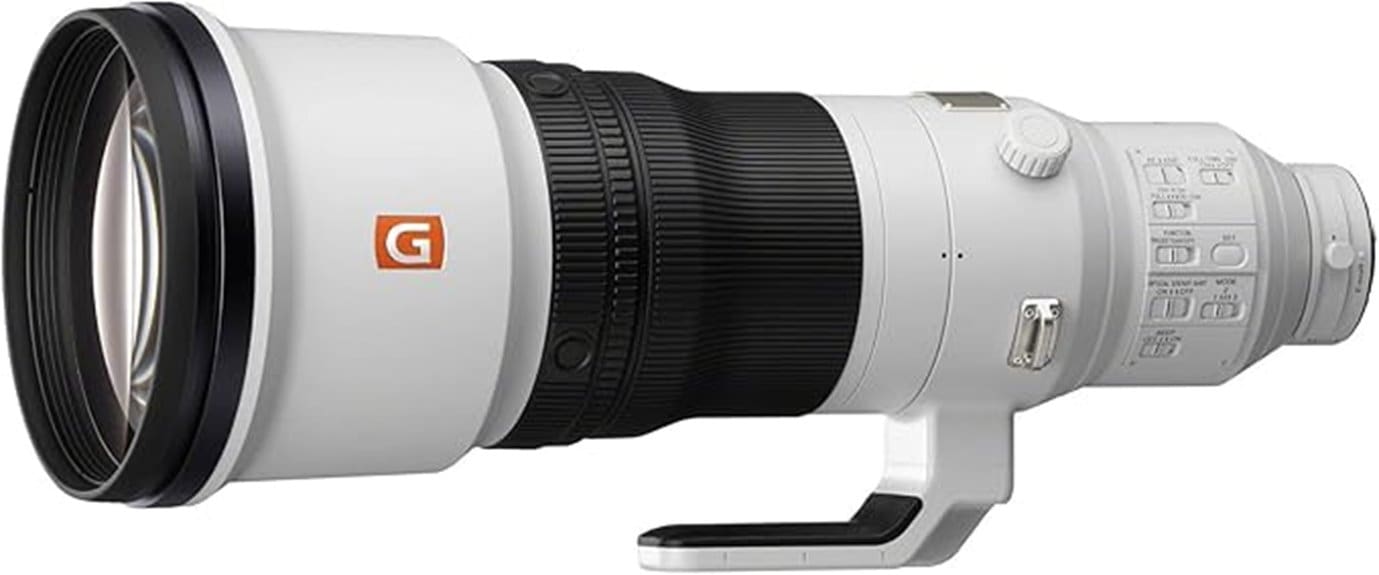
When you need extreme reach, rock-solid image quality, and the speed to track fast subjects, the Sony FE 600mm F4 GM is a professional-grade super-telephoto prime built for sports, wildlife, and action shooters who demand top optical performance from an E-mount full-frame system. You’ll get a purpose-built 600mm prime that favors subject isolation, long-range reach, and reliable handling in demanding environments. You’ll use it for professional sports coverage, birding, and wildlife conservation projects where reach and resolution matter. It’s designed for pros who prioritize build quality, fast autofocus, and a balanced, serviceable tool for extended field use. Our store carries essential gear for mirrorless camera enthusiasts, including accessories that complement super-telephoto lenses like this one and support long outdoor shoots with mirrorless camera accessories.
Key Specs That Matter: Focal Length, Aperture, Stabilization, and Autofocus
Having established who benefits from the FE 600mm F4 GM, let’s look at the specific specs that define its performance: You get a fixed 600mm focal length and a bright f/4 aperture that gives reach and subject separation while keeping weight manageable. Optical OSS stabilizes long-reach shots; you’ll rely on it for handheld or panning work. AF uses dual XD linear motors for fast, quiet tracking compatible with high-speed bodies. The optical design, including XA elements and multicoating, controls chromatic aberration and minimizes focus breathing for consistent framing during focus shifts. These specs prioritize reliability and usable telephoto performance. The lens is ideal for photographers focused on portrait and wildlife work due to its extreme reach and dedicated portrait lens design.
Real-World Performance: Sharpness, Bokeh, AF Speed, and Image Stabilization
Although it’s designed for extreme reach, the FE 600mm F4 GM delivers remarkably practical real-world results: you’ll get pin-sharp center rendering at f/4 with edge performance improving as you stop down, creamy 11-blade bokeh that isolates subjects without harsh onion-ring artifacts, and AF that locks and tracks aggressively thanks to dual XD linear motors—handling bursts up to 20 fps with reliable subject continuity. You’ll notice minimal chromatic aberration even in high-contrast edges, and focus breathing is well controlled for a lens this focal length. Image stabilization (OSS) and excellent low light performance let you maintain sharp results and confident subject tracking. If you’re serious about long-reach photography, pairing this lens with telephoto accessories and mastering zoom lens techniques can elevate your results.
Handling, Build, and Durability: Weight, Balance, Weather Sealing, and Included Carry Gear
Because Sony engineered the FE 600mm F4 GM to be the world’s lightest 600mm F4, you’ll notice its handling is unusually manageable for a super-telephoto: at 6.71 pounds and with a balanced weight distribution, the lens feels less front-heavy on a monopod or gimbal than rivals, letting you track subjects with less fatigue and quicker pan-and-tilt responses. You get confident lightweight handling without sacrificing rigidity: magnesium and carbon-fiber elements keep mass down while maintaining stiffness. Weather sealing is robust for field use. Tripod compatibility is excellent via the removable foot and secure ring, and Sony includes a trunk-style hard case, strap, hood, and caps. Many photographers pair it with protective Pelican cases for secure transport and storage.
Buy-or-Skip Verdict: Ideal Users, Alternatives, and Value Considerations
If you need a true super-telephoto that won’t wear you out during long shoots, the FE 600mm F4 GM is a compelling buy: it delivers G Master image quality, fast XD Linear Motor AF that keeps pace with 20 fps shooting, and a remarkably light, well-balanced package for field work. You should buy it if you prioritize maximum reach, low-light speed, and pro-grade reliability with excellent tripod compatibility for gimbal heads. Skip it if budget alternatives like used 500mm/600mm options or third-party zooms meet your needs. Value hinges on professional use, frequency, and whether weight savings justify the premium. Our shop specializes in tripod and gimbal solutions that pair perfectly with well-balanced packages.
Some Questions Answered
Is This Lens Compatible With APS-C Sony E-Mount Bodies?
Yes — you can use this lens on APS‑C Sony E‑mount bodies. APS C compatibility is provided by the Sony FE mount, though the camera will apply a 1.5x crop factor, effectively giving you a 900mm field of view. You’ll retain autofocus, OSS, and the lens’ performance advantages, but expect a narrower-frame reach, different depth of field, and potential handling balance changes due to the lens’ full‑frame design and weight.
Can the Lens Be Used Handheld for Extended Periods Safely?
Yes — you can use it handheld for short to moderate periods, but you’ll face handheld fatigue so plan accordingly. Its claim as the world’s lightest 600mm F4 and balanced design reduce strain, yet six-plus pounds still demands safety precautions: use a monopod or gimbal for long shoots, employ a lens strap or tripod collar, take frequent rests, and maintain proper posture. That combination keeps you safe and steady during extended use.
Does It Support In-Camera Lens Corrections and Metadata?
Yes — you’ll get in camera corrections and metadata embedding. Your camera applies lens profiles for distortion, vignetting and chromatic aberration when shooting JPEG or RAW+JPEG on compatible Sony bodies, and it records lens-specific metadata (focal length, aperture, serial/model ID, focus distance) into EXIF. Make sure in-camera corrections are enabled in menu and your camera firmware supports the SEL600F40GM to guarantee full correction and metadata embedding.
What Tripod/Monopod Collars or Plates Fit Best?
Use an Arca‑Swiss compatibility tripod collar or the detachable foot for fastest, rock‑solid mounting. You’ll want Sony’s removable tripod foot (detachable foot) or any high‑load Arca‑Swiss clamp that accepts long, dovetail plates. For monopods, pick an Arca‑Swiss compatible monopod head or quick‑release plate sized for the lens foot. Choose gear rated for heavy super‑telephotos, with anti‑rotation pins and a wide contact surface for secure, balanced shooting.
Are Third-Party Teleconverters Fully Supported Without AF Loss?
No — third party compatibility isn’t guaranteed, and you’ll likely see autofocus reliability degrade with non-Sony teleconverters. You should expect potential AF hunting, slower acquisition, and reduced tracking performance, especially at long range and with smaller AF points. For consistent results use Sony’s approved teleconverters; if you try third-party units, test them thoroughly on your camera body and shooting conditions before relying on them in the field.