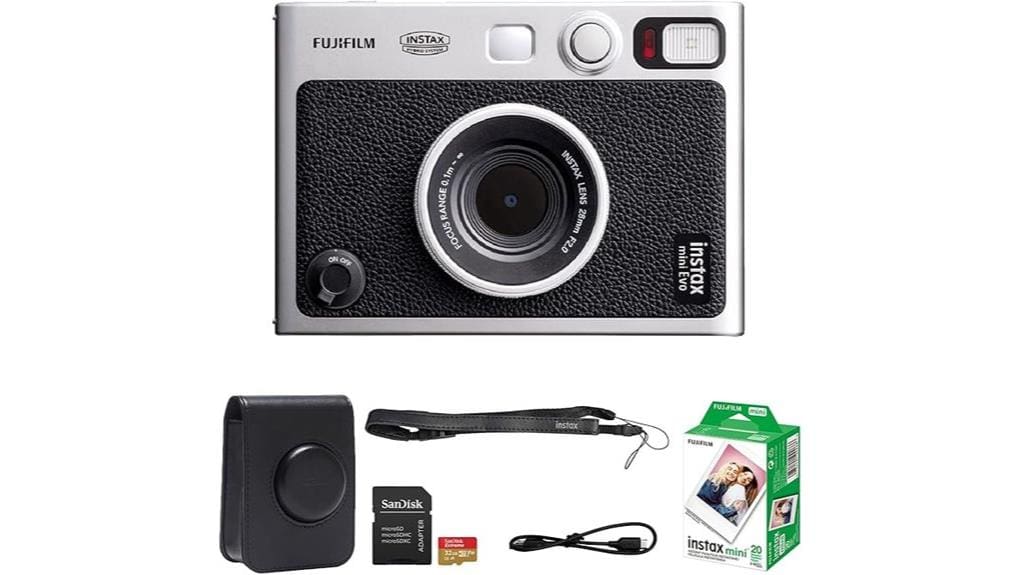

You’ll like the Instax Mini EVO if you want a compact hybrid that shoots digitally and prints instantly; it pairs a 28mm‑equivalent f/2 lens, manual exposure and AF-A/manual focus with 100 film‑simulation presets and a 3.0″ LCD for selective full‑res JPEG backup and print control. The bundled strap, case, 20‑pack film and 32GB card cut initial costs, while ISO‑800 film, modest battery life and no stabilization favor wider apertures and faster shutters—keep going to see deeper comparisons and workflow tips.
Some Key Takeaways
- Hybrid instant camera mixing a 28mm-equivalent f/2 lens, manual controls, and instant printing for creative versatility.
- Produces punchy 2.4×1.8-inch INSTAX MINI prints with ISO‑800 film simulation and 100 film‑style presets.
- 3.0″ LCD, dual shutter buttons, and manual/AF options enable pre-print fine‑tuning and framing control.
- Includes USB charging, a single Li‑ion cell (~100 prints/charge), Bluetooth app transfers, and modest wireless speed.
- Bundle-ready package (strap, case, 20‑pack film, 32GB SanDisk) reduces initial accessory buys and improves resale value.
Who Should Buy the Fujifilm Instax Mini EVO and Why
If you want a compact camera that mixes digital control with instant prints, the INSTAX MINI EVO is for you — it pairs a 28 mm f/2 equivalent lens and manual exposure control with hybrid workflow so you can fine-tune images on a 3.0″ LCD, save full-resolution JPEGs to the included 32GB UHS-I card, then output credit-card–sized INSTAX MINI prints on demand. You’ll appreciate its technical balance: portable 28mm coverage, contrast-detect AF, and 100 creative effect combos. Choose it if you value analog nostalgia with modern JPEG backup, require easy app transfer, or seek clear gift potential for photographers. It’s also a great match for those who want to display photos digitally in stylish frames that showcase their work.
What’s in the Mini EVO Bundle and How It Affects Value
The Mini EVO kit bundles a lot more than just the camera, and that extra gear materially raises the out-of-box value: you get the INSTAX MINI EVO body (black) plus a shoulder strap, soft case, USB charging cable, a 20-exposure pack of INSTAX MINI instant film, and a SanDisk 32GB Extreme UHS‑I microSDHC (with SD adapter), which together cover power, storage, protection and initial consumables. You’ll appreciate the bundle when comparing street cost: included film and storage reduce immediate accessory purchases. The soft case and strap improve field utility and accessory compatibility. That completeness tends to support stronger resale value versus body-only listings. For photographers who carry gear regularly, a good studio equipment bag helps keep all these extras organized and protected.
How the Mini EVO Handles Shooting: Modes, Controls, and Image Quality
When you pick up the Mini EVO you’ll find its shooting interface balances manual control with convenient presets so you can dial in exposure or let the camera handle tricky scenes. You get Custom, Landscape, Macro, Movie, Portrait and Sports modes, plus 100 lens/film combos that mimic film stocks via exposure simulation. Dual shutter buttons and tactile controls (dial, buttons) give precise input; AF-A and manual-focus options aid framing. Sensor limits and lack of stabilization mean sharper results at wider apertures and higher shutter speeds. JPEG output, 3:2 aspect, and ISO 800 film simulation yield punchy color and controlled grain. The camera is a sensible choice for hobbyists who want to combine instant-print fun with more serious shooting options and a curated selection of digital camera accessories.
Printing, Film Performance, and Ongoing Costs to Expect
Shifting from how the Mini EVO captures images to how it delivers them, you’ll find print mechanics and film economics are as important as in-camera controls for the overall experience. You’ll get 2.4×1.8-inch INSTAX MINI prints with consistent color and ISO 800 sensitivity; exposure latitude is narrow compared with lab prints, so metering matters. Each 20-pack yields predictable tonality but raises ongoing print costs—expect per-print pricing higher than inkjet or dye-sublimation. The camera’s thermal/chemical ejection is neat, but consider safe chemical disposal for used cartridges and packaging. Plan budgets around frequent refill purchases versus selective, curated printing. For displaying and protecting those prints, consider using photo sleeves designed specifically for Instax Mini dimensions.
Connectivity, Storage, Battery Life, and Real-World Workflow
Because you’ll be juggling files, prints, and shoots on the go, connectivity and storage behavior determine how smoothly the MINI EVO fits into a real-world workflow. You’ll use Bluetooth-based wireless syncing for quick transfers to the INSTAX EVO app and remote shooting; speed’s modest compared with Wi‑Fi but reliable for thumbnails and selects. The included 32GB SanDisk UHS‑I card enables rapid backups and 4K/1080p recording within its write limits (min 30 MB/s). Power management centers on a single rechargeable Li‑ion cell rated ~100 prints per charge and USB charging. Plan workflow optimization: batch transfers, frequent backups, and spare power. Consider adding a portable power bank to extend shooting sessions when outlets aren’t available.
Strengths and Limitations Compared With Other Instant Hybrids
Although it blends digital capture with instant printing, the INSTAX MINI EVO stakes its position among hybrids on different trade-offs you’ll want to weigh: its 28mm-equivalent f/2 lens and 3:2 JPEG output deliver sharper, more versatile compositions than many toy-grade instant hybrids, while the 100 creative lens/film combinations outmatch rivals that limit in-camera effects; conversely, the small 1/3″ CMOS sensor, lack of stabilization, and fixed wide field mean low-light performance and background separation lag behind larger-sensor hybrids (and dedicated instant printers paired with mirrorless bodies), and Bluetooth-only transfers offer slower file workflows than competitors that include full Wi‑Fi.
You’ll appreciate the dense set of creative presets and tactile controls for on-camera adjustments, producing instant-ready images without postprocessing. Compared with hybrids offering larger sensors, dual-band Wi‑Fi, or optical zoom, the EVO prioritizes compactness and immediacy over outright image quality and transfer speed. You may want to pair the camera with a suitable waterproof camera bag to keep gear dry when shooting outdoors.
Final Verdict: Use Cases, Buying Recommendation, and Quick Pros/Cons
Given those trade-offs, the Instax Mini EVO suits photographers who prioritize immediacy, compactness, and creative in-camera control over maximum image quality and fastest file workflows. You’ll use it for travel, street aesthetics studies, casual events, and creative gifting — its 100-effect matrix and instant prints beat pure digital rivals for tactile output. Buy it if you value hybrid convenience, app-driven remotes, and a credit-card print format; skip it if you need large prints, fast RAW pipelines, or stabilization. Quick pros: compact hybrid, rich effects, reliable film. Quick cons: small sensor, no IBIS, slower file workflow. It’s a natural fit for mirrorless camera enthusiasts who value portability and hands-on creativity, since many in that community already appreciate compact hybrid gear.
Some Questions Answered
Can I Use Third-Party INSTAX MINI Film With the EVO?
Yes — you can use third-party compatibility film with the EVO, but you’ll want to do film brand testing first. You’ll load standard INSTAX MINI-size packs; many third-party films fit mechanically and expose at ISO 800 equivalence. Expect variable color balance, development chemistry, and contrast compared to Fujifilm stock. Test different brands, note hue shifts and density, and adjust exposure or in-camera film-effect presets for peak, repeatable results.
Does the Camera Print Automatically After Every Photo Taken?
No — auto print? no. You won’t get an automatically printed copy after every shot; the EVO stores digital images and gives you control. You can set it to print immediately from the camera or use the app to select images for automatic transfer then print, or choose manual print, yes, to pick frames and settings first. This hybrid workflow lets you compare quality, conserve film, and manage prints precisely.
Can I Transfer RAW Files or Only JPEGS From the EVO?
No — you can only transfer JPEGs; RAW transfer isn’t supported. You’ll get in-camera JPEGs written to the microSD card and sent via Bluetooth or the app for wireless backup. Compared to cameras offering RAW/DNG pipelines, the EVO limits post-processing latitude. For detailed edits, you’ll need to shoot high-quality JPEGs or use a different camera that provides RAW capture and RAW transfer for maximum dynamic range and color grading.
Is the Included Soft Case Padded for Impact Protection?
No — the included soft case is a soft fabric pouch with minimal padding, so it won’t provide substantial impact protection. You’ll get light scratch and dust resistance plus a decorative lanyard for carry convenience, but its cushioning is thinner compared with molded or foam-padded cases. If you need drop or crush protection, choose a structured case or hard shell alternative; the stock pouch is best for everyday, low-risk transport only.
Can the Mini EVO Be Used While Charging via USB?
Yes — you can use the Mini EVO while performing battery charging via USB, but it doesn’t offer true USB passthrough for continuous power. You’ll be able to shoot and transfer images while the internal lithium-ion battery charges, yet camera operation depends on charge state and may pause charging during high-power tasks (prints/flash). Compared to cameras with passthrough, the EVO’s behavior is functional but not optimized for nonstop, mains-powered use.