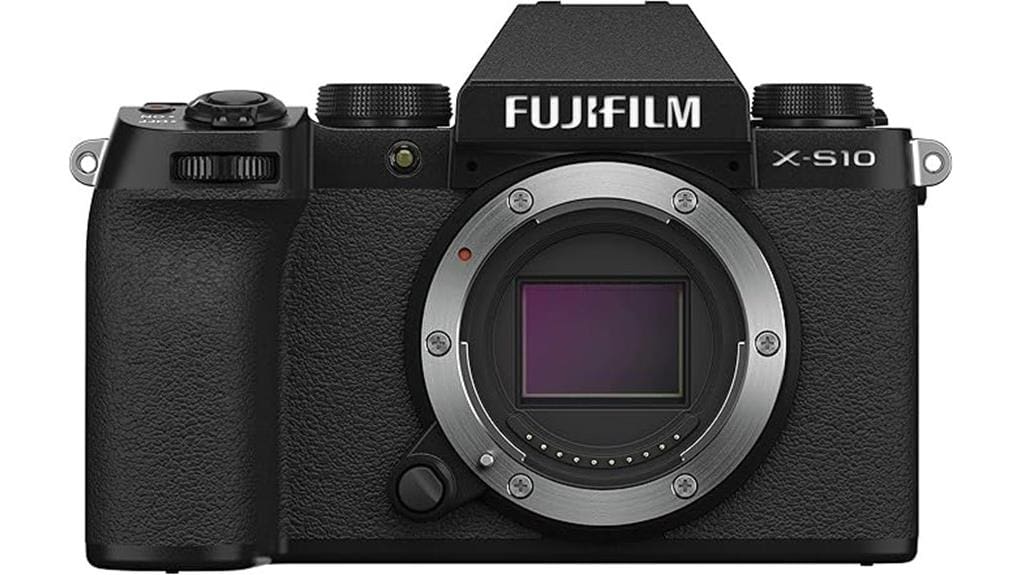
The Fujifilm X-S10 gives you a compact, DSLR-like mirrorless body with a 26.1MP X-Trans sensor, X-Processor 4, and 5-axis IBIS rated to six stops for steady handheld stills and video. You’ll get clean high-ISO performance, 10-bit output and F‑Log for grading, plus a flip touchscreen and solid AF with 425 points and 8 fps bursts. It’s a great hybrid for vlogging and travel; keep going and you’ll get full specs, pros, cons, and alternatives.
Some Key Takeaways
- 26.1MP APS‑C X-Trans CMOS 4 sensor with X‑Processor 4 delivers high-quality images and strong high‑ISO performance up to expanded ISO 51,200.
- 5‑axis IBIS rated up to 6 stops provides reliable handheld stabilization for stills and video.
- 425‑point hybrid AF with AF‑S/AF‑C modes offers fast, accurate subject acquisition and tracking for portraits and street photography.
- 4K/30p with 10‑bit output and F‑Log supports advanced grading; Full HD/240p enables slow‑motion capture.
- Compact, ergonomic body with fully articulating touchscreen, UHS‑II support, and solid battery life ideal for vlogging and travel.
FUJIFILM X-S10 At a Glance: Key Specs and What They Mean
Get up to speed quickly: the Fujifilm X-S10 packs a 26.1 MP APS-C X-Trans CMOS 4 sensor and X-Processor 4 into a compact, ergonomic mirrorless body, delivering 10‑bit output, 4K/30p video, and a 5‑axis IBIS rated up to 6 stops. You’ll appreciate its lightweight grip, fully articulating touchscreen, and high-res EVF for run-and-gun shooting. Controls are intuitive and menu ergonomics are clear, so you’ll navigate settings fast. Expect solid battery life for a day of mixed stills and video, UHS-II card support for speed, and versatile connectivity for external audio and monitoring. It’s an excellent choice for mirrorless camera enthusiasts who want essential gear that balances portability and performance, especially when building a mirrorless camera kit.
Image Quality and Performance: Sensor, Processor, ISO, and Stabilization
While the X-S10’s 26.1‑MP APS‑C X‑Trans CMOS 4 sensor and X‑Processor 4 work together to deliver detailed, low‑noise images, their real strength is in balancing resolution with high‑ISO performance and fast processing for 10‑bit output. You’ll get clean images up to usable expanded ISO 51,200, preserving dynamic range for highlights and shadows. The 10‑bit output and efficient processor maintain color depth for grading and JPEG/RAW workflows. Plus, the 5‑axis IBIS (up to 6 stops) stabilizes handheld stills and video, letting you rely less on fast glass and more on precise exposure control. For photographers serious about accurate color in post, consider using color calibration tools to ensure consistency across devices.
Autofocus, Burst Shooting, and Real-World Handling for Photographers
Because the X-S10 combines a 425-point hybrid AF system with a responsive processor and 8 fps continuous shooting, you’ll find it both fast and reliable for most everyday and enthusiast applications. You’ll get confident subject acquisition with responsive tracking across wide frame coverage, useful for portraits, street, and casual action. Buffer management is competent: sustained bursts are limited but acceptable for typical shoots, and UHS-II cards help clear frames quickly. The IBIS and deep grip make handheld sequences comfortable, controls are intuitive, and AF modes (AF-S, C, M) let you tailor behavior without fuss in real-world use. It’s a great choice for DSLR enthusiasts thanks to its compact design and feature set geared toward DSLR photographers.
Video Features and Vlogging Workflow: 4K, F‑Log, Audio, and Ports
Strong autofocus and steady burst performance carry over into video, making the X-S10 a capable all-in-one for hybrid shooters who want reliable subject tracking while recording. You get 4K/30p with clean detail, F‑Log for grading, and 10‑bit output options that broaden post workflow. The flip screen and compact grip suit vlogging; IBIS stabilizes handheld takes and slow‑motion Full HD/240p adds creative shots. You can plug a microphone and monitor via the mic jack and single HDMI port, and use USB/Wi‑Fi for tethering or Live streaming. External monitors work, but check HDMI compatibility and recording limits. Consider adding a dedicated video light to improve exposure and color when vlogging in low light.
Is the X-S10 Worth Buying Now? Use-Case Recommendations and Alternatives
If you want a compact, well-rounded hybrid camera that handles photo and video reliably, the X-S10 still makes a lot of sense—especially if you can get a good refurbished price. You’ll benefit from excellent IBIS, 26.1MP X-Trans image quality, 4K/30p, F-Log and solid AF for run-and-gun shoots, vlogging, and travel. Choose it if you prioritize ergonomics and creative controls over bleeding-edge specs. Consider budget alternatives like older Sony A6000-series or Canon M-series for cheaper entry points. For future proofing, compare 10-bit workflows and lens ecosystems before committing; newer bodies may offer longer software support. External camera monitors can further enhance framing, focus, and exposure when using the X-S10 for video and hybrid work, especially with improved monitoring for run-and-gun shoots.
Some Questions Answered
Does the X-S10 Include In-Body Subject Tracking for Birds or Animals?
Yes — you get subject tracking that includes animal eye detection and wildlife tracking. You can rely on the X-S10’s 425-point hybrid AF and Eye AF to detect and prioritize animal eyes for sharper focus, while continuous AF and 8 FPS shooting help maintain tracking during motion. You’ll still need good light and appropriate AF settings for best results, but the camera supports effective autofocus tailored to bird and animal subjects.
How Long Does the Battery Last When Shooting 4K Video Continuously?
You’ll get roughly 45–75 minutes of continuous 4K recording on a fully charged NP-W126S battery, depending on settings. Battery runtime shortens with higher frame rates, LCD use, and frequent menu access. Heat management also limits recording: the camera may stop or throttle after extended 4K sessions in warm environments to protect internals. Carry spare batteries and manage ventilation to maximize uninterrupted shooting time.
Can the Camera Charge via USB While Recording Video?
Yes — you can use USB charging while recording video, but there are recording limitations to note. You’ll be able to run the camera off USB power or an external battery via the USB-C port, which helps long shoots and vlogging. However, overheating, recording time caps, or firmware constraints may still limit continuous 4K/30p captures; always test your setup and monitor battery/temperature to avoid unexpected stops.
Is There In-Camera Focus Stacking or Intervalometer Functionality?
No — the camera doesn’t offer built‑in focus stacking or a dedicated intervalometer setup. You’ll need to capture focus‑bracketed shots manually or use external intervalometer solutions (or tethering software) to automate timed exposures, then stack images in post. For focus stacking, use precise manual focus or focus‑bracketing via repeated AF/shot sequences; for interval shooting, rely on third‑party remotes, apps, or computer control to achieve an intervalometer setup.
Are Third-Party Lenses With Adapters Fully Compatible With IBIS?
Yes — you’ll get IBIS with many third-party lenses when using adapters, but results vary. Third party stabilization can’t replace the X-S10’s 5-axis IBIS, so adapter compatibility and lens electronic communication matter: lenses that pass focal length and EXIF data to the body retain full stabilization and AF performance. Mechanical or purely manual lenses may still benefit from IBIS but won’t support lens-based stabilization or full metadata, so test combinations.