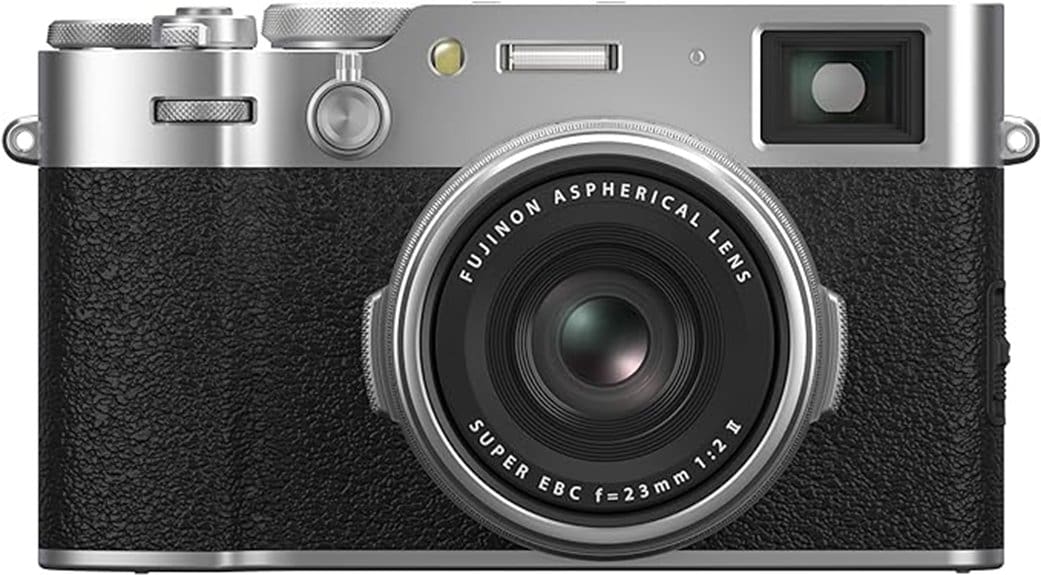
You’ll find the X100VI (Silver) a compact rangefinder that pairs a 40.2MP X-Trans sensor with a sharp 23mm f/2 lens, delivering film-like color and strong corner correction. Its hybrid AF with 425 phase-detect points and five-axis IBIS (≈6 stops) makes fast street shooting and low-light tracking reliable. Video buffs get 6.2K/10-bit H.265 options, though plan storage and batteries. It’s a focused tool with trade-offs—keep going to see how it stacks up against alternatives.
Some Key Takeaways
- 40.2MP APS-C X-Trans CMOS 5 HR sensor and X-Processor 5 deliver high-resolution images with improved fine detail and pleasing film-like color rendering.
- Fixed 23mm f/2 lens offers sharp central resolution, well-corrected corners, and smooth, restrained bokeh from a nine-blade aperture.
- Hybrid AF with 425 phase-detect points, 20 fps continuous shooting, and low-light tracking provides fast, reliable subject acquisition.
- 6.2K/10-bit H.265 4:2:2 video, IBIS up to 6 stops, and recommended UHS-III cards support serious hybrid photo-video workflows.
- Classic rangefinder handling, hybrid OVF/EVF, tilting screen, and compact 480 g body suit street and candid portrait photographers.
FUJIFILM X100VI (Silver) At a Glance : Who It’s For and Why It Matters
While the X100VI borrows the classic rangefinder silhouette of earlier X100 models, it delivers a substantial technical leap that serious enthusiasts and professionals will notice immediately: a 40.2MP APS-C X-Trans CMOS 5 HR sensor paired with the X-Processor 5, five-axis IBIS and a fixed 23mm f/2 lens means you get resolution, stabilization and low‑light agility in a truly pocketable body. You’ll appreciate how its compact heft, tactile dials, hybrid viewfinder and rapid AF tailor it to street photography and candid pocket portrait work. It’s aimed at image-makers who want DSLR-level results without bulk. This makes it an essential piece of gear for mirrorless camera enthusiasts seeking high performance in a small package.
Sensor, Lens, and Image Quality: 40MP X-Trans, 23MM F/2 Real-World Results
Because Fujifilm paired a 40.2MP APS-C X-Trans CMOS 5 HR sensor with the X-Processor 5 and a fixed 23mm f/2 lens, you get unusually high-resolution, characterful images from a compact body. You’ll notice fine detail retention at low ISOs and impressively clean midtones compared with previous X100 models. The lens delivers sharp central resolution and pleasing corner correction for street framing. Color rendering remains true to Fujifilm’s film-inspired palette, with nuanced skin tones and rich greens. Bokeh character is restrained yet smooth—nine blades yield soft highlights without distracting nervousness—making this a refined, versatile shooter. This combination makes the X100VI an excellent choice for photographers who favor wide-angle composition in a compact, ready-to-shoot package.
Autofocus, IBIS, and Performance: Speed, Tracking, and Low-Light Usability
The X100VI’s imaging gains are matched by a much-improved operational core: its hybrid AF system and five-axis IBIS work together to turn that 40MP fidelity into usable, sharp frames across challenging conditions. You’ll notice phase-detect coverage across 425 points speeds focus acquisition and sustains tracking for fast street subjects; continuous 20 fps capture pairs well with reliable Low light tracking down to low single-digit EVs. AF customization lets you prioritize speed, sensitivity, or subject types (people, animals, vehicles), so you tailor behavior to shooting style. IBIS gives up to 6 stops stabilization, improving handheld sharpness and keeper rates. Consider pairing the X100VI with an external field monitor to better judge focus and exposure in bright outdoor shoots.
Video Capabilities and Stabilization: 6.2K, Codecs, and Workflow Tips
If you want the X100VI to double as a serious video tool, its 6.2K capture and robust codec support give you both resolution headroom and color fidelity for demanding post workflows. You’ll appreciate 10‑bit H.265 4:2:2 files for cleaner Color grading and smoother tonal shifts compared with typical 8‑bit H.264. IBIS’s five‑axis stabilization yields up to 6 stops of compensation—better than most compact fixed‑lens rivals—reducing reliance on gimbals for handheld work. For grading, transcode long GOP H.265 to an intra‑frame proxy, practice Log rolling exposure to retain highlights, and use UHS‑III or V30 cards for steady write performance. Our Smooth Moves guide can help you pick the right camera slider to complement handheld and stabilized shooting setups.
Handling and Controls: Hybrid Viewfinder, Dials, Ergonomics, and Daily Carry
While some compacts sacrifice tactile controls for menus, the X100VI gives you precision dials and a hybrid viewfinder that together make direct, confident operation feel natural. You’ll appreciate hybrid ergonomics: the OVF/EVF swap is immediate, and viewfinder customization lets you prioritize exposure data or a clean optical view. Machined tactile dials for shutter, aperture and ISO deliver repeatable settings faster than buried menus, and the two-way tilting screen aids awkward angles. At 480 g and a slim profile it balances pocket portability with serious control, outperforming many mirrorless rivals for daily carry and street work. It’s an excellent choice for DSLR enthusiasts who want compact gear with essential controls.
Battery, Storage, Connectivity, and Practical Shooting Limits
Because you’ll likely shoot long days and heavy video, understanding the X100VI’s power, storage, and connectivity limits is essential: the camera uses a single rechargeable battery (included) that’s optimized for stills but will run down faster during 6.2K/4K recording or prolonged EVF use, so carry spares for multi-hour shoots; storage relies on one SDXC slot—prefer UHS-III cards (V30/U3 minimum for video) to sustain high-bitrate H.265 10-bit 4:2:2 clips and the 40 MP RAW output; and connectivity via USB 3.0, Bluetooth, Wi‑Fi and Micro‑HDMI gives you solid tethering and offload options, though tethered workflows and external-monitor recording will further tax battery and require planning for continuous power and fast media to avoid dropped frames or write bottlenecks. Plan shooting sessions around measured battery longevity; compare UHS-II vs UHS-III for transfer speeds and buffer clearing. Consider carrying a compact external battery pack to extend runtime and support continuous power for extended shoots.
Value Judgment: Comparisons, Trade-Offs, and Who Should Buy the X100VI (Silver)
Though compact and classic in appearance, the X100VI delivers a modern, highly capable package that forces you to weigh image quality, versatility, and workflow needs against its fixed‑lens design and single‑battery/storage constraints. You’ll compare it to APS‑C zoom bodies and mirrorless compacts: sensor, IBIS, and hybrid AF beat many competitors for image fidelity and low‑light work, but you sacrifice focal-length flexibility and dual-card redundancy. If you value tactile controls, color preference (Silver) aesthetics, and strong resale value, buy it. If you need interchangeable lenses, extended shooting, or video-centric ergonomics, consider a larger system instead. Perfect Tripods offers accessories and support for photographers who use compact and classic cameras like the X100VI, including tripod solutions optimized for tripod stability.
Some Questions Answered
Does the X100VI Support In-Camera RAW Editing and Batch Processing?
Yes — you can perform in camera rawediting and limited batch processing on the X100VI. You’ll edit RAW files directly in-camera for exposure, white balance, sharpening and film simulations, then apply settings to single images. Batch processing is available for applying selected adjustments or film simulations to groups, but it’s not as powerful as desktop RAW suites. Compared to full RAW editors, the in-camera tools are fast, tactile and convenient for on-the-go workflows.
Can I Use Third-Party ND Filters or Only Proprietary Attachments?
You can use third-party ND filters if you mount them via compatible filter adapters; you aren’t limited to proprietary attachments. You’ll want high-quality adapters to preserve optical performance and avoid vignetting or color casts. Compare coatings, thread precision, and glass flatness when choosing filters; some third-party options match or exceed OEM results, while cheaper ones can degrade sharpness and contrast. Test before critical shoots.
Is the Lens Weather-Sealed or Usable in Light Rain?
No — the lens itself isn’t fully weather-sealed, so you shouldn’t rely on it for heavy exposure. You’ll want to treat the camera as having limited weather sealing: use lens protection and a rain cover for reliable rain performance. For short term use in light rain you can get away with careful handling and quick shelter, but compared to fully sealed systems it’s riskier; pack protection for longer or harsher conditions.
Are There Firmware Updates That Add New Shooting Modes?
Yes — Fujifilm issues firmware enhancements that can add shooting presets and refine modes. You’ll see performance tweaks, expanded autofocus/object recognition, menu refinements, and occasional new creative presets or film-simulation options. Compare firmware notes between releases to track feature gains versus stability fixes. You should install only official updates, read change logs, and back up settings; that way you’ll benefit from new shooting presets without risking workflow disruptions.
What Accessories Are Compatible With the Hot Shoe and AV Ports?
You can mount flashes and cold shoe accessories on the hot shoe and plug audio/video gear into the AV ports; you’ll find compatibility with standard TTL-capable hot-shoe strobes, wireless triggers, and cold shoe accessories like LED lights or grips. For sound, choose external mic options via the mic input—shotgun mics, lavalier transmitters, or compact stereo mics—while HDMI/USB support recorders and wireless audio interfaces for higher-quality capture.