
You’ll get a reliable 400Ws monolight that’s tuned for portraits, product shots, and small studios. It delivers GN87 reach, stable 5600K color, smooth 61‑step power scaling, fast 0.1–1s recycling, and tight flash durations for action. The 30W modeling lamp and Bowens mount make shaping and previewing easy. Wireless Godox 2.4G control speeds multi‑light setups, though there’s no TTL or weather sealing. Keep reading for full performance, workflow fit, and buying guidance.
Some Key Takeaways
- 400Ws studio flash with GN87 and stable 5600K (±200K) color temperature, offering pro-level output for portraits and small groups.
- 61-step power control (1/64–1/1) with smooth, predictable scaling and flash duration of 1/2000–1/800s.
- Fast recycling (0.1–1s) and good heat management enable sustained shooting and action capture.
- Bowens mount, 30W modeling lamp, and Godox 2.4G Wireless X support broad modifier compatibility and remote group control.
- Lacks TTL and weather sealing, so best for entry pros and small studios using heavy-duty stands and external triggers.
What to Expect From This Review and Quick Verdict for Buyers
While I’ll cover specs, real-world performance, and who this light suits, expect a hands-on take focused on value and usability. You’ll get clear buyer expectations: how this unit performs in portraits, product shots, and small studios, what to expect from build quality, controls, and wireless features. I’ll give concrete examples, highlight trade-offs, and note compatibility points that matter. The quick verdict will state whether this model delivers pro-level output relative to its price and accessories. You’ll finish knowing strengths, limitations, and whether this flash matches your workflow and budget. I’ll also touch on choosing the right continuous lighting and LED lighting for mixed flash-and-continuous setups.
Godox DP400III-V Key Specs and Kit Contents You Need to Know
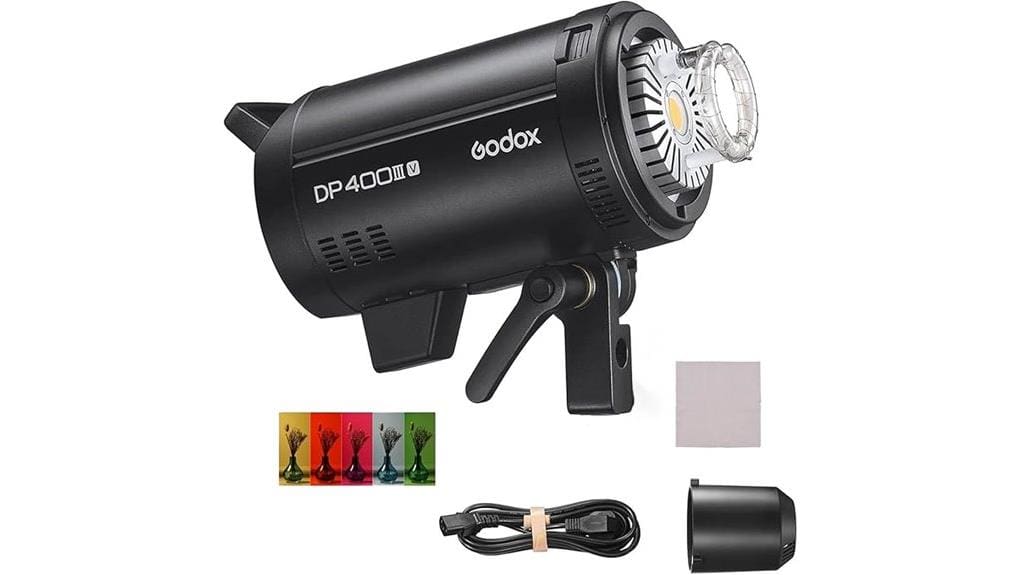
Now that you know what to expect from the review and quick verdict, let’s look at the specs and kit so you can judge fit for your workflow. The DP400III-V delivers 400Ws Output with GN87 Guide reach and stable 5600K Color (±200K). You get Bowens Mount compatibility, a 30W Modeling lamp with adjustable brightness, and 61 Step Control from 1/64 to 1/1 for precise exposure. Recycling runs 0.1–1s with modeling lamp; flash duration spans 1/2000–1/800s. Anti Preflash Support helps TTL-style cameras. Kit includes the studio flash, power cord, lamp cover, and soft diffuser cloth kit. We also highlight that choosing the right heavy-duty light stands can make a significant difference in stability and workflow.
Real-World Performance: Flash Power, Recycling, Duration, and Modeling Lamp
Because the DP400III-V balances power and control, you’ll find it reliable for most studio tasks: its 400Ws output with a GN87 gives plenty of reach for portraits and small groups, the 61-step 1/64–1/1 output control lets you dial exposures precisely, and the 30W adjustable modeling lamp gives a usable preview without overwhelming heat. You’ll appreciate flash consistency across the range; power scaling is smooth so incremental changes predictably affect exposure. Recycling is fast (0.1–1s) for steady shooting, flash duration tight for action, and heat management keeps the unit stable. Modeling lamp aids ambient blending. Ring light users will also find compatibility with common lighting accessories helpful for shaping highlights and shadows, especially when combining with ring light techniques.
Workflow Fit: Compatibility, Wireless Features, Mounting, and Real Shoot Examples
Having established how the DP400III-V performs in power, recycling, and modeling light, let’s look at how it fits into a working kit: its Bowens mount gives you broad modifier compatibility, the built-in Godox 2.4G Wireless X system lets you trigger and adjust groups remotely (though some receiver-dependent functions need additional units), and the remembered settings speed setup between shoots. You’ll appreciate Bowens mounting for rapid modifier swaps in studio setups. Wireless compatibility is reliable for multi-head patterns, though full feature parity sometimes needs extra receivers. On location examples show quick rigging, consistent color, and straightforward group control for small teams. This makes it a practical choice for enthusiasts building or expanding a kit focused on follow focus accessories and smooth workflow.
Should You Buy It? Pros, Cons, and the Best Use Cases for This Monolight
If you need a reliable, mid‑power monolight for portraits, product shots, or small studio work, the Godox DP400III‑V delivers a focused set of strengths: 400Ws output with a GN87, fast recycling (0.1–1s), a useful 30W adjustable modeling lamp, and Bowens compatibility for modifiers. You should buy it if you want consistent color, easy wireless triggering, and affordable build for studio modifiers and straightforward manual control. Pros: powerful GN, rapid recycle, Bowens ecosystem, anti‑preflash support. Cons: no TTL, not weather‑sealed, limited battery life. Best for entry pros, content creators; consider budget alternatives if you need TTL. It also benefits photographers who already use wireless flash triggers and want seamless integration with their existing setup.
Some Questions Answered
Does It Include a Protective Carrying Case?
No — it doesn’t include a padded case. You get the studio flash, power cord, lamp protection cover and a soft diffuser cloth kit, but no dedicated padded case or dust cover listed in the kit contents. You’ll want to buy a separate padded case or dust cover if you plan to transport or store the unit frequently. That protects the Bowens mount, lamp and controls better than the supplied lamp protection cover alone.
Can It Be Used Outdoors in Light Rain?
No — you shouldn’t use it in light rain. The unit’s not water resistant, so take weatherproofing tips seriously: use a rain cover or plastic bag, keep connectors dry, and work under a canopy. You can use umbrellas for diffusion, but umbrella compatibility won’t protect the lamp from wind-driven moisture. If you need reliable outdoor wet-weather use, get a weather-sealed head or protective housing designed for studio monolights.
Is There a Built-In Battery or Only AC Powered?
No, there’s no built-in battery; the unit’s AC powered. You’ll want to regard battery presence as absent — this model relies on mains power only, so portable shoots need external solutions. For off-grid work, you’ll need a separate battery pack or generator and compatible DC adapter; otherwise you’ll be limited to studio or locations with reliable AC. Power options are strictly wired AC unless you add third-party power accessories.
Are Firmware Updates Available for the Wireless Module?
Yes — firmware availability exists for the wireless module, but it’s limited. You’ll want to check Godox’s support site for firmware availability and release notes. The update procedure typically involves downloading the firmware, connecting the unit (or a compatible transmitter/receiver) via USB or a firmware dock, and running the updater app. You should follow instructions precisely, back up settings, and only update from official Godox sources to avoid bricking the module.
Does It Work With Non-Godox RF Triggers?
Yes — it can work with some non-Godox RF triggers, but expect limited third party compatibility. You’ll need a trigger that supports Godox 2.4G X protocol or a simple sync-only transmitter. Test specific combos for stable firing and TTL absence, since features like power ratio or remote modeling lamp control often won’t function. Also check trigger latency; inexpensive triggers can introduce delays or misfires that disrupt sync and repeatability.