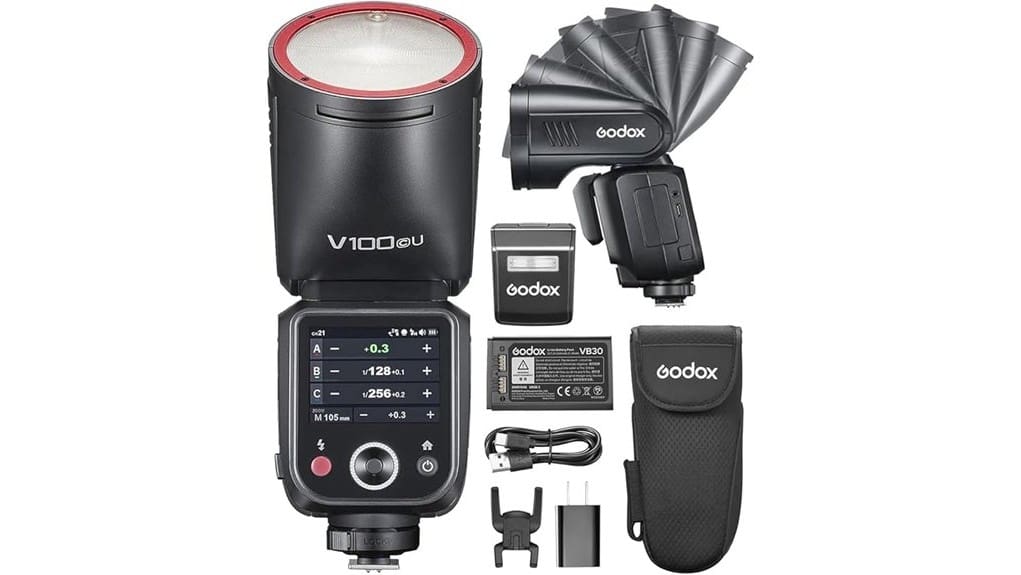
You’ll get a compact, travel-ready flash that delivers 100 Ws peak output with fine 1/1–1/256 M‑mode steps, reliable recycling, and HSS to 1/8000s for fast-shutter work. The 7.2 V/2980 mAh battery and active cooling let you shoot long bursts without immediate throttling, and Type‑C charging plus optional docks speed turnaround. A 2.3‑inch touchscreen, SU‑1 sub‑flash and Godox 2.4G X wireless make control intuitive and pro-friendly — keep going to see detailed performance and accessory recommendations.
Some Key Takeaways
- 100 Ws peak output with fine M-mode steps and power adjustable from 1/1 to 1/256 for precise exposure control.
- High-speed sync to 1/8000s enables freezing action and wide-aperture shooting, though some setups may still face sync limits.
- Robust battery (7.2V / 2980mAh) and advanced cooling deliver reliable recycling and many consecutive full-power flashes.
- 2.3-inch color touchscreen, one-tap controls, detachable SU-1 sub-flash, and 2W modeling lamp streamline workflow and adjustments.
- Built-in Godox 2.4G X system with TTL for Canon, master/receiver modes, and broad accessory compatibility for studio and location use.
Real-World Verdict: Is the Godox V100-C Worth Buying?
While the V100-C borrows familiar elements from the V1 Pro, it earns its place as a versatile, reliable on-camera strobe: you get 100 Ws of adjustable power down to 1/256, robust HSS to 1/8000s, and a battery and cooling system that actually sustain high-output shooting without throttling. You’ll appreciate sensible controls, dependable recycling, and clear firmware updates that refine performance. The active user community shares tips and firmware alerts, which helps maintain long term reliability. Considering build, compatibility, and market demand, you can expect reasonable resale value—making the V100-C a pragmatic investment for working photographers. The V100-C also fits well into setups focused on speedlight gear for creative photography, offering seamless integration with common accessories and workflows.
Power and Speed in Practice: Output, M-Mode Steps, HSS, and Flash Recycling
Because the V100-C pairs 100 Ws of peak output with fine-grained M-mode steps and reliable HSS, you can dial precise exposures and still freeze fast action without worrying about recycling slowdowns. You’ll appreciate output precision from 1/1 to 1/256 in small increments, letting you shape light without trial-and-error. HSS to 1/8000s handles bright scenes and motion, though sync limitations persist for off-camera setups and certain camera models—test your rig. Recycling is swift in typical use; advanced cooling and battery chemistry keep sequence performance steady. In short, the V100-C balances control and speed for demanding shoots. Many photographers who track exposure use dedicated light meters to verify results for critical projects.
Endurance and Charging: Battery Specs, Continuous Full-Power Performance, and Charging Options
If you rely on long shoots or rapid-fire sequences, the V100-C’s 7.2 V / 2980 mAh lithium-ion battery gives you predictable endurance and fast replenishment. You’ll appreciate the battery chemistry for stable voltage and consistent output across 1/1 to 1/256 steps. Godox rates the unit for many consecutive full-power flashes thanks to cooling and pack capacity, so you won’t guess remaining performance. Charging options include Type-C input and compatibility with the VC26T charger or V1 dock, letting you top up on-location or swap batteries quickly. Overall, endurance and charging match professional workflow demands without compromise. Photographers who travel frequently will also value the portability and accessory ecosystem tailored for imaging professionals, like those focused on portable SSDs for fast on-set backups.
Controls, Modeling Light, and Usability: Touchscreen, SU-1 Sub-Flash, Modeling Lamp, and Workflow
Get straight to the point: the V100-C’s 2.3-inch full‑color touchscreen and streamlined controls make adjustments fast and predictable, so you’ll spend less time fumbling and more time shooting. You navigate with clear touchscreen ergonomics, one-tap power changes, HSS toggles, and mode swaps that feel intentional. The detachable SU-1 sub-flash gives precise fill control across 22 steps, expanding lighting options without menu diving. The 2 W modeling lamp offers ten levels and interrupt mode for quick previews. Workflow shortcuts reduce button presses and speed setups, so you’ll maintain momentum on set and iterate lighting decisions confidently. The V100-C integrates smoothly with common wireless flash trigger systems sold for photographers, making remote control and synchronization straightforward.
Compatibility, Wireless Features, and Accessories: TTL Support for Canon, Godox 2.4G X System, Rings, and Recommended Add-Ons
Now that you can control light quickly on the V100-C, consider how it integrates with your camera and other gear. You get reliable TTL compatibility with Canon bodies that support V1-C/V1 Pro-C, plus full manual and HSS support. The built-in Godox 2.4G X System lets the V100-C act as master or receiver and pairs fast with X3 triggers and other units. The removable red ring accepts universal iron or magnetic replacements; quality aftermarket rings expand modifiers. For a practical Accessory ecosystem, add an extra battery, magnetic rings, a dedicated charger, and a compact softbox for versatile, consistent shooting. Many photographers who enjoy lighting rely on bi-color video lights to balance color temperature and achieve consistent results.
Some Questions Answered
Can the V100-C Sync With Non-Canon Cameras via a Third-Party Trigger?
Yes — you can sync the V100‑C with non‑Canon cameras using many third‑party triggers, but test for reliable Third party compatibility and watch for Trigger latency. You’ll pair the V100‑C as a 2.4G receiver or use a universal hotshoe trigger; functionality depends on protocol support (TTL vs. manual). Expect full manual sync and HSS if the trigger supports it, but TTL may be limited or unavailable with mismatched systems.
Is the Flash Weather-Sealed or Moisture-Resistant?
No — the flash isn’t fully weather sealing and offers limited moisture resistance. You should assume it isn’t waterproof or dust-tight; Godox doesn’t rate the V100-C as weather-sealed. If you’ll shoot in rain, snow, or dusty environments, you’ll need protective measures (rain cover, silicone sleeve, or sealed modifier). For confident outdoor use, plan on external protection and avoid prolonged exposure to heavy moisture despite any minor splash tolerance.
How Long Is the Manufacturer Warranty and Service Support?
You get a one-year warranty length from the manufacturer, and you’ll rely on authorized service centers for repairs and support. Keep your purchase receipt and register the product to validate warranty terms; service centers handle firmware updates, diagnostics, and hardware fixes under that period. If you bought from a reseller, check their return policy too. For extended coverage or regional variations, contact Godox or local service centers directly before issues arise.
Can Firmware Be Updated Over Bluetooth or Only via Cable?
You can’t update firmware over Bluetooth; firmware updates require cable only. You’ll use a USB‑C connection to apply firmware updates reliably, so don’t expect a wireless update via Bluetooth. Bluetooth limitations include lack of bootloader access and unstable transfer for critical firmware, making cable only the safe method. Always connect directly, follow update instructions, and guarantee backup power to avoid bricking the unit during the firmware update process.
Are There Color Temperature or Tint Adjustments for the Modeling Lamp?
No — the modeling lamp offers brightness control but not dedicated color temperature or tint adjustment; you can’t perform color correction or tint adjustment on the 2 W LED. You’ll use the flash output or gels for precise color correction. For quick previewing you’ll rely on the 10 brightness levels and continuous/interrupt modes, but if you need specific tint adjustment, plan to modify light with gels or camera/white-balance settings.