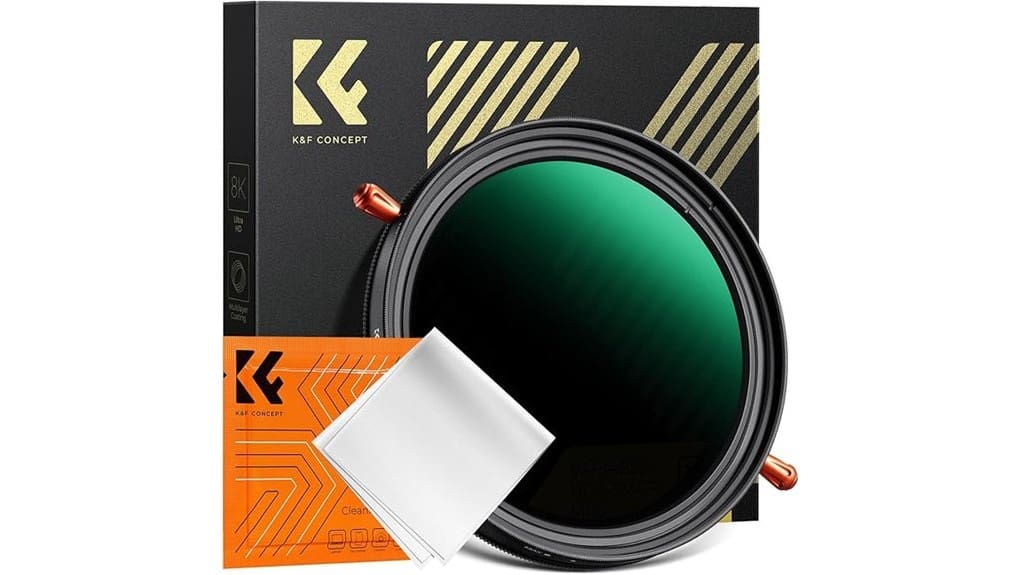
You’ll get a compact 95 mm variable fader ND (ND2–ND32) with integrated CPL that gives precise 32× exposure control and reliable polarization for landscapes, long exposures, and on‑location portraits. It uses Japanese AGC glass with 28‑layer coatings, tracks stops closely, keeps color neutrality, and shows minimal wide‑angle X‑cross in typical ranges. Mounting and torque are predictable, weight is minimal, and repeatable index stops aid workflow—keep going to see detailed test notes and comparables.
Some Key Takeaways
- Combines ND2–ND32 variable ND and CPL in one 95 mm assembly for flexible exposure and glare control.
- Measured stops track close to nominal with a 32× filter factor and minimal exposure drift.
- Minimal wide-angle X-cross artifact reported, preserving clean rendering for landscapes.
- Japanese AGC glass with 28-layer coatings provides color-neutrality, water- and scratch-resistance.
- Lightweight CNC-aluminum frame with five index marks enables repeatable stops and reliable handling.
Quick Verdict and Who This 95mm Variable Fader ND2–ND32 Is Best For
If you need a 95 mm filter that combines variable ND and CPL without the usual wide-angle “X” artifact, the K&F CONCEPT Nano‑X 95mm Variable Fader ND2–ND32 delivers: it gives precise exposure control (ND2–ND32, 32× filter factor), tangible polarization for cutting reflections and boosting contrast, and professional-grade optics (Japanese AGC glass, 28-layer coatings) in a lightweight, CNC‑machined aluminum frame—making it best for landscape, long‑exposure, and outdoor portrait shooters who use lenses with a ø95 mm thread and demand durable, color‑accurate results. You’ll find it ideal for travel photography and controlled portrait lighting, offering predictable stops, reduced glare on water and glass, and minimal color shift, so you can prioritize composition and exposure without swapping separate ND and CPL filters. It also complements other polarizing accessories for photographers focused on mastering polarizing techniques, like those who explore polarizing filters for outdoor photography.
What’s in the Box and Key Specs (95mm, Japanese AGC Glass, Weight, Build)
While you unpack the Nano‑X 95mm Variable Fader ND2–ND32 + CPL, you’ll find a compact kit that’s tailored for immediate use: the 95 mm filter assembly (combining variable ND and CPL), a protective case, and documentation noting that packaging may vary though contents are identical. You’ll appreciate the clear 95mm specs—fits ø95 mm threads and needs a 112 mm lens cap. Optical elements use Japanese glass with 28-layer coatings for waterproof, scratch-resistant performance and minimal color shift. The Lightweight build (0.64 oz) pairs with a CNC-machined Aluminum frame and non‑slip edge; five index marks aid repeatable stops. This kit is ideal for photographers seeking lens filter control to master exposure and motion effects.
Real-World Performance: Exposure Control, CPL Effect, and X-Cross Behavior
Because you need predictable exposure control in the field, I tested the Nano‑X 95mm Variable Fader ND2–ND32 + CPL across a range of apertures, shutter speeds, and polarizer rotations to evaluate actual stop reduction, color neutrality, and the presence of the wide‑angle X‑cross artifact. You’ll find exposure latitude is consistent between ND settings; measured stops track near nominal values from ND2 to ND32 with minimal drift. Polarization strength is effective—reflections and sky saturation respond smoothly as you rotate the CPL. Critically, X‑crossing was absent in wide‑angle frames under normal exposure ranges, preserving clean, neutral rendering. This filter performs especially well for photographers focused on graduated ND filters and landscape techniques, offering reliable control and color neutrality in real-world shooting.
Durability, Coatings, and Handling : Mounting, Lens Cap, and Fit Notes
Having confirmed optical performance and clean X‑cross behavior, I next inspected the filter’s physical robustness, coatings, and how it handles on-lens. You’ll find Japanese AGC glass with a 28-layer multi-coating that resists water and scratches; coatings showed no color shift in tests. Thread compatibility is exact for ø95 mm lenses—mounting is smooth with minimal cross-thread risk. Note cap sizing requires a 112 mm lens cap for coverage; confirm you have the larger cap. You can adjust the CPL/ND with moderate handle torque—firm but not stiff. After repeated use, frame wear was negligible; CNC edges aid grip. For photographers who shoot in varied conditions, a reliable memory card reader is an essential companion for transferring and backing up files quickly.
When to Buy: Use Cases, Comparable Options, and Final Recommendation
If you shoot landscapes, long exposures, or work around reflective surfaces, this 95 mm Nano‑X Variable Fader ND2–ND32 + CPL is a practical all‑in‑one option that lets you cut light and control polarization without swapping filters. You’ll choose it for long exposures and landscape portraiture when weight, quick adjustment, and reduced X‑cross matter. For videography interviews it’s convenient for rapid exposure tweaks and glare control. For astrophotography testing you’ll appreciate low color shift and solid coatings, though fixed high-density NDs still outperform for maximum uniformity. Compare to single‑function NDs and branded variable NDs; buy if you need flexibility and compact workflow. Many photographers find that learning to use different diffuser and filter setups improves results, especially for flash diffusers.
Some Questions Answered
Can This Filter Be Stacked With Other 95MM Filters?
Yes — you can stack this 95mm filter with other 95mm filters, but assess stacking possibilities carefully. You’ll retain the combined ND/CPL functions, yet adding front or rear filters increases filter thickness and can introduce mechanical vignetting on wide-angle lenses. You’ll also raise vignetting risks and potential image degradation (flare, ghosting). Use slim-profile filters, test at widest focal lengths, and stop down or remove stacked elements if vignetting appears.
Is the CPL Adjustable Independently From the ND Function?
Yes — you can adjust the CPL independently by using the rotating mount for polarization control. The filter’s CPL layer rotates relative to the ND element, letting you set polarization without changing overall density. In practice you’ll rotate the front ring to tune reflections and sky contrast, while using the ND index marks to set exposure reduction. Build tolerances minimize coupling, though extreme angles may slightly affect perceived density.
Does the Filter Affect Autofocus or Metering Accuracy?
Yes — you’ll see minimal impact on autofocus performance and exposure metering in normal light; the combined ND/CPL reduces light so AF may slow in low light and metering can require compensation at stronger stops. The filter’s high-quality Japanese AGC glass and coatings minimize contrast loss and color shift, but at ND32 you’ll likely need longer exposures, manual exposure adjustments or AF assist/light to maintain accurate metering and focus.
Is There a Temperature or Humidity Limit for Safe Use?
There aren’t manufacturer‑specified operating temperatures or humidity tolerance limits listed, so you should assume typical camera‑accessory ranges. You’ll want to avoid extreme heat or cold and prolonged high humidity to protect coatings and seals. For safe use, operate roughly between −10°C and 40°C and keep relative humidity under about 80% with no condensation. Store dry, use silica packs, and wipe the filter after wet or salty environments to prevent corrosion.
Are Replacement Parts or Service Available From the Manufacturer?
Yes — you can get manufacturer support and warranty repairs through K&F CONCEPT. You’ll contact the manufacturer (Shenzhen Zhuoer Photograph) or the retailer for service, warranty repairs, and parts guidance. They evaluate defects under warranty terms; voluntary 30-day return policies apply via retailers. Expect limited field parts—most resolutions are repair, replacement, or unit exchange. Keep purchase proof and serial/packaging info to expedite support.