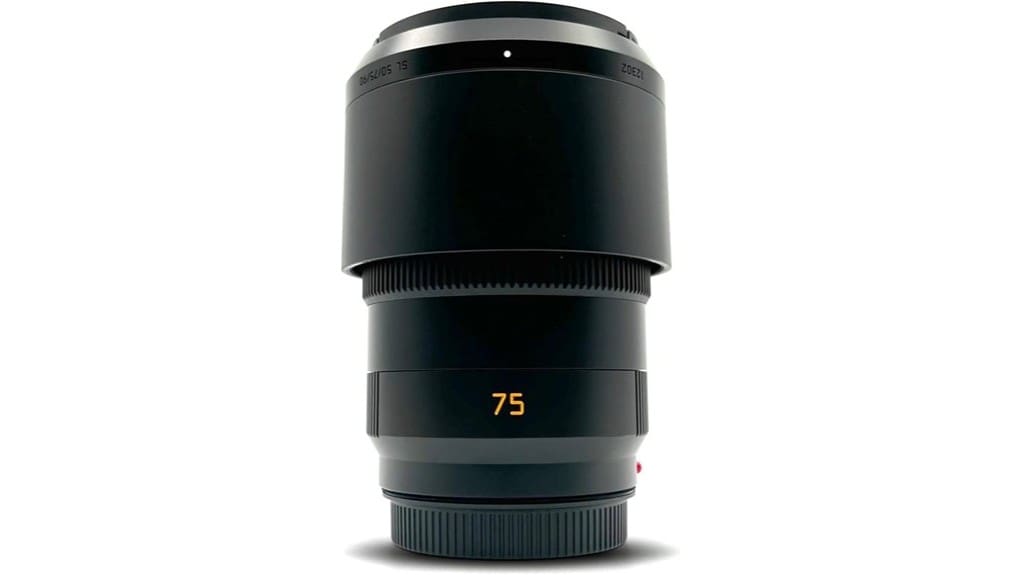

You’ll find the Leica Apo‑Summicron‑SL 75mm f/2 is a compact, weather‑sealed short‑tele prime built for portrait and commercial pros who need pinpoint center sharpness, high micro‑contrast and creamy, controlled bokeh. It delivers strong subject separation and palpable “3D pop,” with floating elements preserving edge rendering and Dual Synchro Drive AF offering quiet, repeatable acquisition. The metal chassis, calibrated focus ring and Quadra coatings resist flare and grit. Keep going and you’ll get detailed performance, handling and buying guidance.
Some Key Takeaways
- Exceptional center sharpness at f/2 with pinpoint resolution and very high micro-contrast for portrait detail.
- Smooth, cinematic bokeh and controlled highlight rendition that produces strong subject separation and 3D “pop.”
- Dual Synchro Drive AF is quiet, precise, and reliable for portraits, events, and handheld video on Leica SL bodies.
- Robust, weather-sealed metal construction with floating elements and Leica Quadra coatings for flare control and edge consistency.
- Premium-priced, aimed at professional portraitists and Leica loyalists; consider 70–85mm alternatives if budget constrained.
What the Leica Apo‑Summicron‑Sl 75MM F/2 Actually Is and Who It’s for
Although it’s a short-telephoto prime designed for full-frame Leica L-mount bodies, the Leica APO‑SUMMICRON‑SL 75mm f/2 delivers a precise toolset for portraitists and commercial shooters who need shallow depth of field and high micro-contrast. You’ll find a compact, weather-sealed 75mm prime with dual aspherics, floating elements, and Leica Quadra coatings that reinforce a clear lens philosophy: prioritize micro-contrast, reliability, and controlled subject isolation. The buyer persona is a professional or advanced enthusiast shooting portraits, studio assignments, or editorial work who values rugged build, predictable autofocus, and optical consistency across focus distances. It’s a purpose-driven instrument. This lens is a natural fit for mirrorless camera enthusiasts who prioritize compact, high-performance glass.
Optical Performance: Sharpness, Bokeh and “3D Pop” in Real Shooting
When you put the APO‑SUMMICRON‑SL 75mm f/2 on a full‑frame L‑mount body it delivers immediate and consistent optical performance: center sharpness is excellent wide open, contrast and micro‑detail remain intact through mid apertures, and the floating element design keeps edge rendering reliable from close focus to infinity. You’ll notice pinpoint resolution at f/2 that tightens through f/4–f/8, preserving edge microcontrast. Bokeh texture is smooth with minimal nervousness; out‑of‑focus highlights remain controlled. Background rendering separates subject cleanly, producing convincing depth layering and a palpable “3D pop” without sacrificing tonal fidelity or color accuracy. This makes it a particularly compelling choice for photographers who prioritize lens quality and are shopping for essential lens gear for better photography enthusiasts.
Autofocus, Handling and Build: Real‑World Usability and Weather Resistance
If you need quick, reliable focus and a robust build for field use, the APO‑SUMMICRON‑SL 75mm delivers: you get Dual Synchro Drive stepping AF that achieves precise, repeatable subject acquisition with silent focusing suitable for discreet shoots. The metal chassis, calibrated focusing ring and front-element seal give tactile control and long-term calibration stability. Weather sealing at the front element, focusing ring and bayonet protects against rain, dust and grit during professional workloads. At 2.94 pounds it’s balanced on SL bodies, and the matched lens hood plus Quadra coatings reduce flare while preserving optics and serviceability in harsh conditions. Designed for photographers who value control and consistency, it pairs well with follow focus systems for smooth manual adjustments and repeatable pulls.
How It Performs for Portraits, Events and Video (Use‑Case Tests)
Because its f/2 aperture and 75mm focal length give you tight framing and strong subject separation, the APO‑SUMMICRON‑SL 75mm excels for portraiture, and its optical design also suits many event and run‑and‑gun video scenarios. You’ll get consistent skin microcontrast, controlled falloff and cinematic bokeh that isolates subjects against busy backgrounds. Dual Synchro Drive AF tracks reliably during event flow, while weather seals and robust build let you work in challenging venues and low light. For handheld video the lens balances well on Leica SL bodies; lack of stabilization means you’ll rely on camera IBIS or technique. The lens also pairs well with camera cages for added protection and accessory mounting.
Should You Buy It? Price, Alternatives and Final Recommendation
Having established how the 75mm performs for portraits, events and video, you should weigh its strengths against price and alternatives before committing. You’ll pay a premium; perform a strict price comparison against premium 70–85mm primes and used Leica stock. If you own Leica L bodies it’s native; adapters open alternative mounts but factor in AF performance and calibration. Assess long term value via build, coatings and resale; professional durability justifies cost for heavy users. Match buyer profiles: dedicated portrait/event pros and Leica system loyalists benefit most. Casual shooters should consider less costly alternatives or used options. Also consider how prime lenses often deliver superior image quality and subject separation compared with zooms when deciding if the investment is worth it.
Some Questions Answered
Does This Lens Include Image Stabilization for Handheld Low‑Light Shots?
No — the lens doesn’t include optical stabilization. You’ll rely on camera-body stabilization or electronic stabilization in post or in-camera video modes for handheld low-light shots. Its fast f/2 aperture, dual Synchro Drive AF and floating elements improve low-light capture and subject separation, but there’s no in-lens vibration reduction. If you need shake control, use a stabilized Leica body, gimbal, higher ISO, or enable electronic stabilization where available.
What Filter Types Work Best With the 67MM Thread?
Use 67mm glass filters—UV/protective, polarizers, and neutral density—to preserve image quality. You’ll prefer high‑quality multi‑coated glass filters to avoid flare and maintain contrast; slim circular polarizers reduce vignetting. For exposure control, use solid ND or variable ND glass, but test variable ND for potential polarization/X‑pattern at wide apertures. Screw them onto the 67mm thread; stack sparingly and use the matched lens hood to minimize stray light.
Is the Lens Compatible With Third‑Party Lens Caps and Hoods?
Yes — you can use aftermarket caps and third‑party hoods, but you should be precise. You’ll want caps sized for the 67 mm thread and a hood matched to the lens’ bayonet/profile to avoid vignetting or fit issues. Choose rigid, well‑toleranced products to preserve sealing at the front element and focusing ring. Verify material, bayonet alignment and inner baffling; poorly made hood/cap combos can degrade contrast or block autofocus.
How Long Is the Manufacturer Warranty and What Does It Cover?
The manufacturer warranty is typically 2 years (warranty duration) and covers defects in materials and workmanship (coverage specifics). You’ll need the original purchase receipt and must register the product per Leica’s process. It won’t cover accidental damage, normal wear, misuse, or unauthorized repairs. Shipping or inspection procedures may apply for claims. Check your retailer’s return policy and Leica’s official warranty document for exact regional terms and exclusions.
Does the Lens Maintain Sharpness on Aps‑C or Crop‑Sensor Bodies?
Yes — on APS‑C bodies you’ll retain excellent center sharpness and reduced field curvature impact, because the smaller sensor samples the central sweet spot. Corner resolution improves relative to full‑frame since edges of the full‑frame image fall outside the crop, yielding more uniform detail across the frame. Stop down slightly from f/2 for peak corner resolution, and you’ll get consistently high microcontrast and subject separation on crop cameras.