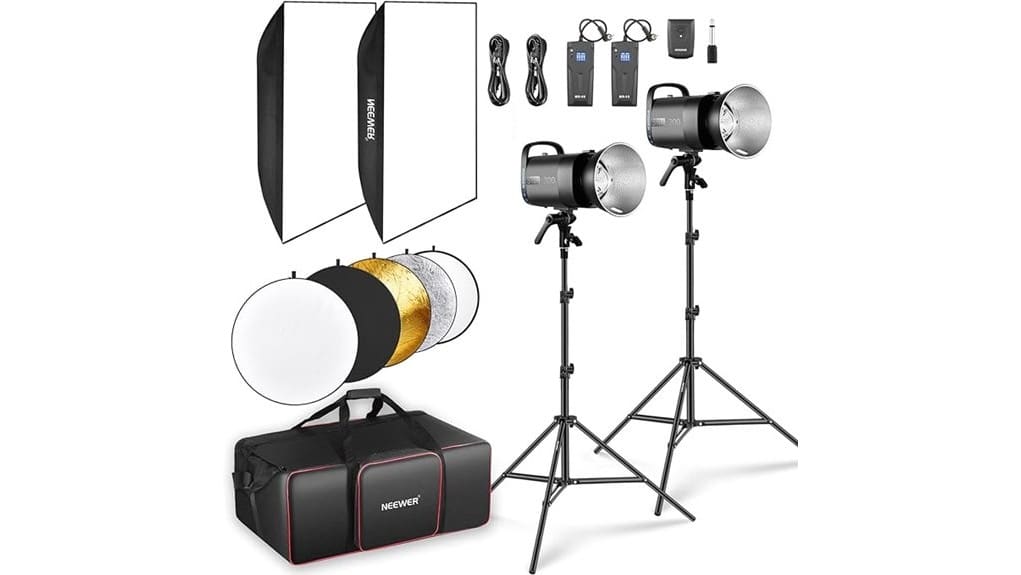

The Neewer 600Ws kit gives you about 300Ws effective per head with consistent 5600K color, short 1/2000–1/800 flash durations, and 0.4–2.5s recycling for steady portrait and product work. You’ll get Bowens compatibility, a usable 150W modeling lamp, RT-16 wireless control with S1/S2 modes, and solid metal housings with active cooling. It’s a budget-friendly, reliable option for freelancers and small studios; keep going if you want specifics on workflow, modifiers, and limits.
Some Key Takeaways
- Two 300 Ws monolights (600 Ws total) provide solid output for portraits and product work without being overkill.
- Consistent 5600K daylight color across power levels yields predictable skin tones and easy color matching.
- Fast flash durations (1/2000–1/800) and 0.4–2.5 s recycling support motion freezing and reasonable shot cadence.
- Built-in RT-16 wireless control (16 channels) and quick sync to 1/200 s simplify multi-light setups and triggering.
- Budget-friendly kit includes Bowens mounts and accessories, ideal for beginners and small studios needing reliable value.
Real-World Power and Output: How the 600WS Monolights Perform in Studio and Location Shoots
When you push these Neewer 600Ws monolights into real shoots, they deliver predictable, usable power both in-studio and on location: the 300 Ws per unit gives you solid output for portraits and product work without overkill, the 5600K color temp stays consistent across power levels, and the 1/2000–1/800 flash durations plus 0.4–2.5 s recycling let you freeze motion and keep reasonable shot cadence. You’ll appreciate stable color and repeatable output; modeling lamp control aids previewing. Battery performance isn’t a focus here—these are mains-first units—but portable setups work with external packs. Shutter compatibility up to quick sync limits feels reliable. These kits are aimed at photographers who want reliable studio-grade lighting for both photo and video with straightforward setup and controls, making them a good entry point into video light kits for hobbyists and enthusiasts.
Controls, Triggering, and Workflow: RT-16 Transmitter, S1/S2 Modes, and Sync Behavior
Although the RT-16 transmitter and built-in S1/S2 options keep the kit straightforward, you’ll want to understand how each mode and sync limit affects real-world workflow: the RT-16 gives reliable wireless control across 16 channels with a practical 99 ft/30 m outdoor range (66 ft/20 m indoors), quick sync up to 1/200 s, and channel/group selection that speeds multi-light setups; S1 lets you trigger the flashes optically off a manual master while S2 ignores pre-flashes for TTL masters, and the unit’s memory function preserves your channel/group and power settings so you don’t have to reconfigure between takes.
You’ll appreciate low wireless latency for near-instant firing, though dense venues can introduce dropouts; channel scanning simplifies finding a clear band but adds a moment to initial setup. Overall controls are logical, tactile, and suited to fast-paced shoots where predictable sync behavior and saved presets matter. You can streamline multi-light shoots further by planning trigger channels and groups ahead of time and using wireless flash triggers to keep setups consistent across sessions.
Light Quality and Modifiers: Color Accuracy (5600K), Modeling Lamp, Bowens Mount Softbox Tests
Because the Neewer 600WS kit targets daylight-balanced shooting, you’ll find its 5600K output impressively consistent across softboxes, delivering neutral skin tones with minimal corrective work in raw files. You’ll appreciate accurate color rendition straight out of camera; whites stay neutral and hues remain predictable when you meter or white-balance to 5600K. The 150W modeling lamp with nine levels gives usable previewing for shape and shadow without overwhelming heat. In softbox comparison tests the Bowens mount accepted modifiers securely and produced even falloff, tight highlight control in smaller grids, and softer wrap with larger rectangular boxes—reliable, predictable shaping for portraits. Many photographers pair these results with collapsible photo reflectors to fine-tune fill and catchlights.
Build, Cooling, and Reliability: Heat Management, Flash Tube Durability, and Long‑Use Stability
Since you’ll be running these lights for extended shoots, Neewer’s focus on cooling and robust construction really matters. You’ll notice solid metal housing, secure mounts, and enlarged air inlets that feel built for repeat use. The active cooling system blends quiet fans and vents for effective heat dissipation, keeping recycling times stable during prolonged bursts. Flash tubes are engineered against deformation and high voltage stress, which should translate to measurable tube longevity under routine loads. In practice, you can push through long sessions with minimal thermal cutouts, though extreme continuous full‑power firing still shortens component life. Many photographers prefer heavy-duty stands for stability with powerful heads, so consider compatible heavy-duty light stands to ensure safe, reliable setups.
Value and Buying Recommendation: Who Should Buy This Kit and When to Choose Alternatives
If you shoot portraits, product photos, or content on a budget and need reliable, repeatable output, this Neewer 600Ws kit delivers strong value—two powerful monolights, Bowens compatibility, and a full set of accessories for a fraction of pro-brand prices. You should buy it if you’re a budget buyer needing consistent 5600K color, decent recycling (0.4–2.5s), and portable weddings coverage when light stands and a carry bag matter. Choose alternatives if you need TTL, faster recycle at full power, higher sync speeds, or superior build for heavy commercial use. Overall: smart buy for beginners, freelancers, and small studios. Perfect light stand choices can improve setup stability for on-location shoots, so consider durable light stands when planning your kit.
Some Questions Answered
Does the Kit Include Spare Flash Tubes or Replacement Parts?
No, the kit doesn’t include spare flash tubes or dedicated replacement parts. You’ll get two S101-300W monolights with durable flash tubes engineered for heat and high-voltage resistance, which helps tube longevity, but spare availability is limited to ordering replacements separately from the manufacturer or retailers. You should plan for potential wear over heavy use, check warranty coverage, and confirm local parts sources before relying on continuous high-duty shooting.
Are Batteries Required for the RT-16 Transmitter?
No, batteries are required for the RT-16 transmitter to power transmitter operation; you’ll need two AAA cells. You’ll insert them into the battery compartment to enable wireless triggering and channel selection. This battery requirement is standard, and using fresh alkaline or NiMH rechargeables guarantees consistent range and response. You’ll want spares on hand for sessions, since depleted batteries will immediately prevent remote flash firing and disrupt your shoot.
What Is the Kit’s Total Weight for Travel With the Carrying Bag?
The kit’s travel weight with the carrying bag is about 28–32 lbs, so you’ll handle a moderately heavy pack. You’ll appreciate the organized carrying bag, but expect two bulky monolights, stands, softboxes, triggers, reflector, and accessories to add heft. For airline or long-distance travel you’ll want wheels or a luggage dolly. If you need exact shipping weight, check the seller’s spec sheet—manufacturers sometimes list packed weight precisely.
Are There Warranty Details or Customer Support Contact Info?
Yes — you’ll typically get a limited warranty; warranty duration often runs one year but can vary by seller. Check your purchase paperwork and seller page for exact terms. For support channels, you’ll use manufacturer email, phone, and online ticketing, plus seller returns where applicable. Keep serial numbers and receipts handy, note any shipping deadlines, and document faults with photos to speed claims. Contact support promptly for replacement or repair.
Can the Monolights Be Used Outdoors in Light Rain or Humid Conditions?
No — they’re not rated for rain. You shouldn’t expose the monolights to wet weather without extra protection because there’s no official weatherproof rating and internal electronics and fans can be damaged. You can use protective covers and umbrellas to shield heads and connections, avoid direct exposure, and keep gear elevated. For humid conditions, monitor condensation risk, use silica packs in bags, and power down if moisture appears to prevent corrosion or shorting.