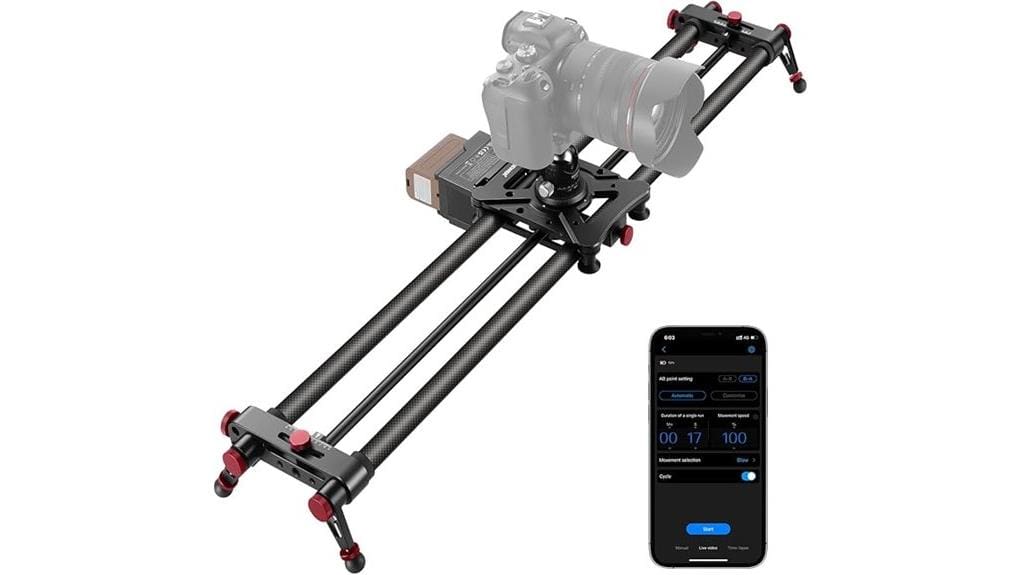

You’ll get an 80 cm carbon‑fiber slider with a silent stepper, four roller bearings, and configurable video/time‑lapse modes that suit solo creators and small teams. It supports up to 5 kg horizontally (2.5 kg at 45°), offers app and 2.4G remote control, and has slow‑start/stop profiles for low jerk. Expect motor heat on long runs, no weather sealing, and separate charger/remote purchases. Continue for detailed performance, mounting tips, and buying advice.
Some Key Takeaways
- 80 cm carbon-fiber rail offers light portability with preserved rigidity for solo creators and small teams.
- Silent stepper motor with four roller bearings provides smooth, low-friction motion and slow-start/stop profiles.
- Max horizontal payload 5 kg (45°: 2.5 kg) suits mirrorless kits but struggles with heavy DSLRs and long lenses.
- App and 2.4G remote enable gesture control, configurable speed/intervals/presets, and repeatable automated moves.
- Pros: precise quiet motion and time‑lapse modes; cons: charger/remote sold separately, limited tilted capacity, no weather sealing.
NEEWER ER1-80 at a Glance: Key Specs and Who It’s For
Though compact and lightweight, the NEEWER ER1-80 packs professional-grade features for automated camera motion: an 80 cm (31.5″) carbon-fiber slider with a silent stepper motor, four roller bearings, and a maximum horizontal payload of 5 kg (11 lb) (2.5 kg/5.5 lb at 45°). You get motion modes for manual, constant-speed video, and time-lapse, plus app and 2.4G control with configurable start/end points, frames, intervals, and exposure settings. Battery and Type-C power options support extended shoots. Target users include solo content creators, small production teams, and technical shooters who need compact portability and modular tools for creative workflows. It’s an excellent choice for photographers and videographers aiming to achieve smooth cinematic motion in a portable package.
Build and Mounting: Carbon Fiber, Bearings, and Stability Tested
You’ll notice the ER1-80’s construction reflects its compact, professional intent: an 80 cm carbon-fiber rail keeps weight down while preserving rigidity for mounted gear. You get carbon fiber aesthetics without compromising stiffness; the tube resists flex under the specified 5 kg horizontal load. Four precision roller bearings guarantee smooth carriage travel and suppress vibration, delivering repeatable, low-friction motion. Mounting hole versatility is practical: 1/4″ and 3/8″ threaded sockets on bottom and sides allow tripod, rig, or accessory attachment. In testing the assembly remained true under load, with stable tracking and minimal rail deflection across typical setups. The product fits well within the site’s focus on choosing the right slider for photographers, offering useful features for those comparing camera sliders.
Motion Modes and Controls: Video, Time‑Lapse, App and Remote Use
When you switch between modes on the ER1-80, the slider gives precise, repeatable motion for both continuous video and interval-based time lapses. You set start/end points, speed, frames and intervals via the NEEWER app or the 2.4G RT-08 remote, switching between Video (constant speed, ramped start/stop) and Time‑lapse profiles. Gesture control on the app offers quick local adjustments; the remote provides tactile operation. Silent stepper motor guarantees accuracy. You can update control logic through firmware updates to add features or fix behavior. Configuration is deterministic, with saved presets for repeatable automated moves. This makes the ER1-80 a solid choice for photographers seeking motorized camera sliders to master smooth motion.
Performance in Real Shoots: Load Limits, Smoothness, Noise, and Battery Life
Because the ER1-80 is built around a silent stepper motor and carbon-fiber rail, it delivers precise, low-vibration moves up to its rated loads—11 lb (5 kg) horizontally and 5.5 lb (2.5 kg) at 45°. You’ll find motion smooth across speeds; slow-start/stop profiles minimize jerk when you’re near load limits. Noise is negligible for on-set dialogue, though heavier rigs approach audible strain. Monitor thermal behavior during extended runs; the motor and driver warm predictably, affecting torque. Perform motor calibration after changing payloads, and install firmware updates to refine motion control. Expect gradual battery degradation over many cycles; plan charging and spare cells. Handheld gimbals users will appreciate how the ER1-80 complements smooth shot techniques commonly used by enthusiasts.
Final Verdict and Buying Advice: Pros, Cons, Alternatives, and When to Buy
Having tested load handling, smoothness, noise, and battery behavior, you can judge whether the ER1-80 fits your workflow. You’ll get precise, quiet motion, carbon-fiber portability, and useful time-lapse modes; max loads suit mirrorless kits but limit heavier DSLRs with long lenses. Pros: compact build, configurable controls, multiple mounting points. Cons: charger and remote sold separately, limited tilted load, no weather sealing. Accessory recommendations: buy an NP-F spare battery, USB-C power bank, and sturdy tripod plate. Watch pricing trends for discounts; buy during sales if you need portability and repeatable motion without pro-heavy payloads. For broader gear selection and tripod-related accessories, check out resources on perfect tripods to help round out your kit.
Some Questions Answered
Does It Include a Charger for the Np‑F750 Battery?
No — it doesn’t include a battery charger for the NP‑F750. You get a 4400 mAh NP‑F750 battery, but the package omits a charger, so you’ll need to use a compatible external charger or a 5V 2A Type‑C portable power bank to charge on the go. Battery charger? not included. Consider buying spare batteries? if you need extended runtime, grab additional NP‑F750 cells and a dedicated charger for efficient workflow.
Can the Slider Be Powered Continuously via AC Adapter?
Yes — you can use continuous power via an AC adapter by feeding the slider’s DC input (5V 2A Type‑C). That gives continuous power without relying on the NP‑F750 battery, effectively allowing a battery bypass during operation. You’ll still want to fully charge the battery for longevity if you switch between modes. Use a reliable 5V 2A USB‑C adapter to guarantee stable, noise‑free motor performance and avoid undervoltage issues.
Is There a Warranty Extension or International Support?
No—NEEWER generally offers a one-year manufacturer warranty that isn’t transferable and doesn’t include formal warranty transferability provisions. You’ll need to register and claim under the original purchaser where applicable. International repairs are limited: NEewer provides regional service channels but coverage and parts availability vary by country, so you’ll likely pay shipping or local service fees. Contact NEewer support for country-specific repair options and to confirm any exceptions.
Are Motorized Presets Transferable Between App and Remote?
Yes — presets sync one-way from the app to the remote via App syncability; you can push configured start/end points, intervals, and motion profiles to the RT-08. The remote won’t upload custom presets back to the app. There’s no Preset encryption; presets transfer in plain config packets over 2.4G, so you shouldn’t expect secure encryption. You’ll want to back up complex presets in the app for safety and repeatability.
Can Firmware Be Updated and Where to Download Updates?
Yes — firmware updates are available. You’ll find firmware availability and the update procedure on Neewer’s official support/download page or within the NEEWER app. Download the specific ER1-80 firmware file, connect the slider via USB-C or follow the app’s OTA prompts, then run the update per instructions (ensure battery charged). Follow checksum and restart steps shown in the guide to complete the firmware update procedure safely.