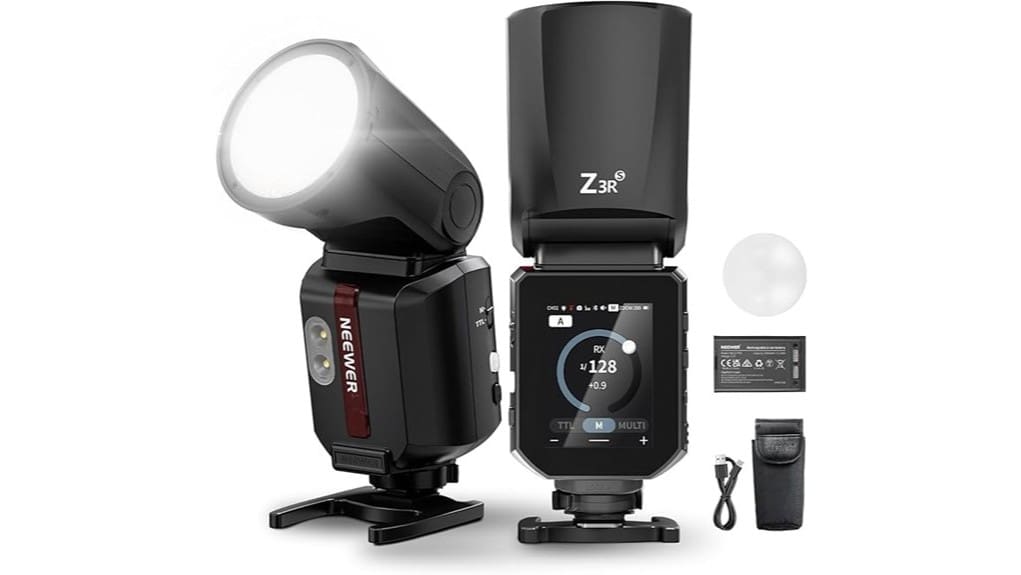
The Neewer Z3R‑S (100Ws) is a compact, Sony‑friendly off‑camera flash that gives you TTL, HSS to 1/8000s, and 100Ws with 0.1 EV steps—useful for portraits and location work. Its 3000mAh battery recycles quickly and supports ~500 full pops per charge, while the round head plus magnetic diffuser creates pleasing catchlights. Built‑in 2.4GHz Q wireless and limited Godox compatibility cover most setups, though it’s not rugged pro‑weather gear; keep going to see detailed performance and workflow notes.
Some Key Takeaways
- Affordable 100Ws Sony-compatible flash with TTL and 0.1 EV steps, ideal for mirrorless portrait and location work.
- Built-in 2.4GHz Q/X wireless (4 groups, 32 channels) with TTL/master/slave functionality and Sekonic L-858D support.
- Round head plus magnetic diffuser creates flattering catchlights and works well with portrait modifiers.
- 3000mAh battery supports ~100 full-power flashes, ~1.7s recycle at full, USB‑C charging for on-location use.
- Excellent color stability (~6000K) and HSS to 1/8000s, but not recommended for weatherproof pro rigging or broad radio ecosystems.
Real-World Summary: Who the Z3R-S Is Best For and the Quick Verdict
While the Z3R-S brings a strong spec sheet—100Ws power, 1/8000s HSS, 0.1 EV control and a 2.8″ touchscreen—you’ll appreciate it most if you shoot Sony mirrorless bodies and need a reliable, feature-rich off-camera flash on a budget. You’ll find it suits portrait lighting tasks, location shoots, and hybrid studio work where studio portability matters. Controls and TTL compatibility simplify mixed lighting, and the round head plus magnetic diffuser gives flattering catchlights. It’s not for weatherproof pro rigging or photographers needing extreme brand-agnostic radio ecosystems, but it’s a compact, capable option for Sony shooters. It’s also a practical choice for photographers learning to master wireless flash triggers with their gear wireless flash triggers.
Key Specs That Matter: Power, Battery, Sync, and Controls
Because the Z3R-S balances a strong 100Ws output with fast recycling and precise control, it’s worth looking at power, battery, sync, and controls together — those are the specs that determine how the unit performs in real shooting scenarios. You get 100Ws with 0.1 EV steps, GN42 reach, and continuous full-power capability for burst work. The 3000mAh battery supports ~500 full-power flashes, USB-C charging, and long battery health life ratings; monitor cycles to preserve capacity. Built-in 2.4GHz Q/X wireless covers groups/channels and TTL/manual modes. The 2.8″ touchscreen and button layout favor clear control ergonomics. Continuous LED lighting is especially useful for photographers who prefer consistent output during shoots and for video work, making it a versatile tool for creators who value continuous lighting in both photo and video setups.
Performance in Use: Flash Output, Recycle, HSS, Modeling Lights, and Color Stability
Having covered the core specs, let’s look at how the Z3R-S performs when you actually shoot: its flash output delivers consistent GN42 power across 1/256–1/1 with 0.1 EV steps, and the optimized round flash tube plus magnetic diffuser give an even falloff that’s easy to shape. You’ll get reliable flash consistency across bursts — the battery supports up to 100 full-power flashes and recycles ~1.7s — and HSS to 1/8000s holds exposure at fast shutter speeds. Modeling lights offer 10 brightness levels with solid modeling accuracy, and reported color stays near 6000K with minimal shift. This makes it a strong choice for creators focused on flattering portrait and selfie lighting setups.
Compatibility and Wireless Systems: Sony Hot Shoe, Q vs X vs Godox Compatibility, and Firmware Notes
If you need a Sony-native on-camera flash, the Z3R-S drops into Sony hot shoes and supports the camera line’s TTL/control features, but its real strength is off-camera flexibility: it runs Neewer’s 2.4 GHz Q system (4 groups, 32 channels, 99 IDs) as master or slave, can act as a slave for Godox 2.4GX (RX COMP) and select X-system transmitters, and also communicates with Sekonic L-858D light meters (RT-GX). You’ll get robust Q system control and simple X compatibility as a slave, but remember Q and X can’t run together; check for Firmware updates to enable newer transmitter support. This makes it a useful choice for photographers building a versatile drone camera lighting kit.
Buying Considerations: Accessories, Value Compared to Alternatives, and Final Recommendation
When weighing the Z3R-S, consider the accessories you’ll need for a full kit—light stands, modifiers that fit the round head or magnetic diffuser, extra batteries or a USB power pack for extended shoots, and a compatible trigger if you want master control beyond the built-in Q system; these add-ons will affect overall cost and versatility. You’ll also want soft cases, clamp mounts for on-camera or grip use, and third party chargers if you prefer spares. In a value comparison versus Godox or native-brand strobes, the Z3R-S offers strong specs and portability, making it a sensible buy if ecosystem limits and firmware nuances suit you. For users who prioritize consistent color and flicker-free output, consider matching panels rated for high CRI performance to ensure accurate skin tones and reliable results.
Some Questions Answered
Does It Come With a Protective Carrying Case?
Yes — it includes a storage bag that offers basic transport protection for the head, battery compartment and accessories. You’ll get the lithium battery, magnetic diffuser, USB cable and a soft carry pouch rather than a hard case. That pouch protects against scratches and light bumps but won’t replace a padded or hard case for heavy travel; consider a dedicated protective case if you need stronger impact or weather resistance.
Is There a Built-In LED Video Light?
No, it doesn’t have a dedicated built-in LED video light. You get two modeling lamps with adjustable brightness for previewing output, but these aren’t intended as continuous video illumination and their color temperature is listed at 6000 K. The unit’s battery life (3000 mAh) supports many flashes and modeling usage, but if you need sustained LED video lighting you’ll want an external continuous light or a separate LED panel for consistent color and runtime.
Can I Use Third-Party Batteries Safely?
Yes — you can use third-party batteries, but check battery compatibility and follow safety guidelines. Use reputable brands that match voltage, capacity, and contact layout; avoid cheap clones. Inspect batteries for damage, use correct USB-C charging specs (5V/2A) and compatible external packs, and monitor temperature. Stop using swollen or hot cells. Remember third-party use may void warranty, so weigh cost versus risk before relying on them.
Is There a Lock on the Hot Shoe Mount?
Yes — the flash has a locking pin on its hot shoe for hot shoe security and mount compatibility. You’ll slide the unit onto your camera’s Sony-style hot shoe and engage the spring-loaded lock to secure it. That prevents accidental release during use and maintains electrical contact for TTL and TTL/M modes. Always verify the lock engages fully and confirm firmware or adapter compatibility when using third-party mounts or accessories.
Does It Support Optical Slave Triggering?
No — it doesn’t offer a dedicated optical slave mode. You’ll rely on its 2.4 GHz Q/X wireless system for remote triggering, which is more reliable than optical in mixed lighting. If you try optical triggering with third-party gear, be aware optical sensitivity and trigger distance will vary; bright modeling or ambient light can prevent a clean trigger and useful range drops markedly compared with RF, so test before critical shoots.