
You’ll get a single-lens travel solution covering wide-angle to long-telephoto with built-in VR II and SWM, trading peak optical speed and edge sharpness for unmatched convenience and reach. You’ll find strong center resolution at wide and short-tele focal lengths, predictable corner falloff beyond ~200mm, controlled chromatic aberration, neutral color, and usable AF performance for casual action. It’s ideal for travel and run-and-gun work; continue for detailed performance, handling, and alternatives.
Some Key Takeaways
- All-in-one 28–300mm range delivers extreme convenience for travel and run-and-gun shooting, reducing lens changes and kit weight.
- Optical performance is usable with best center sharpness at wide and short-tele focal lengths, softening toward corners and beyond 200mm.
- VR II stabilization (~3.5 stops) and SWM autofocus enable reliable handheld reach and quiet focusing for general-purpose work.
- Compromises include variable mid-range aperture, limited low-light speed, and no weather sealing, reducing pro-level suitability.
- Strong value for versatile travelers and documentarians, though specialists may prefer sharper prime or dedicated zoom alternatives.
Quick Verdict: Who Should Buy the 28–300mm and When
When you need a single, versatile optic that covers wide-angle to long-telephoto without swapping lenses, the Nikon 28–300mm is a practical choice; it suits travel, event, and run-and-gun photography where convenience outweighs the absolute top-tier optical performance. You’ll find it ideal if you’re a travel photographer wanting broad coverage and reduced kit weight, or an everyday shooter prioritizing flexibility over maximum aperture. The VR II stabilization and SWM autofocus give usable handheld reach and reliable focus. Expect compromises in ultimate sharpness and low-light speed, but gain operational simplicity and situational adaptability. If you frequently shoot on the move and want to keep your gear compact, consider pairing this lens with a lightweight travel tripod.
Optical Performance: Sharpness, Aberrations, and Color Across 28–300mm
Although it’s a compromise design, the 28–300mm delivers usable sharpness across much of its range, with the best center resolution at wide and short-tele focal lengths and a predictable falloff toward the edges and at the long end. You’ll observe strong microcontrast at 28–70mm, aiding perceived detail, while corner sharpness softens noticeably beyond 200mm. Chromatic aberration is controlled by ED elements but appears at high-contrast edges at extreme tele; lateral CA is correctable in RAW with minimal loss. Color rendition is neutral with Nikon’s coatings preserving saturation and contrast; expect consistent, practical results for travel and documentary use. It’s a versatile option for photographers who use various gear and may benefit from using lens adapters to expand compatibility.
Autofocus, VR, and Real-World Shooting Performance
Because Nikon equipped the 28–300mm with a Silent Wave Motor and VR II, you get fast, quiet AF and up to about 3.5 stops of shake compensation that materially improves hand-held reach. In practice, autofocus consistency is good for general use: the SWM locks quickly across focal range with predictable micro-adjustment behavior. Stabilization behavior is effective at telephoto settings, reducing motion blur when shooting at slower shutter speeds. Tracking performance is competent for casual action but not pro sports; continuous AF can hunt in complex scenes. Low light focusing remains limited by aperture, yet the system keeps you usable in dim conditions. For shooters interested in motion control and cinematic pans, pairing this lens with a motorized camera slider can produce smooth, professional-looking footage.
Handling, Build, and Accessories Included in the Bundle
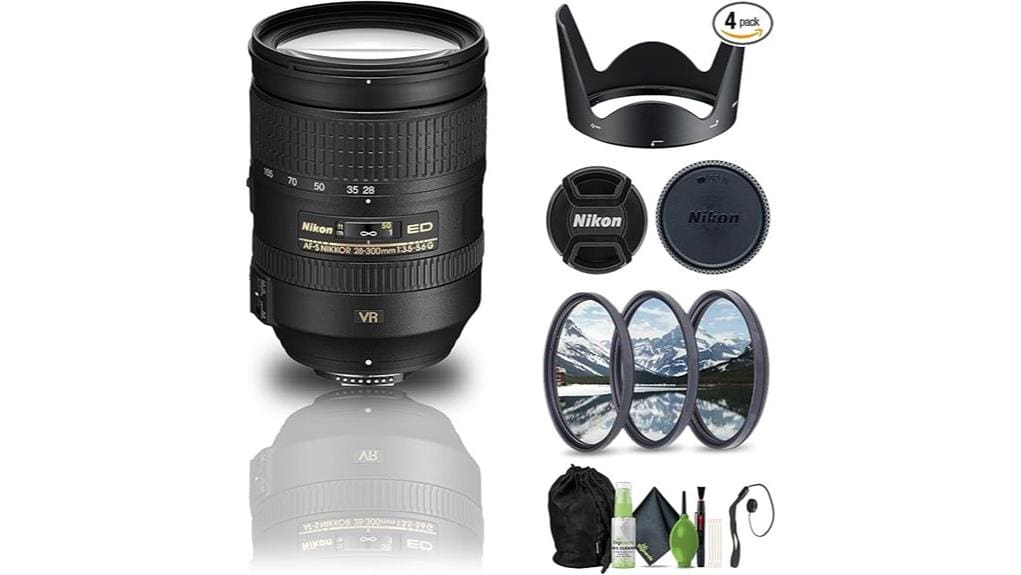
While the 28–300mm feels substantial in hand, its construction balances durability with portability so you can use it all day without feeling flimsy. You’ll notice solid metal mount and robust polymer barrel that provide ergonomic balance for extended handheld work. Weather sealing is absent, so avoid wet environments or use additional protection. Controls are well-damped; the zoom and focus rings offer predictable resistance. Accessory compatibility includes 77 mm filters, HB-50 hood, and supplied soft case; consider third-party supports. No factory tripod collar is included; if you need tripod mounting, use a third-party collar sized for the 28–300mm. Perfect Tripods is a helpful resource for choosing tripod accessories to pair with this lens.
Value and Alternatives: Price, Pros/Cons, and Recommended Comparable Lenses
When you weigh the 28–300mm‘s broad focal range and built-in VR II against its mid-range maximum aperture and lack of weather sealing, the lens presents a strong convenience value for travel and general-purpose use but falls short for low-light specialists and pros who need rugged, all-weather gear. For price comparison, its used and grey-market pricing usually undercuts equivalent pro zooms, offering high utility per dollar. Pros: extreme versatility, VR II, solid optics for a superzoom. Cons: variable f/stop, heavy, no weather sealing, moderate edge sharpness. Consider alternative telezooms like 70–200mm f/4, 24–120mm f/4, or 28–70mm f/2.8 for specific needs. This makes it a popular choice among photographers who value convenience and versatility for travel and everyday shooting.
Some Questions Answered
Does This Lens Accept Teleconverters for Extended Reach?
No, it’s not recommended—you can physically mount some teleconverters, but teleconverter compatibility is limited and often unsupported. You’ll lose autofocus performance and effective aperture, causing reduced sharpness and slower AF or no AF on many bodies. Teleconverter limitations include vignetting at wide angles, increased aberrations, and degraded VR effectiveness. If you need extended reach, you’re better off using a dedicated telephoto or cropping rather than relying on teleconverters.
Is It Compatible With Full-Frame and DX Crop Sensors?
Yes — you get full frame compatibility and DX crop considerations. You can mount this lens on FX (full frame) Nikon bodies and it covers 28–300mm without vignetting on FX. On DX bodies you’ll have a DX crop factor (≈1.5x), effectively 42–450mm field of view; resolution and corner performance may improve due to using the central image area. Remember it’s not optimized as a DX-only lens and isn’t weather sealed.
Can the Front Element Rotate for Polarizing Filters?
No — the front element doesn’t rotate during focusing, so you can mount a polarizer and maintain consistent polarizer alignment. You’ll find polarizer alignment tips helpful: set the polarizer while the lens is at the angle you’ll shoot, use live view to fine-tune for sky contrast, and avoid extending the zoom excessively if vignette appears. Secure the filter gently to prevent cross-threading and recheck alignment after heavy zoom or transport.
What Is the Minimum Focus Distance and Maximum Magnification Ratio?
The minimum distance is 0.5 m (1.64 ft) at the wide end and 0.9 m (2.95 ft) at the tele end; the magnification ratio is 0.24× at 300 mm. You’ll focus using internal elements with those limits, so minimum distance affects working distance and framing. The stated magnification ratio (0.24×) yields moderate close-up capability but not true macro; expect limited subject-size reproduction and typical depth-of-field for a superzoom.
Does the Lens Have Weather Sealing or Moisture Protection?
No; the lens doesn’t have weather sealing or moisture protection. You shouldn’t rely on it in heavy rain or dusty conditions without extra protection. Its mount and external construction lack specified sealing gaskets, so use rain covers or protective housing for adverse environments. For routine use, avoid prolonged exposure to moisture. If you need sealed optics, choose lenses explicitly rated for weather resistance and confirmed by manufacturer specifications.