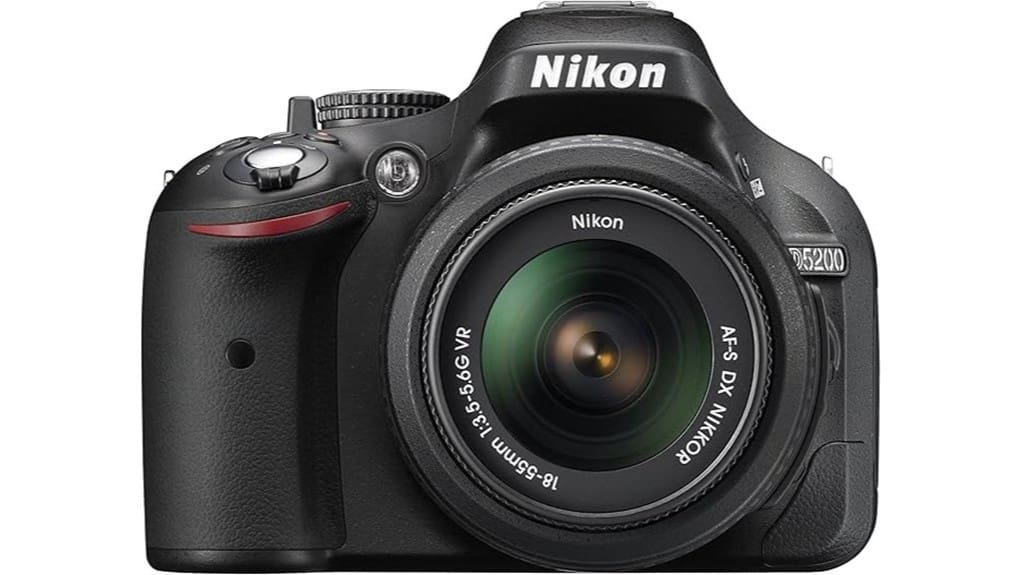
You’ll find the Nikon D5200 a capable 24.1 MP DSLR that delivers class-leading stills for its class, crisp textures and accurate color in JPEG and RAW, and respectable low-light performance up to ISO 1600 with usable detail at 3200. Its 39-point AF and 5 fps burst handle most everyday action, while the articulating 3.0-inch screen helps creative angles. Battery life and lack of in-body stabilization limit video work, and more details follow if you want to learn about trade-offs and alternatives.
Some Key Takeaways
- 24.1MP DX sensor with EXPEED 3 delivers high-resolution stills with good color and detail suitable for large prints and moderate cropping.
- 39-point Multi-CAM4800DX AF and 5 fps continuous shooting provide accurate autofocus and steady bursts for everyday action and portraits.
- Articulating 3.0-inch vari-angle screen and approachable controls make the D5200 user-friendly for learners and creative framing.
- Good high-ISO performance to ISO 1600, usable at 3200 with softer shadows; RAW preserves highlights and midtones.
- Limitations include no in-body stabilization, single card slot, older video/features; strong used-market value versus D5300/D5600 or entry mirrorless.
Nikon D5200 at a Glance: Key Specs and Who It’s For
Start with a quick scan: the Nikon D5200 pairs a 24.1 MP DX-format CMOS sensor with an EXPEED 3 processor to deliver high-resolution stills and Full HD 1080p video, while a 39-point Multi-CAM4800DX AF system and 5 fps continuous shooting make it versatile for fast-moving subjects. You’ll find an approachable control set, articulating 3.0-inch monitor, and scene modes that reinforce its entry level appeal without limiting growth. The 18–55mm kit lens balances focal range, VR and compactness, offering kit lens versatility for portraits, landscapes and casual tele work. Ports, battery life and accessory options suit learners. The site also offers essential gear for DSLR enthusiasts and photographers to complement the camera.
Image Quality and Low-Light Performance: Real-World 24.1 MP Results
When you push the Nikon D5200 into real-world shooting, its 24.1 MP DX sensor paired with the EXPEED 3 processor delivers finely detailed images that hold up well for large prints and moderate cropping, especially under good light. You’ll notice crisp textures and accurate color with JPEG or RAW. High ISO performance is respectable up to ISO 1600; noise remains controlled, with usable detail at 3200 if you accept softer shadow tones. Dynamic range is broad for its class, preserving highlight and midtone detail while allowing recovery in RAW. Overall, expect class-leading stills for everyday shooting. The site also offers a wide selection of compatible lenses and accessories for camera enthusiasts, including digital cameras and related gear.
Autofocus, Burst Shooting and Video: How It Performs in Action
Grip the D5200 and you’ll find a capable, fast-reacting AF system that suits most enthusiast shooting: the Multi-CAM4800DX module with 39 points locks accurately in good light, while AF-S and AF-C modes give you predictable single-shot and continuous behavior for stills and action. You’ll get reliable autofocus tracking in both viewfinder and Live View (contrast-detect in Live View is slower). Continuous shooting at up to 5 fps handles short bursts of action; buffer performance is modest—expect a limited RAW burst before slowing. Video delivers 1080p with subject-tracking AF and manual audio level control for practical results. This performance is well suited to photographers who also use a tripod head designed for stability and precision when composing shots.
Ergonomics, Battery, Display and Connectivity: Daily-Use Strengths and Annoyances
Having covered how the D5200 performs under the lens and in motion, let’s look at how it feels and functions during everyday use. You’ll appreciate comfortable grip comfort for extended shoots; the textured grip and compact body keep handling secure with kit lenses. Battery life is decent for a day’s work but you’ll want a spare EN-EL14 for long sessions or video. The 3.0-inch vari-angle screen articulation aids low and high framing and live-view shooting. Native wireless connectivity needs the optional WU-1a adapter, so transferring images or remote control requires extra hardware and apps. Keep shooting longer sessions confidently with a spare camera battery.
Is the D5200 Worth Buying Today? Pros, Cons and Recommended Alternatives
So, is the D5200 still a smart buy today? You’ll find its 24.1MP sensor, articulating screen and competent AF make it a capable entry-level DSLR for photos and 1080p video. Pros: image quality, light handling, kit-lens compatibility and compact ergonomics. Cons: no in-body stabilization, single card slot, older EXPEED 3 performance and limited native video features. Used marketability is decent, but check shutter count and battery health. Firmware updates ended years ago, so expect no new features. Alternatives to ponder: used Nikon D5300/D5600, Canon EOS 70D, or modern mirrorless APS-C bodies. If you’re transitioning from DSLRs, consider investing in mirrorless accessories to support future gear changes.
Some Questions Answered
Does the D5200 Include In-Body Image Stabilization?
No, the D5200 doesn’t include in-body image stabilization. You’ll rely on lens-based stabilization or post-processing. The camera’s sensor stabilization isn’t present, so optical VR in compatible Nikkor lenses handles shake. The D5200 does offer electronic stabilization only through certain video workflows or accessories, but it’s not a native body feature. You should pair VR lenses or use a tripod/gimbal for handheld low-light or long-exposure shooting.
Can the Camera Record Longer Than 60 Minutes Continuously?
No — you’re limited to about 60 minutes of continuous recording per clip. That’s the camera’s stated recording cap; while some users bypass file-size limits by using lower frame rates or external recorders, you’ll still face video limits and potential overheating risk during extended shoots. To record longer, you should monitor temperature, use an external HDMI recorder or swap batteries and cards, and allow cooling breaks to avoid shutdowns or damage.
Is the Built-In HDR Automatic or Manual-Only?
The built-in HDR on the D5200 is automatic—you’ll use Auto HDR for simple merged images straight out of camera—while you can also do Manual Bracketing by shooting bracketed exposures and merging them yourself for more control. You’ll get quick results with Auto HDR’s in-camera processing, but if you need precise exposure separation, tone mapping, or RAW merging, you’ll prefer Manual Bracketing and external software to achieve finer detail and dynamic-range control.
Which Batteries and How Many Spares Are Recommended for Travel?
Use the EN-EL14 rechargeable Li-ion battery and bring at least two spare batteries for a day of heavy shooting; three spares if you’ll be away multiple days or shooting lots of video. Carry travel chargers: a dedicated Nikon charger and consider a USB/USB-C power bank-compatible travel charger or an external dual-bay charger for fast top-ups. Keep batteries cool, rotated, and in carry-on to avoid discharge and damage.
Does the Kit Lens Support Full-Frame (FX) Coverage?
No, the kit lens won’t fully cover full-frame (FX) sensors. You’ll find lens compatibility is DX-specific, optimized for the smaller sensor, so mounting it on an FX body causes severe vignetting and reduced image circle. You should consider the crop implications: on DX bodies you retain intended field of view, but on FX bodies you’ll either lose corners or force heavy crop/FX-mode, negating resolution and altering composition compared with a true FX lens.