
You’ll find the D7500 kit a versatile DX system that balances image quality, speed, and telephoto reach. You get a 20.9MP sensor, EXPEED 5 processing, 4K/30p video, and reliable AF that tracks well in mixed light. The included 18–55mm and 70–300mm cover wide-to-tele needs with respectable sharpness and smooth bokeh from the long zoom. Battery life and controls suit day trips, and the kit’s portability makes it a strong hybrid stills/video choice—more specifics follow.
Some Key Takeaways
- Excellent 20.9MP DX sensor and EXPEED 5 deliver clean detail, strong dynamic range, and usable ISO up to 6400 (web to 12800 workable).
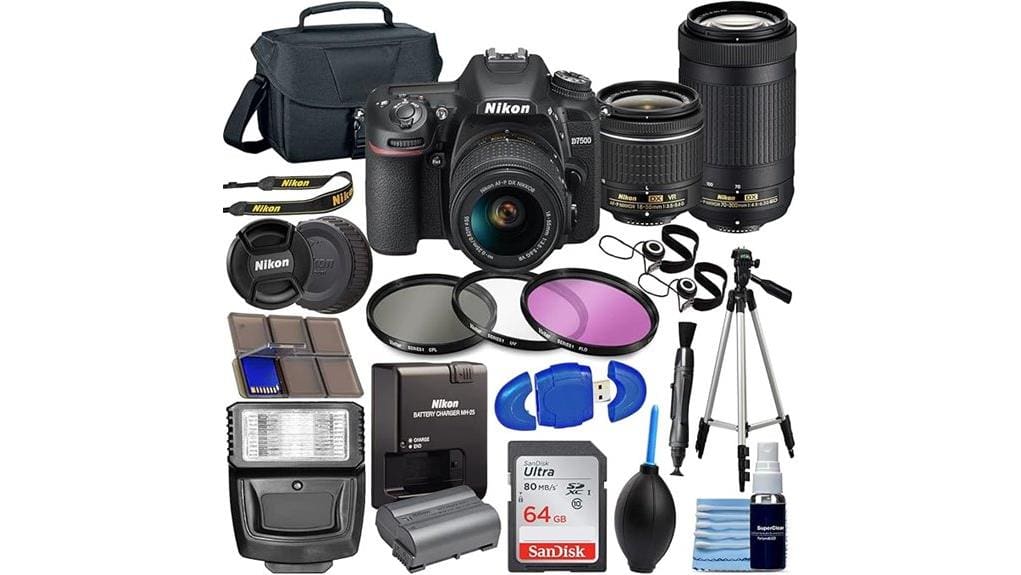
- Kit includes D7500 body, AF-P 18–55mm and 70–300mm lenses, EN-EL15a battery, 64GB UHS‑V60 card, and useful accessories.
- 8 fps continuous shooting, reliable AF tracking, and quick autofocus make it well suited for action and event photography.
- 4K/30p video and tilting touchscreen aid vlogging and hybrid use, though no in-body stabilization and some rolling shutter exist.
- Compact, weather‑resistant body with ergonomic controls, long battery life, and telephoto reach ideal for travel and portrait creators.
Quick Verdict : Who the D7500 Kit Is Best For
Who should buy the D7500 kit? You’ll find the D7500 kit ideal if you need a versatile APS-C DSLR that balances image quality, speed, and reach. Portrait enthusiasts will value the 20.9MP sensor, reliable AF, and tilting touchscreen for composed headshots. Travel vloggers will appreciate 4K video, durable battery life, and the included 18–55mm and 70–300mm lenses for adaptable framing without swapping gear constantly. You’ll also get effective subject tracking and expandable ISO for low-light scenarios. If you want a competent hybrid stills/video system with telephoto flexibility, this kit serves pragmatic, quality-focused creators well. It’s also a great match for photographers who prioritize portability and often shoot on the move with a lightweight tripod.
What’s Included in the Kit and Useful Extras
Included in the D7500 kit are everything you need to start shooting immediately: the import-model D7500 body, two versatile AF-P DX NIKKOR zooms (18–55mm f/3.5–5.6 VR and 70–300mm f/4.5–6.3 ED), an EN-EL15a battery with MH-25 charger, and a Sandisk 64GB Class 10 UHS V60 card. You also get filters, a slave flash with bracket, bag, tripod, card reader and cleaning kit. Pack smart: use the gadget bag and memory wallet for accessory organization and travel packing. Keep the 3-piece filters clean with regular filter maintenance. Practice flash positioning with the bracket before shoots. For photographers on the move, consider a dedicated camera backpack to protect and organize all your gear.
Body, Controls, Battery Life and Usability Highlights
Although it’s compact for an enthusiast DSLR, the D7500’s body feels robust and purposeful in your hands, with a deep grip, well-placed controls, and a weather-resistant build that handles everyday shooting demands. You’ll appreciate the ergonomic layout: primary dials and AF controls sit where your fingers expect, speeding operation. Grip comfort reduces fatigue during long shoots. Menu customization lets you tailor function buttons and My Menu for faster access to frequently used settings. Battery life is solid for day trips, and the included EN-EL15a charger replenishes quickly. Overall usability is refined, focusing on practical, durable performance. The site offers a range of essential accessories for DSLR users, including camera straps and protective gear to complement the D7500.
Lens Performance: 18–55mm and 70–300mm Tested
When you pair the D7500 with the bundled 18–55mm and 70–300mm AF‑P lenses, you get a versatile kit that covers wide‑angle through telephoto needs with reliable autofocus and useful stabilization. You’ll find the 18–55mm sharp centrally at most apertures, though edge sharpness softens toward the corners wide open. The 70–300mm holds contrast and resolves well for its class, with minimal chromatic aberration thanks to ED elements. Bokeh comparison favors the longer lens for smoother backgrounds. Autofocus is quick and consistent; focus breathing is modest on both, suitable for stills and casual video use. This combination is ideal for mirrorless camera enthusiasts seeking adaptable essential gear for travel and everyday photography.
Image Quality and Low-Light Performance (ISO, Dynamic Range)
If you push the D7500 into higher ISOs, you’ll find it holds detail well up to about ISO 6400, with clean midtones and controlled luminance noise thanks to the EXPEED 5 processor and the 20.9MP DX sensor. You’ll get usable files at ISO 12800 for web use, though grain and color shifts appear. Dynamic range is strong for a DX sensor class: preserve highlights reliably and retain recoverable data in shadows. High ISO handling is pragmatic rather than miraculous; apply moderate noise reduction. For deliberate exposure, prioritize slight overexposure to aid shadow recovery and minimize chroma noise. Fast storage and reliable write speeds on high-speed memory can help sustain continuous shooting and reduce buffer delays.
Video, Autofocus and Continuous Shooting in Real Situations
While shooting handheld or from a monopod, you’ll find the D7500’s 4K/30p video and 3.2″ tilting touchscreen make framing and monitoring straightforward, though you should be aware of rolling shutter and the absence of in-body stabilization for critical handheld work. In practice, its AF system locks quickly on contrast and phase cues, and touch autofocus on the LCD speeds composition changes during recording. At 8 fps continuous you can capture decisive moments, with buffer depth sufficient for most events. Exposure and AF tracking hold well in mixed light, but for demanding action you’ll want fast lenses and careful technique. Consider pairing the camera with dedicated camera remote accessories to enhance shooting flexibility.
Final Buying Guidance: Alternatives, Recommended Accessories, and Value Assessment
Although the D7500 delivers a compelling blend of image quality, speed, and features, you should weigh alternatives and add-ons to match your shooting needs and budget. If budget’s tight, inspect the used market for well-kept bodies; you’ll often find kits with accessory bundles that add value. Prioritize lenses over minor body upgrades—consider third party lenses for cost-effective focal range expansion and carry lens adapters if you mix mounts. The included dual-zoom kit and extras cover most starters, but buy a spare EN-EL15a, a sturdier tripod, and quality filters if you want longevity and flexibility. Consider also keeping a dedicated spare camera battery on hand so you can keep shooting longer without interruption.
Some Questions Answered
Is the Kit Compatible With Third-Party Batteries and Chargers?
Yes — you can use third party batteries, but check batteries compatibility carefully. Aftermarket cells often work and save money, yet they can vary in quality and capacity. You should prioritize reputable brands and verify voltage, contacts, and firmware matches. For chargers safety, use quality chargers with overcharge and short‑circuit protection; avoid cheap unregulated units. Expect no Nikon warranty coverage if aftermarket power causes damage.
Can the D7500 Shoot in Raw+Jpeg Simultaneously?
Yes — you can shoot RAW+JPEG; the D7500 supports Simultaneous Capture of both formats. You’ll set Image Quality to a RAW+JPEG option in the menu, then each exposure saves a full-resolution RAW file plus a processed JPEG. That gives you maximum editing latitude from RAW while keeping ready-to-share JPEGs. Expect larger files and fewer shots per card; manage storage and buffer if you’re shooting long bursts.
Does the Camera Support In-Camera Focus Stacking or HDR?
No — the D7500 doesn’t offer focus stacking or in camera hdr. You’ll need to capture multiple exposures or focus-bracketed frames and combine them externally. For HDR, shoot bracketed JPEGs or RAW+JPEG and merge in software. For focus stacking, use manual focus increments or bracketed shots with focus adjustments, then stack in post. This workflow gives you greater control and better results than relying on limited in-camera processing.
Is Weather Sealing Available for the Body or Lenses?
No, the body and kit lenses lack robust weather sealing. You shouldn’t expect professional dust/moisture protection. While some Nikon lenses use lens gaskets? at the mount to resist light moisture, the included 18–55mm and 70–300mm kit optics don’t advertise sealed construction. If you need reliable weather resistance, you’ll want bodies/lenses specified as weather‑sealed or add protective covers and careful handling in wet or dusty conditions.
Are Firmware Updates Applied via USB or Memory Card?
You install firmware updates via memory card, not direct usb connectivity. For the Nikon D7500 you download the firmware file, copy it to an appropriately formatted memory card, insert it, then run the firmware installation from the camera menu. That update method is reliable; USB connectivity is used for transfers and remote control, but firmware installation requires the memory card approach. Follow Nikon’s firmware installation instructions precisely to avoid issues.