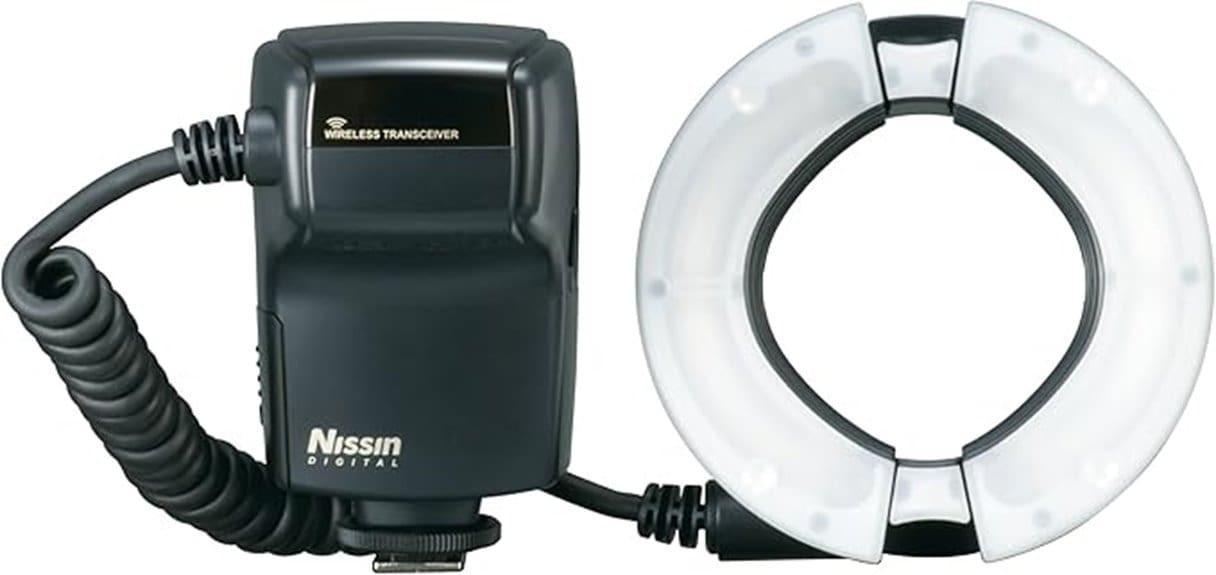

You’re getting a compact, shoe‑mount macro ring flash that mounts via 52–77mm adapter rings and delivers neutral 5600K light with GN16. It supports manual, TTL and Fine Macro steps down to 1/1024 for extreme close work, plus LED modeling and HSS to 1/8000s. Controls are clear with a 2‑inch LCD, but AA power limits runtime and no weather sealing exists. It’s ideal for regular macro, nature, and dental shooters — more details follow.
Some Key Takeaways
- Compact shoe‑mount macro ring flash offering GN16 and Fine Macro control down to 1/1024 for extreme close‑up work.
- Fixed 5600K with built‑in diffusion produces neutral, soft light ideal for macro, dental, and product photography.
- Mounts via included 52–77mm anodized adapter rings for secure lens alignment and consistent catchlights.
- Supports manual, TTL, HSS to 1/8000s, and LED modeling; AA battery power limits runtime and heavy HSS use.
- Best for regular macro shooters needing precise, repeatable lighting; consider alternatives for higher GN or weather sealing.
What the Nissin MF18 for Nikon Actually Is and Who It’s For
Think of the Nissin MF18 for Nikon as a dedicated shoe‑mount macro ring flash engineered for close‑up work; it mounts to your lens via included anodized aluminum adapter rings (52–77mm) and delivers soft, diffuse 5600K light optimized for macro, nature close‑ups, and dental photography. You’ll find it’s a purpose-built Macro lighting tool with manual, TTL, and fine macro output control, compact weight, and LED modeling for focus. Buyer profile: working macro shooters, entomologists, dental photographers, and technicians who need consistent, diffuse illumination and straightforward operation. It’s not for users needing waterproofing or built‑in power packs. Brighten your photography with on-camera LED lights to enhance subject detail and achieve more consistent results.
Key Specs That Affect Performance (Power, Size, Mounting, and Controls)
Although compact, the MF18’s core specs directly determine how you’ll use it: its GN16 output and 1/1–1/64 manual range (with Fine Macro down to 1/1024) set practical working distances and depth‑of-field tradeoffs for close‑up subjects; the 5600K color temp and built‑in diffusion deliver soft, neutral light suited to macro and dental work; and the 4 AA battery design constrains recycle time and runtime compared with external packs. You’ll appreciate the clear controls: color LCD, large numerics, and dedicated Fine Macro steps. Mount adapters (52–77mm) provide lens compatibility. Expect modest battery life and predictable, low‑power guide number performance. Designed for photographers who value portability and precise close‑focus lighting, the MF18 is a practical choice for on‑the‑go macro work with portable diffusers.
Real-World Shooting: Macro, Close-Up, and Dental Use Cases
With those specs in mind, you’ll find the MF18 well suited to close‑range work where controlled, soft illumination and precise power stepping matter. You’ll use fine macro mode for extreme close distances, dialing 1/128–1/1024 to avoid hotspots. For close up portraits it gives even eye catchlights and consistent color at 5600K; TTL assists exposure but manual stepping guarantees repeatability. In tactile product photography the ring form reduces shadows and reveals surface detail for texture capture. Dental documentation benefits from LED modeling lights and compact mounting; wired control and adapter rings keep alignment stable for clinical workflows. The site also offers a range of macro ring light accessories, including adapter rings and mounting options for macro photography.
Strengths and Weaknesses From Daily Use (Battery, Controls, TTL & HSS)
Because the MF18 balances compact power with precise control, you’ll find its battery, controls, TTL and HSS behavior predictable and usable for routine macro work. You get decent Battery longevity with four AA cells; expect reliable daily sessions though pack swaps are necessary for intensive shoots. Control ergonomics are good: a clear 2-inch LCD and logical menus speed adjustments without fumbling. TTL reliability is consistent for close distances, with effective TTL compensation range; expect occasional minor front/back focus corrections. HSS performance to 1/8000s works as specified, enabling ambient control. Weaknesses: battery drain under heavy HSS and lack of weather sealing. For set-ups where continuous lighting matters, combining the MF18 with continuous LED lighting can help create more consistent results during product and macro shoots.
Should You Buy the Nissin MF18 for Nikon or Pick Something Else?
If you shoot close-up work regularly and need a compact, predictable shoe‑mount that gives soft, color‑accurate light and reliable TTL/HSS control, the Nissin MF18 for Nikon is worth buying; otherwise, consider alternatives that offer greater power, weather sealing, or built‑in rechargeable packs. You’ll buy it for controlled macro lighting, accurate 5600K output, and fine manual steps down to 1/1024. Choose something else if you require higher GN, rugged sealing, or integrated battery packs for faster recycle. Evaluate budget alternatives for occasional use, and weigh long term reliability against manufacturer warranty, service, and user reports. Many fisheye and macro shooters also benefit from mastering composition and lighting techniques specific to extreme close-ups, such as using off‑camera modifiers and precise positioning with macro lighting to enhance detail and depth.
Some Questions Answered
Can I Use This Flash on a Camera Brand Other Than Nikon?
Yes — but with compatibility limitations. The MF18N is built for Nikon mounts; it’ll work on other brands only if you use appropriate mount adapters or buy the Canon-specific variant. Mount adapters can allow physical fit but may not provide full TTL, HSS, or radio functionality. Expect manual-only operation or limited features when using adapters. Verify electronic pin compatibility and test before critical shoots to avoid exposure or triggering failures.
Are Replacement Adapter Rings Sold Separately?
Yes — replacement adapter rings are sold separately. You can swap rings to match lens mount compatibility; Nissin’s kit includes common sizes but you’ll find individual rings (52–77mm equivalents) from Nissin or third parties. Check materials: original adapter materials are anodized aluminum for durability and precise fit, so you’ll want replacements made from anodized aluminum or similarly rigid metals to maintain secure mounting and optical alignment during macro work.
Does the Unit Support Rechargeable AA Batteries?
Yes — you can use rechargeable AA batteries; the unit requires four AAs so rechargeable compatibility is supported. Expect similar voltage but different discharge curves from NiMH cells versus alkalines, which can improve battery performance for sustained high-speed sync or repeated bursts. Use high-quality 2000–2500 mAh NiMH cells and keep spares charged. Note the manufacturer lists average battery life; real-world runtime will vary with flash power, usage pattern and modeling light use.
Is There a Ttl-Compatible Off-Camera Radio Trigger Option?
Yes — you can use a radio trigger with TTL compatibility. You’ll need a trigger system that supports Nikon i-TTL and Nissin’s radio interface or a compatible third-party radio trigger that passes TTL signals. Mount the MF18 on a compatible transmitter or use Nissin-compatible receivers; confirm the trigger explicitly lists Nikon TTL support. Test functions like TTL exposure, TTL compensation, and high-speed sync to verify full interoperability before critical shoots.
Can the MF18 Be Used Underwater With a Housing?
No — you shouldn’t use the MF18 underwater even with waterproof housings unless the housing and flash are explicitly rated for submersion. The unit isn’t water resistant and its electrical interfaces and battery compartment can fail. If you attempt it, you must use a certified underwater housing designed for strobes, perform rigorous pressure testing at the intended depth, and accept that manufacturer warranty won’t cover water damage. Consider purpose-built underwater strobes instead.