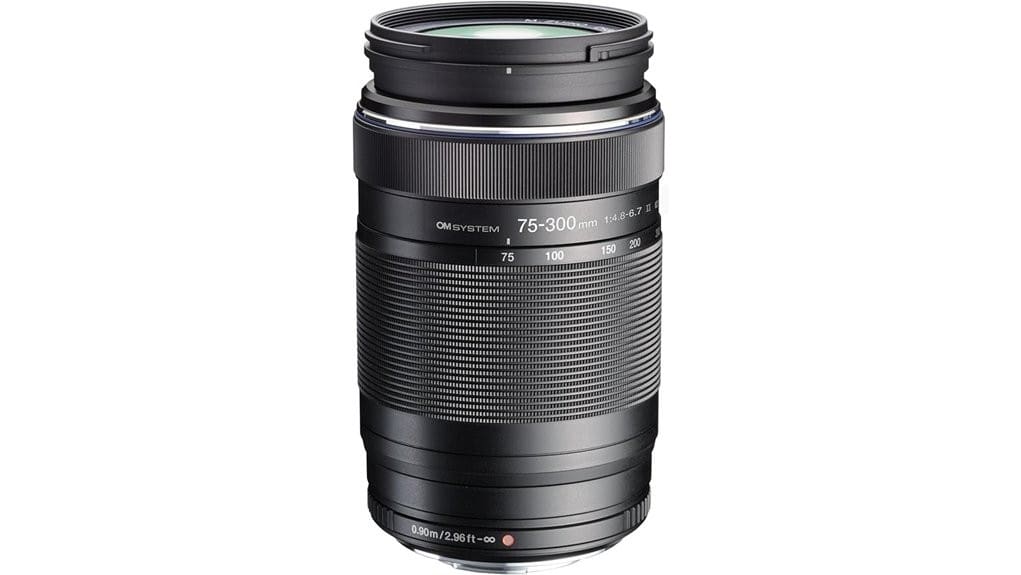
The OM System M.Zuiko 75–300mm f/4.8–6.7 gives you a compact, lightweight super‑telephoto that extends Micro Four Thirds reach to 150–600mm equivalent while sacrificing aperture speed and built‑in stabilization. You’ll get strong center sharpness at mid to long ranges, controlled chromatic aberration, quiet MSC autofocus with occasional hunting, and pleasing long‑lens bokeh. It’s ideal for travel and beginner birding when portability matters, but not for low‑light or pro stabilized work — keep reading for full test findings.
Some Key Takeaways
- Lightweight, compact 75–300mm (150–600mm equiv.) telephoto ideal for travel and Micro Four Thirds portability.
- Strong center sharpness at mid–long focal lengths; edges soften near close focus and wide-open apertures.
- Quiet MSC autofocus is mostly accurate but can hunt in low light or busy backgrounds.
- No optical stabilization—rely on in-body stabilization, tripod, or higher shutter speeds at long reach.
- Good value for casual birding/wildlife; skip if you need pro-grade IS, faster apertures, or rugged build.
Quick Verdict: Who This 75-300mm Lens Is Best For
Who needs the OM SYSTEM M.Zuiko 75-300mm? You do if you prioritize a compact, lightweight travel telephoto that extends a Micro Four Thirds kit to a 150–600mm equivalent without heavy expense. You’ll find it suited to beginner birding and casual wildlife where portability and reach matter more than pro-level optics. Compared to larger super-telephotos, it trades absolute speed, stabilization, and extreme close-focus for affordability and packability. You’ll use it for hiking, trips, and sports when you want long reach with minimal gear. It’s less ideal if you require in-body stabilization, fastest apertures, or maximum low-light performance. Perfect Tripods recommends considering tripod compatibility when pairing this lens with lightweight support for better handheld results.
Real-World Optical and Autofocus Performance (Sharpness, Chromatic Aberration, Bokeh)
If you value the 75–300mm for its reach and portability, you’ll want to know how it actually renders subjects and locks focus in the field. You’ll see center sharpness strong at mid to long focal lengths wide-open, but noticeable sharpness variation toward edges and at close focus distances. Chromatic control is good thanks to ED elements; occasional color fringing appears in high-contrast edges, corrected in RAW. MSC AF is quiet and usually accurate, though occasional focus hunting occurs in low light or busy backgrounds. Background rendition is pleasingly smooth—creamy bokeh at longer focal lengths—suiting wildlife and distant subjects. For those looking to extend reach further while maintaining image quality, consider pairing with compatible teleconverters to increase effective focal length.
Handling and Usability in the Field (Size, Weight, Focus Speed, Stabilization Note)
Because the M.Zuiko 75–300mm packs a 150–600mm equivalent reach into a sub‑1 lb, 2.7×4.58 in package, you’ll notice its portability instantly—it’s one of the lightest super‑tele zooms for Micro Four Thirds and compares favorably to bulkier full‑frame equivalents. You’ll benefit from compact handling on long walks; balance on small bodies is superior to larger telephotos. The MSC autofocus yields fast, quiet focusing that suits wildlife and casual sports. Note there’s no optical stabilization, so you’ll rely on in‑body stabilization or support at longer focal lengths. Build and control layout are functional and unobtrusive for field use. It’s a great choice for mirrorless shooters who prioritize portability and reach with essential gear.
Tested Focal Lengths and Image Examples: 75mm, 150mm, 300mm Equivalents
Having noted its compact handling and MSC autofocus in the field, you can now assess how the 75–300mm behaves at representative focal lengths: 75mm, 150mm (35mm equiv. 150mm/300mm? 3) At 75mm landscapes show wide coverage with good edge sharpness stopped to f/8; close up compression is modest but useful for foreground-background separation. At 150mm portraits produce balanced subject isolation and pleasing bokeh for head‑and‑shoulders framing. At 300mm wildlife captures distant subjects with reachable reach though you’ll need higher shutter speeds and ISO without stabilization. Overall sharpness favors central zones; chromatic aberration is controlled but visible in high contrast edges. This lens complements a kit focused on prime lenses by offering a compact telephoto option for varied shooting scenarios.
Buy-or-Skip Checklist: Pros, Cons, Alternatives, and Final Recommendation
While it won’t replace pro-grade stabilized telephotos, the OM SYSTEM M.Zuiko 75–300mm delivers a compelling, compact super-telephoto option for Micro Four Thirds shooters who prioritize reach and portability over ultimate speed and stabilization. You’ll gain 150–600mm equivalent reach, lightweight handling, and decent optics with ED/HR elements, but you’ll lack optical stabilization and fast apertures. Buy if you need affordable, portable reach and acceptable image quality; skip if you require IS, faster glass, or pro robustness. Consider alternatives: stabilized 100–400mm MFT lenses or third‑party telephotos. Assess long term durability, accessory compatibility, and your shooting priorities before deciding. If you plan extended shoots, also factor in spare camera batteries to avoid downtime.
Some Questions Answered
Is This Lens Weather-Sealed or Splash-Proof?
No — it isn’t weather sealed; it lacks official weather sealing, so don’t expect full splash protection. You’ll want splash resistance? only if you add camera body sealing and cautious handling. Compared to weather-sealed telephotos, this lens is lighter and less rugged: it trades environmental robustness for compactness. In wet or dusty conditions you should avoid exposure or use additional protection like rain covers or sealed housings for reliable outdoor use.
Can It Be Used With Teleconverters or Extenders?
Yes — you can use teleconverters, but native teleconverter compatibility is limited and third-party extenders require caution. You’ll gain reach but suffer aperture loss and autofocus performance degradation; expect notable image quality impact (reduced sharpness, contrast, increased aberrations). Comparatively, using a dedicated native teleconverter on similarly designed lenses fares better. If you need extension, test specific extender models on your camera for acceptable AF, exposure and optical trade-offs before committing.
Does It Support In-Camera Lens Corrections/Metadata?
Yes — you’ll get in camera corrections and lens metadata support when using compatible Micro Four Thirds bodies. The camera applies distortion, vignetting and chromatic aberration corrections automatically and records lens metadata (focal length, aperture, lens ID) for RAW/RAW+JPEG workflows. Compared to third‑party lenses, integration is tighter; proprietary elements (Super ED/HR) benefit from tailored correction profiles, improving sharpness and color accuracy in post and in-camera JPEGs.
What Tripod Collar or Mounting Options Exist?
The lens doesn’t include a tripod collar or mounting foot, so you’ll need an aftermarket solution. You can attach a slim Arca-type lens foot to the lens barrel or use a third-party clamp-style tripod collar that fits its 2.7″ diameter. Compare low-profile mounting foot options versus full rotating collars: feet stay lighter and lower, collars add stability and rotation for panoramas but increase bulk and weight. Choose compatibility with Micro Four Thirds balance.
Is There a Dedicated Lens Cap or Rear Cap Model Number?
No official dedicated lens cap or rear cap model number is listed by the manufacturer. You’ll check lens compatibility with standard Micro Four Thirds caps (front 58mm approximate—confirm thread), and consider cap alternatives: generic snap-on caps, screw-in filter caps, or third-party rear caps matching the OM SYSTEM mount. Compare fit tolerances, retention method, and material; choose a snug, scratch-resistant option ensuring secure protection and proper flange clearance.