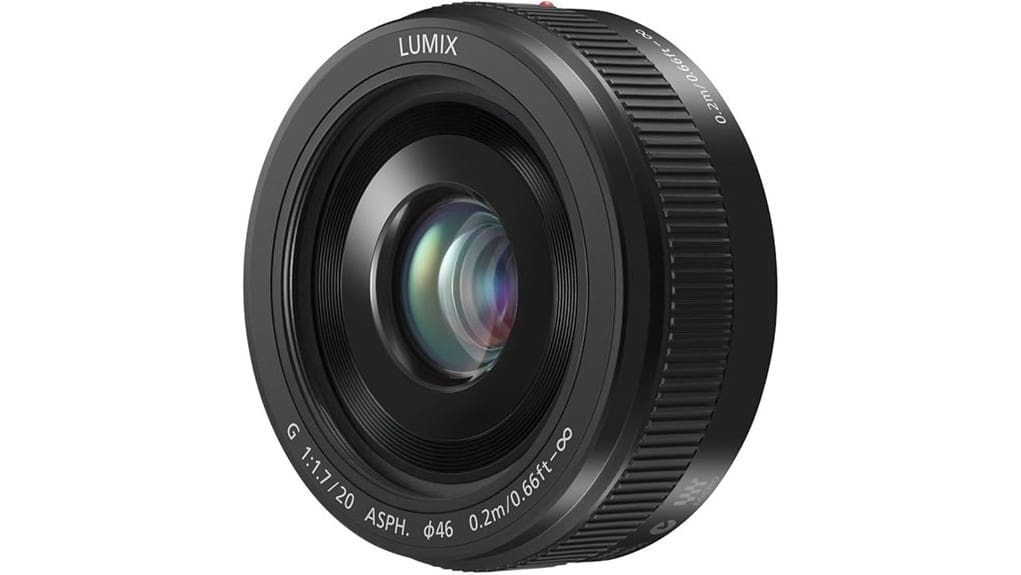
If you shoot Micro Four Thirds and want a compact, fast normal prime, the Panasonic LUMIX G II 20mm F1.7 is a smart choice. It gives a 40mm-equivalent field of view, strong center sharpness at F1.7 that tightens by F2.8–F4, pleasing bokeh, and reliable low-light performance. The metal-plastic build feels solid, contrast AF is quiet and predictable, and 0.2 m close-focus adds versatility. Keep going and you’ll find detailed image samples, handling notes, and alternatives.
Some Key Takeaways
- Compact 20mm F1.7 (40mm equivalent) prime ideal for Micro Four Thirds street, travel, and environmental portrait use.
- Strong center sharpness at F1.7 with improved edge performance by F2.8–F4 and controlled chromatic aberration.
- Fast aperture provides reliable low-light performance and pleasing, natural bokeh for subject separation.
- Solid metal-and-plastic build and compact handling support discreet, all-day carry and confident operation.
- Contrast-detect AF on Lumix bodies is quiet, predictable, and close-focus to 0.2 m adds framing flexibility.
Quick Verdict: Who the Panasonic LUMIX G II 20mm F1.7 Is Best For
If you shoot on a Micro Four Thirds Lumix G body and want a compact, fast prime that handles everyday, street, and intimate portrait-style work, the Panasonic LUMIX G II 20mm F1.7 is for you. You’ll appreciate its small footprint, bright F1.7 for subject separation, and contrast-detection AF that stays unobtrusive during handheld streetwork. Choose it if you prioritize discretion, vintage rendering character, and the flexibility of a 40mm-equivalent field for environmental portraits and walkaround shooting. It rewards photographers who frame by movement, favor natural bokeh, and want a reliable, lightweight prime for daily use. This lens is an excellent addition to any kit focused on mirrorless cameras and everyday carry.
Key Specs at a Glance (20mm F/1.7, Size, Focus, Close-Focus)
While compact in form, the Panasonic LUMIX G II 20mm F1.7 packs clear, photographer-friendly specifications: a 20mm prime (40mm equivalent) with a bright F1.7 maximum aperture, seven elements in five groups, Micro Four Thirds mount, contrast-detection AF, a 0.2 m (0.66 ft) closest focusing distance and roughly 0.13x magnification (≈0.25x equivalent), all in a lightweight package meant for discreet, walkaround shooting. You’ll appreciate the small footprint in any size comparison: it sits appreciably smaller than many standard primes yet balances on compact bodies. Specs promise snappy focus, close-focus utility, and neutral color rendition for versatile everyday use. Perfect Tripods is a great place to find supporting gear for this lens, including compact tripods and accessories for tripod-focused photographers.
Real-World Image Quality: Sharpness, Bokeh, Low-Light Performance
Because the 20mm F1.7 balances a bright aperture with a compact optical design, you’ll find its real-world output both punchy and predictable: center sharpness is strong from wide-open, with fine detail resolving cleanly at F1.7 and improving slightly by F2.8–F4, while edges tighten up toward the mid-apertures. You’ll notice modest edge softness at F1.7 that diminishes by F4. Chromatic aberration is well controlled in most scenes, and coma control keeps highlights near corners usable for night work. Micro contrast gives images clarity and separation, and the fast aperture yields reliable low-light performance and pleasing bokeh for subject isolation. It’s also a great match for enthusiasts using lens mount adapters to adapt legacy glass to modern mirrorless bodies.
Handling and Autofocus: Size, Build, Focusing Speed, and Close-Focus Use
The LUMIX G II 20mm F1.7 keeps its compact optical strengths when you handle it: the metal-and-plastic construction feels solid without adding bulk, making the lens unobtrusive on any Micro Four Thirds body and easy to carry for street or all-day use. You get compact handling that’s deliberate — balance and weight feel intentional. The tactile build inspires confidence when mounting and adjusting. Contrast-based AF on Lumix bodies yields fast autofocus for most subjects, with quiet, predictable shifts. Close focus to 0.2 m lets you frame tighter than typical wides, though magnification remains modest for near-macro work. This lens is a strong example of why many photographers prefer prime lenses for improved sharpness and compactness.
Should You Buy It? Use Cases, Alternatives, and Value for Money
If you want a compact, sharp normal-angle prime that excels in low-light and street shooting, the Panasonic 20mm F1.7 is a very practical choice—its 40mm-equivalent field of view and bright F1.7 aperture give you natural framing and shallow depth of field without adding weight, and the solid metal-and-plastic construction plus responsive contrast AF make it a reliable everyday lens. You should buy it if you shoot street photography, casual portraits, or run-and-gun travel. It’s excellent for portrait lighting practice, pleasing background compression, and filmic vintage colorgrading workflows. Alternatives include 25mm F1.7 or 17mm primes; value is strong. The site focuses on helping photographers choose the best portrait camera lenses for their needs.
Some Questions Answered
Does It Accept Filters or Screw-On Accessories?
Yes — you can use screw-on accessories: the lens has a front filter thread (46mm on this model) so you can attach filters directly. You’ll find adapter compatibility if you need step-up or step-down rings to fit other filter sizes, and you can mount slim filters to avoid vignetting at wide apertures. Keep an eye on thickness for close focusing; bulky adapters or thick filters can affect handling and field of view.
Is It Weather-Sealed or Moisture-Resistant?
No, it isn’t weather-sealed. You won’t get factory weather sealing or notable moisture resistance from this 20mm prime, so you should avoid heavy rain or humid immersion. Rely on careful handling, lens caps, and camera-body sealing if available to protect internals. For long term durability, treat it gently, keep it dry and clean, and consider aftermarket protective covers; build quality is decent but not rated for outdoor wet conditions.
Can It Be Adapted to Non-Mft Cameras?
Yes — you can adapt it to many non-MFT cameras using a mount adapter, provided the target body has a longer flange distance than Micro Four Thirds. You’ll retain full optical quality but usually lose autofocus and electronic aperture control unless the adapter supports electronics. Check for an adapter that maintains correct flange distance to allow infinity focus. Expect manual focus and potential need for a tripod or focus peaking.
Is There Image Stabilization in the Lens?
No, it doesn’t have optical stabilization or in lens stabilization. You rely on your camera body’s sensor stabilization (IBIS) or faster shutter speeds to control shake. Given the compact 20mm focal length (40mm equivalent) and bright F1.7 aperture, you’ll get usable low-light performance and some depth-of-field control, but if your camera lacks IBIS, consider a tripod, higher ISO, or lenses that include optical stabilization for steadier handheld shots.
What Colors/Finishes Are Available?
You can get the lens in matte black and brushed silver finishes. You’ll find the matte black version most common, offering a stealthy, low-reflection look that blends with most Lumix G bodies. The brushed silver option gives a classic, slightly retro appearance and pairs nicely with lighter camera colors. Both finishes keep the compact, prime design and identical optical and mechanical specs, so your choice is purely aesthetic.