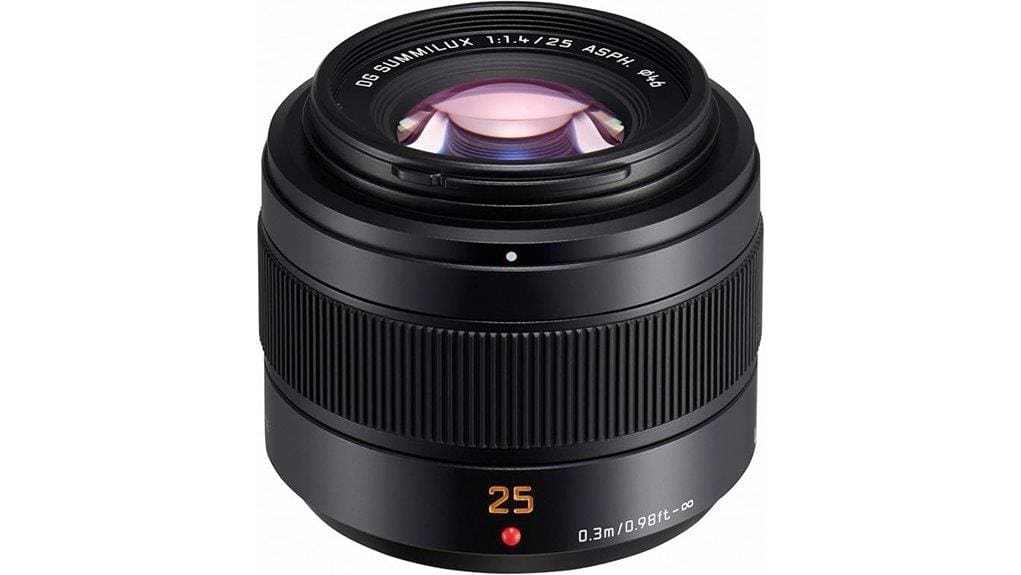
You’ll find the Panasonic LUMIX G Leica DG Summilux 25mm f/1.4 a compact, weather‑resistant prime that delivers outstanding center sharpness, creamy bokeh and low longitudinal CA for portraits and low‑light work. Its inner‑focus, stepping motor gives near‑silent, fast AF with minimal breathing, while Nano Surface Coating preserves contrast and reduces flare. There’s no optical stabilization, so rely on body IS for handheld video. If you want detailed tests, handling notes and comparison guidance, keep going for more.
Some Key Takeaways
- Exceptional center-to-corner sharpness, with corners improving significantly by f/2.8–f/4.
- Creamy bokeh and smooth defocus rendering make it excellent for portraits and low-light work.
- Fast, near-silent inner focus with stepping motor suits both stills and 4K video, with minimal focus breathing.
- Compact, weather-sealed metal/plastic build (≈12 oz) includes hood, caps, and 46mm filter compatibility.
- No optical stabilization; relies on body sensor-shift systems and retains good resale value as a Leica-branded optic.
Verdict: Should You Buy the Panasonic LUMIX G Leica DG Summilux 25MM F/1.4?
While the lens isn’t cheap, you should consider buying the Panasonic LUMIX G Leica DG Summilux 25mm f/1.4 if you want a compact, high-performance standard prime that delivers sharp center-to-corner resolution, smooth defocus rendering, and reliable AF for both stills and 4K video. You’ll find market demand steady among Micro Four Thirds shooters who value optical quality over size. Assess long term resale realistically: Leica-branded optics often hold value, though competing mounts can command higher prices. Read user testimonials for consistency on AF and bokeh. If you prioritize image character and video usability, buy it. This lens pairs especially well with mirrorless camera systems favored by enthusiasts.
At-A-Glance Specs and Build: What the 25MM F/1.4 Offers Physically
Examine the 25mm f/1.4 and you’ll notice a compact, thoughtfully engineered standard prime aimed at Micro Four Thirds shooters who need both portability and optical performance. You get a metal-and-plastic chassis with dust- and splash-resistant sealing, 46mm filter compatibility and a supplied hood and caps. The internal focus and 7-blade diaphragm support smooth operation without extending the barrel, contributing to lightweight handling (about 12 ounces). Controls are minimal but well-placed; tactile controls include a crisp manual-focus ring and reliable mount. Overall, the physical package balances durability, ergonomics and practicality for everyday use. This lens is a great match for photographers who use monopods for improved stability and mobility with compact rigs monopod stability.
Image Quality Deep Dive: Sharpness, Bokeh, Coatings, and Optical Quirks
Because Panasonic built this 25mm f/1.4 around a compact, high-quality optical formula, you’ll see its strengths immediately: excellent center resolution even wide open, strong corner performance that tightens noticeably by f/2.8–f/4, and generally neutral contrast that benefits from the Nano Surface Coating to cut flare and maintain micro-contrast in backlit scenes. You’ll notice minimal longitudinal chromatic aberration stopped down, with only slight purple fringing in extreme highlights at f/1.4. Bokeh shapes stay roundish with seven blades, producing creamy highlights and smooth gradation zones. Minor onion-ring texture appears rarely; overall rendering is controlled and pleasing. This lens is a great match for photographers who use reflectors to shape light and want consistent results from a compact setup, especially when paired with white photo reflectors.
Handling and Performance: Autofocus, Video Use, Stabilization, and Weather Resistance
Although compact, the Panasonic LUMIX G Leica DG Summilux 25mm f/1.4 feels purposeful in hand and lets you focus quickly and quietly thanks to its inner focus drive and stepping motor — you’ll notice smooth, near-silent AF that pairs well with high-speed contrast-detect systems and sensor drives up to 240 fps. You get fast focusing and quiet operation useful for run-and-gun shooting and controlled studio work. Video centric features include minimal breathing and consistent focus tracking for 4K capture. Stabilization claims are limited: the lens provides lens-level information but relies on body or sensor-shift systems for effective compensation. For shooters wanting to monitor results or exposure in real time, pairing the lens with an external camera monitor can improve framing and focus accuracy, especially during video work with external camera monitors.
Buying Guidance: Who This Lens Suits, Value vs Alternatives, and What’s Included
When you’re weighing whether the Panasonic LUMIX G Leica DG Summilux 25mm f/1.4 is the right purchase, focus on how its strengths match your shooting priorities: its fast f/1.4 aperture and high-resolution center-to-corner rendering make it ideal for portraiture, low-light work, and video where shallow depth of field and smooth bokeh matter, while its compact, weather-resistant build and near-silent stepping-motor AF suit run-and-gun or hybrid photo/video use on Micro Four Thirds bodies. You’ll value portrait suitability and video performance; compare price comparison results against faster primes and third-party 25–45mm options. Included: lens cap, rear cap, hood, storage bag. Consider pairing it with a sturdy tripod head to fully exploit its sharpness and compose precise shots with tripod heads.
Some Questions Answered
Is This Lens Compatible With Full-Frame Cameras via Adapter?
No — you can’t use it on full frame bodies without compromises. The Micro Four Thirds lens has an image circle sized for MFT, so with an adapter you’ll get vignetting or heavy crop; adapter compatibility lets you mount it, but crop factor and image circle limit coverage. You’ll need to crop or expect dark corners, and autofocus/metadata may be limited depending on the adapter and camera firmware. It’s best kept on MFT.
Can I Use Third-Party Filters Like Polarizers and ND With It?
Yes — you can use third-party filters like polarizers and ND with this lens. You’ll enjoy broad filter compatibility and accessory options thanks to its 46 mm thread. Choose high-quality, slim-profile filters to avoid vignetting at wide apertures and preserve sharpness. Test coatings to minimize flare and color cast. For rugged use, guarantee proper sealing when mounted and keep filters clean to maintain the lens’s optical performance and bokeh characteristics.
Does the Lens Maintain Focus Breathing During Video Zoom-Like Moves?
No — you’ll notice minimal focus breathing during video zoom-like moves; the lens controls focus breathing well, keeping framing stable as you rack focus. That said, slight aperture shift can occur at wide f/1.4 if you change exposure or stop down, subtly altering depth of field and perceived magnification. Overall it’s well-behaved for cinematic work, but monitor focus and exposure when doing long, critical focus pulls.
Are Firmware Updates Available for This Lens Model?
Yes — firmware availability exists occasionally for this lens through Panasonic. You’ll check Panasonic support for firmware availability and follow manufacturer update procedures posted for Micro Four Thirds lenses. You’ll download the correct firmware, confirm the lens model H-XA025 and battery/camera requirements, then install via a compatible Panasonic body or PC tool per instructions. You’ll verify version post-update and follow any rollback or help guidance if issues arise.
How Long Is the Typical Manufacturer Warranty Period?
Typical warranty periods are usually one year from purchase, but you should check your retailer and region since warranty variations occur. You’ll want to verify the exact coverage, what’s included (parts, labor) and any registration requirements. For extended protection you can often buy additional plans. Keep purchase receipts and serial numbers; they’ll help if you need service. Manufacturer warranty terms and claim procedures vary by country and seller.