You’ll get pro-level ultra-wide performance with the Sigma 14–24mm f/2.8 DG DN Art: strong center sharpness across the zoom, peak microcontrast at f/4–f/8, and good coma control for stars. Autofocus on Sony E bodies is fast and reliable, build is weather-sealed and well-balanced, and bundled accessories add immediate value. Expect some corner variability and minor 14mm distortion corrections in software. If you want detailed comparisons, performance charts, and real-world use cases, keep going.
Some Key Takeaways
- Delivers consistently strong center sharpness across 14–24mm with peak microcontrast and resolution at f/4–f/8.
- Fast f/2.8 aperture enables low-light, astrophotography, interiors, wildlife, and sports versatility.
- Excellent coma control and compact star rendering make it well-suited for astrophotography.
- Solid build, weather sealing, damped controls, and useful bundled accessories improve out-of-box value.
- Minor edge softening at 14mm and slight field curvature/distortion may require software correction.
Real-World Verdict: Is the Sigma 14–24mm F/2.8 DG DN Art Worth It?
Cutting to the chase, if you need a fast, ultra-wide rectilinear zoom for Sony E full-frame bodies, the Sigma 14–24mm f/2.8 DG DN Art delivers optical performance that matches or narrowly outperforms many native options while costing less and bundling useful accessories. You’ll appreciate its low light versatility at f/2.8 for astrophotography and interiors, and supplied accessories improve out-of-the-box utility. Compared to native rivals, you get similar control over distortion and chromatic aberration; watch for subtle field curvature effects at extreme edges and close focus. Overall, you obtain excellent value when weighing performance, build, and the included bundle. This lens is especially appealing to those focused on wildlife and sports photography where reach and sharpness matter.
Sharpness and Optical Performance at 14–24mm and F/2.8–F/22
When you shoot between 14–24mm at f/2.8 the Sigma DG DN Art delivers impressively consistent center sharpness across the zoom range while the extreme corners show the greatest variability, particularly at the widest 14mm end where slight softness and field curvature are noticeable. You’ll find peak microcontrast and resolution at f/4–f/8, with diffraction reducing fine detail toward f/22. Lateral edge distortion remains well-controlled for rectilinear correction, though you’ll apply minor software tweaks at 14mm. Coma control is strong for astrophotography, keeping stars compact near the frame edges. Overall optical performance is competitive with class leaders. This makes it a great choice for photographers who want to master wide-angle lenses for landscape and architectural work.
Autofocus, Handling, Weather Sealing, and Build Quality on Sony E Bodies
After evaluating its optical performance, you’ll notice the Sigma 14‑24mm f/2.8 DG DN Art pairs that resolving power with a fast, reliable AF system on Sony E bodies. You get fast autofocus performance with minimal hunting on A7-series cameras; tracking is consistent compared with earlier third‑party wide‑angles. Handling is straightforward: the zoom and focus rings offer tactile controls with damped resistance that aid precise adjustments. Weather resistance and robust construction are evident—sealed mount and solid barrel materials resist moisture and dust better than consumer-grade lenses. Mount rigidity and balance on smaller bodies are favourable, yielding professional tactile feedback during prolonged use. Many photographers who value ergonomic support often complement this lens with camera shoulder rigs for improved comfort during long shoots.
Who Should Buy It: Use Cases, Pros/Cons, and Value With Included Bundle Accessories
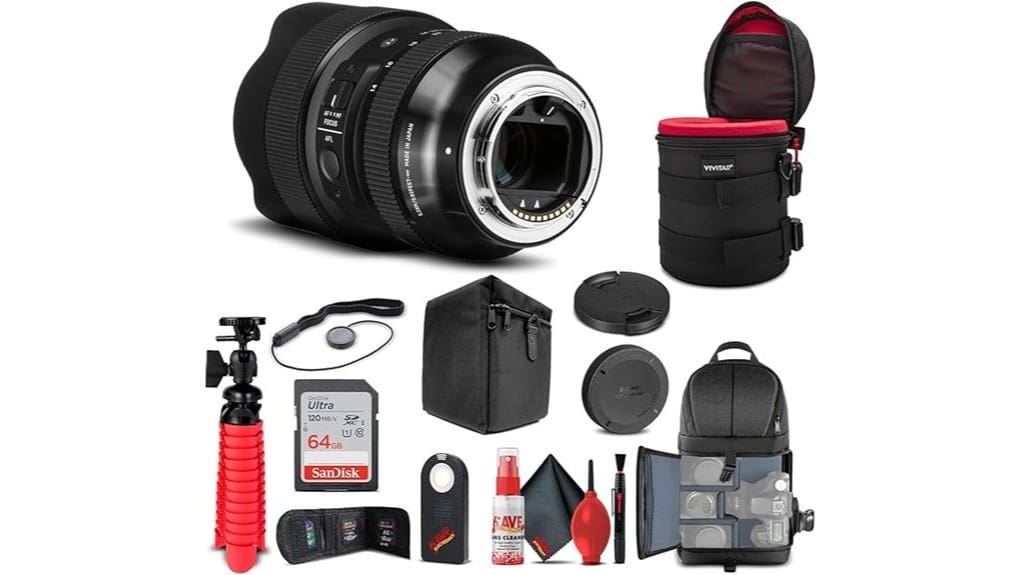
Although the Sigma 14–24mm f/2.8 DG DN Art is tailored to professionals and serious enthusiasts, you’ll find its combination of optical sharpness, robust build, and fast AF makes it a compelling choice for landscape, architecture, astrophotography, and environmental interior work on Sony E bodies. You should buy it if you prioritize edge-to-edge resolution for landscape photography, require distortion control for architecture detailing, or want low-light reach for astrophotography tips. Bundle accessories—case, sling pack, remote, tripod, cleaning kit, SD card—raise out-of-box value and portability for travel shooting. Downsides: size, weight, and cost versus narrower-angle alternatives. This gear is ideal for photographers who favor mirrorless camera systems and want accessories that match their compact workflows.
How It Compares to Rivals (Sony FE 12–24/14–24, Tamron 17–28) and Final Buying Recommendation
Because you’ll be weighing sharpness, focal range, and size against cost and system fit, it helps to compare the Sigma 14–24mm f/2.8 DG DN Art directly to Sony’s ultra-wide options and Tamron’s lightweight zooms to see where it stands. You’ll find Sigma delivers edge-to-edge sharpness close to Sony’s FE 12–24/14–24 while beating Tamron’s 17–28 at wider angles. Chromatic aberration is well controlled; flare resistance rivals Sony’s coatings. The bundled accessories improve immediate usability versus competitors. Check user testimonials for real-world handling and factor likely resale value—Sigma tends to retain value but not quite at Sony OEM levels. The site also offers a range of related camera accessories for enthusiasts, making it easy to find complementary gear like filters and cases related accessories.
Some Questions Answered
Is This Lens Compatible With APS-C Sony Bodies Without Vignetting?
Yes — you can use it on APS-C Sony bodies, but you’ll see corner cropping compared with full-frame coverage and a noticeable focal shift in effective field of view (about 1.5x). On APS-C the 14–24mm behaves like a ~21–36mm equivalent, reducing extreme ultra-wide perspective and corner illumination; vignetting is minimal once cropped, yet edge sharpness and microcontrast differ compared to full-frame, so evaluate trade-offs for wide-angle needs.
Does the Package Include a Lens Hood and Front/Rear Caps?
Yes — the package includes lens caps, and it typically ships with a lens hood as part of standard accessory sets. You’ll get front and rear lens caps for protection; the hood attaches to reduce flare and protect the front element. Compared to bare-lens purchases, this bundle adds protective and optical accessories, matching expected retailer kits. You’ll still want the premium lens case and cap keeper included for added security and convenience.
Can the Lens Be Used for Astrophotography Effectively?
Yes — you can use it effectively for astrophotography. You’ll get excellent star field sharpness across much of the frame, superior coma control compared with older ultra-wides, and a fast f/2.8 aperture that helps with light pollution resilience. Its wide field stacking performance is strong for panoramas and mosaics, though you’ll still compare results to dedicated astro primes for ultimate pinpoint stars and minimal vignetting.
What Warranty Length and Manufacturer Coverage Are Provided?
You get a limited warranty from the manufacturer, typically one year covering defects in materials and workmanship; you should register the lens to confirm exact terms. You can buy extended protection through the retailer or third-party plans to lengthen coverage and include accidental damage, often up to two or three additional years. Compare exclusions, service turnaround, and authorized repair networks to decide which extended protection best matches your shooting risk profile.
Are There Any Firmware Updates Needed for Sony Camera Compatibility?
Yes — you should check for firmware compatibility updates. You’ll often need Sony camera firmware updates to guarantee peak autofocus performance and full communication with third‑party lenses. Compare your camera’s current firmware against Sony’s release notes and Sigma’s lens firmware advisories; newer body firmware typically improves AF speed, tracking and stability. If discrepancies exist, update the camera first, then the lens (via Sigma’s recommended procedure) to maximize compatibility.