The Sony a6400 gives you fast, reliable autofocus, compact handling, and 4K video in a travel‑friendly mirrorless body that suits vloggers and enthusiasts. You’ll get detailed 24MP images, Real‑Time Eye AF, 11 fps bursts, and S‑Log3/HLG for grading, though stabilization depends on lenses and long takes can heat up. Battery life is modest, so pack a spare; the kit lens and accessories make it travel‑ready. Keep going to see practical tips, trade‑offs, and best kit choices.
Some Key Takeaways
- Compact APS‑C mirrorless ideal for beginner vloggers and travel photographers seeking versatile photo/video performance.
- 24.2MP sensor with BIONZ X delivers detailed stills, good dynamic range, and controlled noise at typical ISOs.
- Fast, reliable AF with 425 points, Real‑Time Eye AF/Tracking, and 11 fps continuous shooting for action and portraits.
- Internal UHD 4K up to 30 fps with S‑Log3/HLG; rolling shutter and heat limit long, fast‑panned video takes.
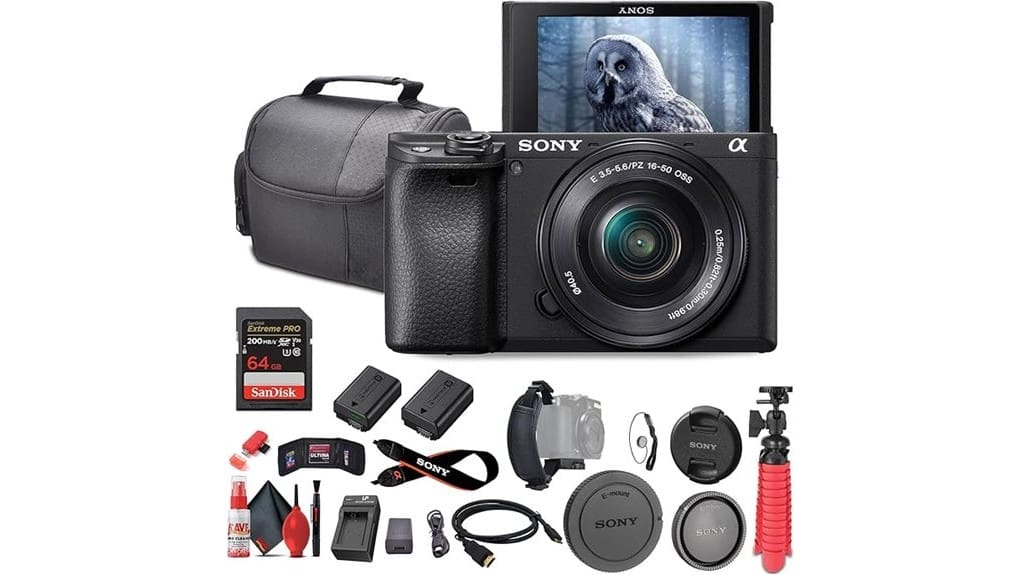
- Practical travel bundle includes 16–50mm OSS lens, spare battery, charger, case, and 64GB card; bring extra battery and stabilization.
Who the Sony a6400 Is Best For and What Questions This Review Answers
Who is the a6400 aimed at? You’re likely a beginner vlogger, travel photographer, or enthusiast who wants compact versatility without sacrificing image quality. This review answers whether the a6400 handles everyday photo and video needs, how usable its autofocus and shooting modes are in real situations, and if the kit lens plus included accessories cover travel setups. You’ll learn about battery life, ergonomics, connectivity, and bundle value—what’s in the box and what you’ll still need. It won’t dive deep into sensor, AF technical specs, video codecs, or stabilization performance here; those follow in later sections. We also highlight essential add-ons for mirrorless users like extra batteries and compact lenses that complement the a6400.
Key Specs That Determine Real‑World Performance (Sensor, AF, Video, Stabilization)
Because real-world results come down to how the sensor, autofocus, video features, and stabilization work together, you should evaluate the a6400 by how those systems perform in everyday shooting rather than just by specs alone. Its 24.2MP APS-C sensor and BIONZ X processor deliver good dynamic range and low‑noise files, useful for recovery and grading. AF system—425 phase/contrast points with Real‑Time Eye AF—keeps subjects sharp in motion. 4K internal recording, S‑Log3/HLG support, and modest rolling shutter affect video choices. Stabilization relies on lens OSS, so expect varied effectiveness depending on lens and shooting technique. For enthusiasts and camera fans, this model fits well in a broader gear guide for mirrorless options.
How the a6400 Performs for Stills: Autofocus, Image Quality, and Low‑Light Shooting
Having covered how the sensor, AF, video, and stabilization interact, let’s look specifically at stills: the a6400’s 24.2MP APS‑C sensor and BIONZ X engine produce detailed files with good dynamic range and controlled noise, and the camera’s autofocus system—425 phase/contrast points with Real‑Time Eye AF and Real‑Time Tracking—keeps moving subjects sharply rendered for most everyday scenarios; combined with 11 fps continuous shooting and responsive AF‑C, you’ll capture action reliably, while low‑light performance holds up well up to moderately high ISOs thanks to noise suppression that preserves color and detail, though aggressive exposure recovery or extreme ISO pushes will reveal some grain and reduced fine detail.
You get dependable phase detection-driven focusing and accurate eye autofocus for portraits. Fine detail and color remain strong at typical ISOs; push to high iso and noise performance declines predictably. Overall, for stills the a6400 balances speed, accuracy, and usable low‑light output for most enthusiast needs. Many photographers pair the body with external tools like lens calibration to eke the best focusing performance from their lenses.
How the a6400 Performs for Video: 4K, S‑Log3/HLG, Codecs, and Recording Limits
While the a6400’s 4K capabilities give you sharp, detailed footage, its real strengths are flexible picture profiles and reliable codecs that suit both run‑and‑gun and graded workflows. You get internal UHD 4K (up to 30 fps) in MP4/MOV, with S‑Log3 and HLG for extended dynamic range and cleaner color grading. Codec options are modest but dependable for editing; expect 8‑bit internal files. Rolling shutter is noticeable with fast pans, so plan movements or use stabilization. Sony’s heat management is decent for typical shoots, though long continuous 4K takes can still trigger limits—monitor recording time. Consider using an external monitor for better framing and exposure when shooting outdoors or in demanding setups external camera monitors.
Handling, Controls, Battery Life, and the Included Accessory Bundle
The a6400’s responsive autofocus and 4K features are only part of the story when you pick it up: its handling, control layout, and included accessories shape the day‑to‑day shooting experience just as much. You’ll find logical button placement and a compact control cluster that keeps settings reachable without shifting your grip. Grip comfort is adequate for short shoots; add the included hand grip strap or deluxe soft case for longer sessions. Battery life with the NP‑FW50 runs about two hours; the extra replacement battery and external charger in the bundle reduce downtime. Menu navigation is swift. Heat management is acceptable for typical clips. For longer outings, consider carrying a spare NP‑FW50 replacement battery to extend shooting time.
Strengths and Trade‑Offs Compared to Competing Mirrorless Cameras
Although it doesn’t lead the pack in every metric, the a6400 gives you a compelling mix of speed, image quality, and portability that beats many rivals for hybrid shooters; its 24.2MP APS‑C sensor with BIONZ X processing delivers clean high‑ISO performance and 4K capture, the Real‑Time Eye AF and 11 fps burst are class‑leading for its segment, and the compact body plus included accessories (extra battery, charger, 64GB card, 16–50mm OSS lens) make it a ready‑to‑shoot package. You’ll appreciate low autofocus latency and stellar tracking, plus versatile video features. Trade‑offs include modest build durability and limited in‑body stabilization compared with higher‑end models. Consider pairing the camera with an on‑camera LED light for improved low‑light and portrait shooting on-camera LED lights.
Buying Recommendations: When to Pick the a6400, Best Kit Options, and Final Verdict
If you want a fast, compact hybrid that handles both stills and 4K video without a steep learning curve, the a6400 is a smart pick. You should choose it if you need reliable Real-Time Eye AF, 11 fps shooting, and a lightweight kit for travel or vlogging. Best kit options pair the 16–50mm PZ lens bundle with a spare NP-FW50 battery, 64GB card, and a small gimbal or microphone. Factor in upcoming accessories and strong resale value when buying used. Verdict: versatile, cost-effective, and future-proof for enthusiasts who prioritize autofocus and portability. Consider pairing the camera with essential DSLR accessories like compact tripods and protective cases to complete your travel kit.
Some Questions Answered
Does This Bundle Include a Warranty Extension Option?
No, the bundle only includes a 90-day limited warranty and doesn’t list a warranty extension option. You should check warranty transferability with the seller before buying, since transfer rules can vary. If you want longer coverage, ask about extended service plans or buy one separately from the retailer or a third-party provider. Keep receipts and serial numbers handy to simplify claims or potential transfers later on.
Is the 64GB Card Uhs‑Ii or Uhs‑I Rated?
The 64GB card included is UHS‑I rated, not UHS II. You’ll get standard UHS II compatibility when you insert an actual UHS‑II card, but the bundle card itself won’t reach those top speeds. If you need faster write/read for heavy 4K or burst Speed benchmarking, swap to a genuine UHS‑II card from a reputable brand. That’ll improve sustained performance for video and high‑frame‑rate continuous shooting.
Can the Np‑Fw50 Be Charged In‑Camera via USB?
Yes — you can charge the NP‑FW50 in‑camera via USB, but be aware of battery charging and USB limitations. The a6400 accepts USB power for in‑camera charging with the supplied AC adapter and cable, letting you top up the 1020 mAh cell when away from a desktop charger. Charging is slower than dedicated external chargers, and some third‑party cables or power banks might not support consistent charging or fast recharge.
Are Third‑Party Lenses Compatible Without Functionality Loss?
Yes — you can use many third‑party lenses on the a6400, but third party compatibility varies and you may see limits in lens communication. You’ll get basic exposure and autofocus with well‑updated Sony E‑mount third‑party glass, yet advanced features like Real‑Time Eye AF, full AF-C tracking, or in‑camera lens corrections can be inconsistent. Check vendor firmware updates and compatibility lists to verify full functionality before you buy.
Does the Kit Include a Screen Protector for the LCD?
No, the kit doesn’t include a screen protector for the LCD. You’ll want to buy a compatible screen protector separately; look for tempered glass or PET film sized for the 3.0″ 921.6k-dot tilting touchscreen. Installation tips: clean the screen with the supplied cleaning kit, align carefully using a dust-free environment, apply from one edge to avoid bubbles, and use a soft card to smooth out remaining air. Keep dust away during fitting.