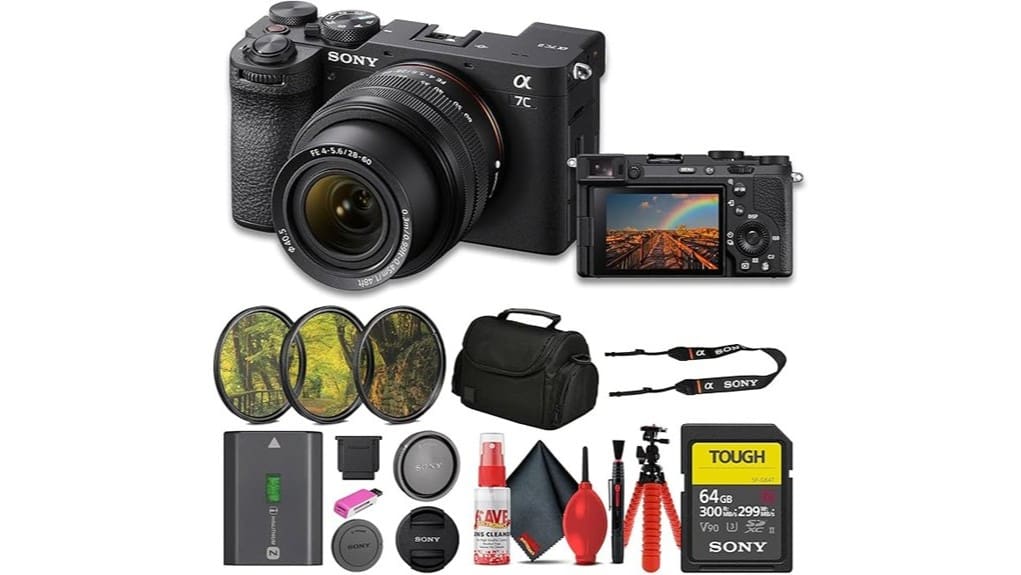
You’ll find the Sony a7C II a compact full‑frame hybrid that packs a 33MP back‑illuminated sensor, BIONZ XR processing, and a 759‑point phase‑detect AF for reliable tracking and Eye AF. It gives 10 fps stills, IBIS rated to 7 stops, and internal 10‑bit 4K30 with S‑Log3/S‑Cinetone for flexible grading. Battery uses NP‑FZ100 with USB‑C charging and a single UHS‑II slot; keep going to see practical workflow and kit trade‑offs.
Some Key Takeaways
- Compact full-frame mirrorless body with 33MP back-illuminated sensor balances high-resolution stills and portable handling for hybrid shooters.
- BIONZ XR processor and 759-point PDAF deliver fast 10 fps bursts, reliable Eye AF, and wide-frame subject tracking.
- Video-ready: internal 10-bit 4K30 with S-Log3, S-Cinetone, clean HDMI, and user LUT support for flexible grading.
- IBIS up to 7 stops and good high-ISO control enable handheld low-light shooting, though single SD card slot limits redundancy.
- Vari-angle touchscreen, USB-C charging, and strong accessory compatibility make it ideal for travel, vlogging, and event coverage.
Quick Verdict and Who Should Buy the Sony a7C II
While compact in a full-frame body, the Sony a7C II delivers serious stills and video chops: its 33MP back-illuminated sensor and BIONZ XR processor give you high-resolution images, 10-bit 4K30 video with S-Log3/S-Cinetone, and 759-point phase-detect AF covering about 94% of the frame, all backed by up to 7 stops of in-body stabilization. You’ll appreciate its compact portability and balanced ergonomics if you’re an enthusiast hybrid shooter who toggles between run-and-gun video and detailed still work. It’s optimized for travel, vlogging, and event coverage where size, AF reliability, and versatile video codecs matter. The camera pairs well with lightweight lenses popular among mirrorless camera enthusiasts for maintaining portability without sacrificing image quality.
Key Specs That Matter: Sensor, AF, Stabilization, and Battery Life
Start by looking at the a7C II’s core hardware: a 33MP back-illuminated full-frame Exmor R sensor paired with Sony’s BIONZ XR processor, which together deliver high-resolution files, strong low-light performance across a native ISO range of 100–51,200 (expandable 50–204,800), and support for JPEG and RAW capture plus 10-bit video modes. You’ll get modern sensor chemistry that boosts full frame dynamics and low-noise latitude. Autofocus employs 759 phase-detection points for extensive autofocus coverage (~94%), hybrid AF fine-tuning, and reliable tracking. In-body stabilization offers a manufacturer stabilization rating of up to 7 stops. Battery life uses the NP-FZ100 cell. Consider pairing the a7C II with an external monitor for improved framing and exposure control during shoots, especially when using external camera monitors.
Still-Photo Performance in Real-World Shooting (Speed, ISO, AF Accuracy)
Having covered the a7C II’s sensor, processor, AF architecture, and stabilization, let’s examine how those pieces perform when you’re shooting stills in the real world. You’ll get 10 fps burst mode with AF/AE, sustained by the BIONZ XR and fast buffer on UHS-II cards; frame-to-frame latency is minimal. The 759-point PDAF and hybrid AF deliver precise focus tracking and reliable eye AF for portraits and moving subjects. Noise handling up to native ISO 51200 is competent—clean midtones, controlled fine-grain at higher ISOs. IBIS reduces shutter speed requirements, improving hit rate and sharpness in low light. For photographers who meter manually or want consistent exposures across setups, pairing the camera with a dedicated light meter can improve accuracy and workflow.
Video Capabilities and Workflow (4K 10-Bit, S-Log3, Inputs, and LUTs)
Because the a7C II records 10-bit 4K internally up to 30p and supports S-Log3, S-Gamut3 and S-Cinetone, you get a professional-grade capture pipeline that preserves color depth and grading latitude for demanding workflows. You’ll record 4K files with ample headroom for 4K grading, and the camera accepts user LUTs to preview graded looks in-camera and speed color decisions on set. HDMI inputs provide clean output to external recorders and monitors, while onboard 10-bit capture reduces reliance on external hardware. Audio monitoring via the accessory shoe and mic input guarantees sync and level control during takes. For run-and-gun setups where lighting needs to be adjusted quickly, pairing the a7C II with bi-color video lights offers flexible color temperature control and consistent illumination for both photo and video shoots, making setup faster and results more reliable with bi-color video lights.
Ergonomics, Lens Kit Value, Battery/Card Practicalities, and Final Pros & Cons
While compact and deceptively simple at first touch, the a7C II’s ergonomics put deliberate compromises and strengths in clear relief: the reduced-body form factor and vari-angle touchscreen make handheld shooting and vlogging comfortable for extended periods, but the smaller grip and control spread will feel cramped with larger telephoto lenses or gloved hands. You get excellent compact handling and accessory compatibility for microphones and cages, plus kit versatility from the FE 28-60mm, tripod and filters. Charging logistics rely on the NP-FZ100 and USB-C power; storage management is single SDXC slot with fast UHS-II card. Pros: image quality, stabilization; Cons: grip, single card. Perfect Tripods offers a selection of compatible tripod and accessory options to maximize the a7C II’s compact handling and stability.
Some Questions Answered
Does the a7C II Have Dual Card Slots for Extended Shooting?
No — the a7C II doesn’t have dual slots, so you can’t use dual slots for extended recording. You’re limited to a single SDXC card slot (UHS-II compatible) for stills and 10-bit 4K video, which constrains workflows that require simultaneous backup or overflow recording. For uninterrupted extended recording you’ll need external recording via HDMI or frequent card swaps; manage file sizes, recording limits, and battery/heat considerations when planning long shoots.
Is the Camera Weather-Sealed for Outdoor Use?
No, it’s not fully weather-sealed; the a7C II lacks official weather sealing, so you shouldn’t assume rugged protection. For outdoor durability, you’ll get some basic dust and splash resistance from careful construction, but it’s not rated for heavy rain or immersion. You should use protective measures—rain covers, sealed lenses, and careful handling—if you plan extended outdoor use in harsh conditions to avoid moisture and particulate damage.
Can the Included 64GB Card Sustain Prolonged 10-Bit 4K Recording?
Yes — the included 64GB SF-G Tough UHS-II card can record 10-bit 4K, but it limits continuous duration. You’ll hit card and battery life constraints quicker than storage capacity alone. Card endurance is high (fast write speeds ~299 MB/s) so dropped frames are unlikely, yet 64GB fills fast with 10-bit 4K footage. You’ll want extra high-capacity cards and spare batteries to sustain long recording sessions reliably.
Does the a7C II Support In-Camera RAW Video Recording?
No — the a7C II doesn’t record in camera RAW video; it captures 10-bit 4K internally in long GOP or XAVC S-I/HS formats and outputs RAW over HDMI to external recorders. You can implement an in camera RAW-like workflow by recording 10-bit internally while simultaneously outputting RAW to an external recorder, then use a proxy workflow to edit low-res proxies and relink to the external RAW for final color grading.
Is the Camera Compatible With Older Sony A-Mount Lenses Without Loss?
Yes — you can use older Sony A-mount lenses via adapters, but expect limitations without lossless native support. You’ll need adapter options (like the official LA-EA4/LA-EA5) to retain AF and aperture control; some adapters require flange calibration for best focus and infinity accuracy. You’ll get full-frame coverage and IBIS compatibility, but AF speed, PDAF accuracy, and lens metadata can vary depending on adapter firmware and lens electronic communication.