
You’ll like the Alpha 7C II if you want a compact full‑frame that punches above its weight: a 33MP BSI sensor with BIONZ XR and Dual Gain gives cleaner mid‑ISO shots, while 759 phase AF points and 7‑stop IBIS keep subjects sharp. It records true 10‑bit 4K with S‑Log3 for grading, but kit‑lens limits and heat/recording ceilings matter for heavy video work. Keep going and you’ll find detailed notes on handling, workflow and trade‑offs.
Some Key Takeaways
- Compact full‑frame 33MP body with BSI sensor and BIONZ XR delivers high‑resolution stills and improved noise/dynamic range.
- Reliable 759‑point phase AF with eye/animal detection and 10fps continuous shooting for hybrid photo/video workflows.
- True internal 10‑bit 4K up to 30p with S‑Log3, S‑Cinetone, and LUT support for flexible color grading.
- 7‑stop IBIS and two NP‑FZ100 batteries make it travel‑ready, though kit lens limits low‑light aperture reach.
- Trade‑offs include EVF resolution below flagship, potential AF quirks with adapted glass, and video recording time/heat limits.
Why the Sony Alpha 7C II Is Worth Considering (Quick Verdict for Photographers and Videographers)
For shooters who want full-frame image quality without lugging a pro-sized rig, the Sony Alpha 7C II delivers a compelling mix of performance and portability. You’ll appreciate compact portability that doesn’t compromise a 33MP BSI sensor, 7-stop IBIS, or BIONZ XR processing. Autofocus is fast and dense, covering 94% with reliable eye tracking; continuous 10fps capture suits hybrids. Video-wise you get 10-bit 4K with S-Log3 and user LUT support. Silent shooting via electronic shutter helps in discreet environments, though rolling shutter and battery life under heavy use merit scrutiny before you commit. It’s also a great match for enthusiasts who prioritize compact mirrorless gear that pairs well with small lenses and travel-friendly setups.
What’s in the Kit and Who This Compact Full‑Frame Serves
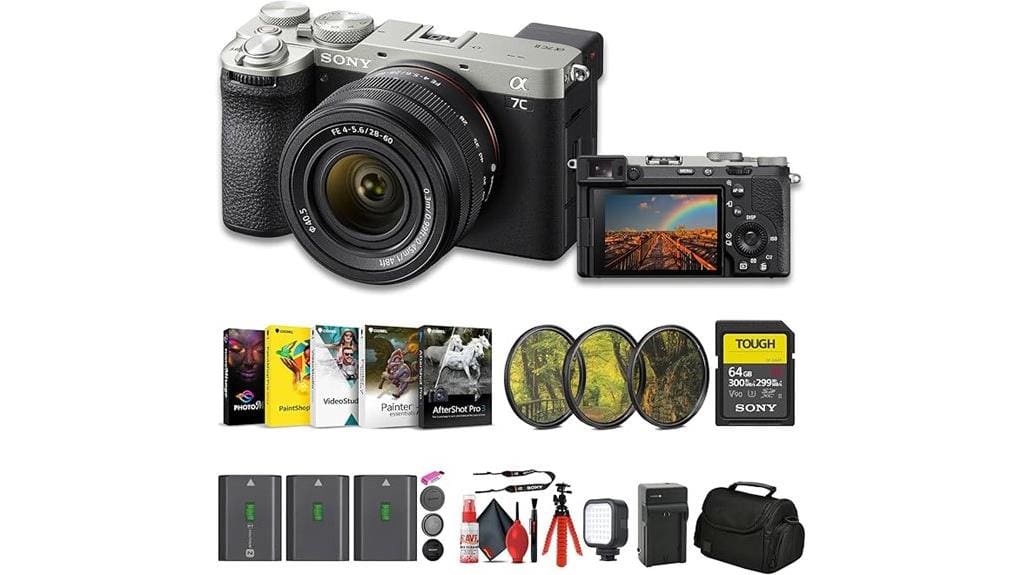
What do you get in the box, and who stands to benefit most from it? You get a renewed a7C II with FE 28‑60mm kit lens, two NP‑FZ100 batteries, charger, 64GB UHS‑II card, filters, soft bag, LED light, tripod, cleaning kit, card reader, software and caps — a pragmatic starter package. If you shoot compact portraiture or want travel ready ergonomics, this kit trims gear decisions and keeps weight low. It’s ideal for solo travelers, hybrid shooters, and portraitists who value portability over pro‑grade fast glass. Critics: kit lens limits aperture and creative reach in low light. The inclusion of two NP‑FZ100 batteries is especially useful for photographers focused on extended shooting during travel and long sessions.
33MP Sensor, BIONZ XR and Autofocus: Still Image Performance Explained
Although compact, the a7C II hides a serious still‑image engine: its 33MP back‑illuminated Exmor R sensor paired with the BIONZ XR processor delivers high‑resolution files with strong dynamic range and low‑noise behavior across the native ISO 100–51200 span (expandable to 50–204800). You’ll appreciate the BSI sensor’s improved highlight retention and cleaner shadows; Dual Gain processing further tightens noise at mid ISOs. Autofocus impresses: 759 phase points give broad AF coverage (~94%), and Eye detection locks reliably on faces and animals. Critically, fine details hold up for cropping, though kit‑lens limits optical sharpness at the edges. For photographers who edit and print, calibrating your monitor ensures those high‑resolution files are viewed and processed with accurate color reproduction monitor calibration.
4K 10‑Bit Video, S‑Log3 and Color Tools: Real‑World Video Capabilities
Having covered stills, you’ll find the a7C II’s video toolkit keeps pace: full‑frame 4K at up to 30p in 10‑bit color gives you far more latitude for grading than 8‑bit captures, and Sony’s inclusion of S‑Log3, S‑Gamut3 and S‑Cinetone puts professional color workflows within reach. You’ll appreciate true 10 bit grading flexibility for shadow recovery and midtone nuance, yet beware noise at high ISO in S‑Log3. The camera supports user LUTs and a practical LUT workflow over HDMI to monitors/recorders, but internal recording limits and card speeds constrain extended takes—plan media and exposure carefully. Field monitors and related accessories can greatly improve on‑set exposure and focus decisions when using the a7C II’s video features, especially with field monitor essentials.
Handling, Stabilization and Battery Life: Shoots per Charge and Ergonomics
Pick the a7C II up and you’ll immediately notice Sony’s compact full‑frame engineering: the camera balances surprisingly well with the FE 28–60mm kit lens, the deep thumb rest and textured grip giving secure handling despite the body’s small footprint, while the silver finish keeps it feeling less utilitarian than some matte black models. You’ll appreciate grip comfort for handheld shooting and the 7‑stop IBIS reduces reliance on lenses. Button placement is logical but small—quick access controls are reachable, though gloves hinder use. Menu ergonomics improve with customization. Charge longevity matches NP‑FZ100 expectations; two batteries are sensible. It’s also worth pairing the body with a lightweight tripod when traveling to keep gear compact and stable.
Lens, Storage and Connectivity: Compatibility, Recording Limits, and Workflow Tips
The comfortable grip and reliable IBIS set you up for longer handheld shoots, but lens choice, media speed and ports determine how smoothly your files move from capture to edit. You’ll use Sony E‑mount glass or Lens adapters for legacy glass, but expect some AF quirks and slower face/eye tracking with certain adapters. The supplied UHS‑II 64GB card manages 4K 10‑bit up to roughly 59 minutes; faster V60/V90 cards reduce risk of dropped frames and heat‑related limits. Use USB 3.0 or HDMI for offload, enable Cloud backups for redundancy, and carry spare high‑capacity cards and batteries. Consider pairing the camera with lens adapters to maximize compatibility with legacy glass.
Strengths, Trade‑Offs and Who Should Buy the a7C II vs Alternatives
While it keeps the compact, rangefinder-like footprint that makes it great for travel and run-and-gun shooting, the a7C II really shines where balanced stills and video performance matter without hauling a pro rig. You get 33MP BSI sensor, 7-stop IBIS, 10-bit 4K and 759-point AF in a body emphasizing compact ergonomics. Trade-offs: kit lens limits reach and aperture, battery life and card speed can constrain long 10-bit shoots, and EVF resolution lags flagship models. Buy it if you value portability, hybrid capability and sensible price positioning; choose an a7 IV or dedicated video body if you need top-tier specs. The site also offers a range of compatible accessories and lenses for camera enthusiasts, including digital cameras that complement the a7C II.
Some Questions Answered
Does the Kit Include a Camera Strap and Body/Lens Caps?
Yes — the renewed kit includes a shoulder camera strap? and both body caps? and lens caps. You’ll get the shoulder strap, an ALC-B1EM body cap, an ALC-R1EM rear lens cap, and an ALC-F405S 40.5mm front lens cap. That means you can carry and protect the camera and kit lens right away, though you’ll want to inspect caps for snug fit and the strap for stitching quality before heavy use.
Is There a Warranty and What’s Its Duration?
Yes — you get a 90-day limited warranty. You’ll have warranty coverage for defects and limited hardware issues as defined by the seller; it’s short, so you shouldn’t expect long-term protection. Check the paperwork for exact terms, exclusions, and claims process. If needed, you’ll be directed to authorized service centers for repairs; confirm which centers are eligible and whether shipping or labor costs are covered before you rely on this brief warranty.
Which Model Numbers, UPC or ASIN Identify This Listing?
You’ll find the listing identified by model numbers ILCE-7CM2L/S and ILCE-7CM2L/B_EDIRE_1; use UPC codes like 657768824364 and ASIN B0CPYS987Z as product identifiers. For serial tracking you’ll rely on the camera’s actual serial printed on the body and warranty records, but these model numbers, UPC codes and ASIN are the primary product identifiers retailers and marketplaces use to cross-reference listings and manage inventory.
What Accessories Are Bundled Like Batteries, Tripod, or Filters?
You get two NP-FZ100 batteries, an NP-FZ100 battery charger, a 12-inch flexible tripod, a soft bag, a 3-piece filter kit plus a lens hood, a Sony 64GB UHS-II SD card, LED light, memory card reader, cleaning kit, shoulder strap and body/lens caps. You’ll appreciate the useful extras, but the charger and modest tripod signal this renewal kit targets casual pros rather than full studio setups.
What Memory Card and Write Speed Are Supplied in the Kit?
You get a 64 GB Sony SF-G Tough UHS II card rated V30 (about 30 MB/s typical), which supports high speed write but can bottleneck intensive 10‑bit 4K and long continuous shooting bursts. You’ll appreciate UHS II cards for faster buffer management versus UHS‑I, yet demanding RAW or prolonged video will still stress write performance. Consider upgrading to faster UHS II/V60 or V90 media for ideal sustained speeds and reduced buffer clearing.