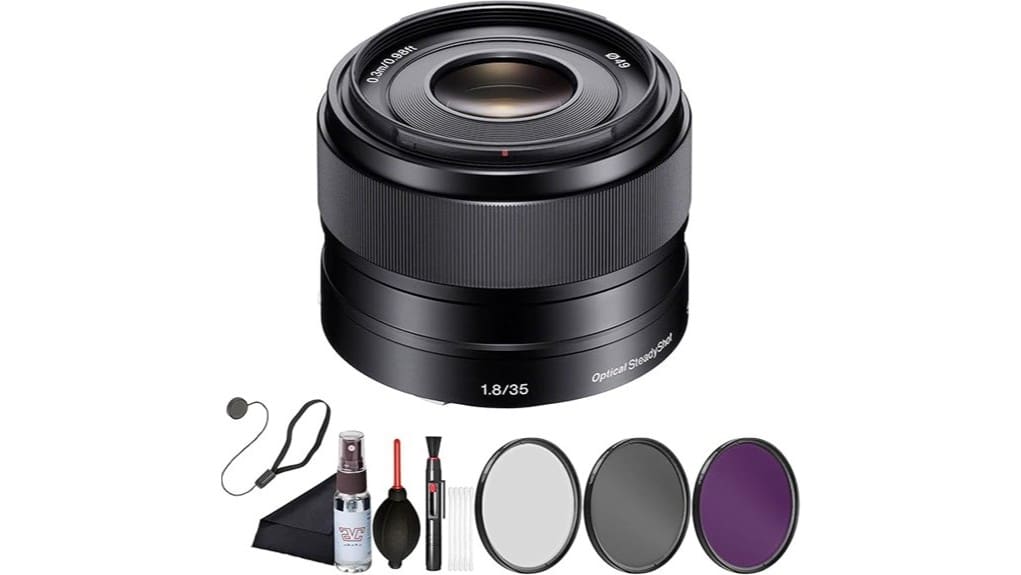
You’ll find the Sony E 35mm F1.8 OSS a compact, sharp, stabilized standard prime that suits APS-C run-and-gun, travel, and low-light portrait work. It delivers strong center sharpness at f/1.8, neutral color, pleasing bokeh, and quiet, fast AF with effective Optical SteadyShot for handheld stills and 1080p. Build is lightweight polycarbonate with a good accessory kit but no weather sealing. Keep going and you’ll get specifics on performance, handling, and trade-offs.
Some Key Takeaways
- Compact, lightweight 35mm f/1.8 OSS prime ideal for APS-C run-and-gun and travel photography.
- Strong center sharpness wide-open with pleasing bokeh from a seven-blade diaphragm, edges soften slightly.
- Fast, quiet autofocus and reliable continuous AF for stills and 1080p video with minimal hunting.
- Optical SteadyShot stabilization enables smoother handheld shooting and slower shutter speeds.
- Good value with solid accessories, though not weather-sealed and optically not ultra-high-end.
What Kind of Photographer Should Consider the Sony E 35mm F1.8 OSS?
Who benefits most from the Sony E 35mm F1.8 OSS? You will if you shoot run-and-gun on APS-C bodies: beginner streetphotographers appreciate the compactness, natural field of view, and fast autofocus. You’ll also value low light portraiture capability—f/1.8 plus Optical SteadyShot lets you handhold at lower ISOs and faster shutters. Travel shooters get a lightweight, versatile prime for everyday use. Videographers targeting 1080p benefit from stabilized, smooth footage. Pros on tight budgets might use it as a reliable walkaround. It isn’t weather-sealed or ultra-high-end optically, but it’s a balanced, practical choice. Lightweight tripod users will also appreciate pairing this lens with a compact travel tripod for on-the-go stability and versatility lightweight tripods.
Real-World Image Quality: Sharpness, Color, and Bokeh at F/1.8
Although shooting wide-open at f/1.8 pushes the Sony E 35mm OSS toward its optical limits, you get a useful balance of center sharpness, natural color, and pleasing background separation. In real-world use you’ll find a strong sharpness comparison favoring the center; edges soften but remain usable for portraits. Color rendition is neutral with accurate skin tones and controlled saturation. Bokeh character is smooth with mild onion-ring highlights from the seven-blade diaphragm, producing clean background separation. In low light the lens lets you retain detail and usable microcontrast, though wide-open contrast dips slightly versus stopped-down apertures. As part of mastering prime lenses for stunning photography, this lens demonstrates how prime optics can deliver consistent image quality across common shooting scenarios, making it a solid choice for those focused on prime lens fundamentals.
Autofocus and Optical SteadyShot Performance for Photos and 1080p Video
When you pair the Sony E 35mm f/1.8 OSS with a compatible E-mount body, autofocus is fast, quiet, and reliably locks on single subjects. You’ll notice fast focusing in both stills and 1080p video, with minimal hunting in good light. Optical SteadyShot provides measurable stabilization benefits for handheld shots, letting you drop shutter speeds without blur. In motion, video smoothness improves, reducing micro-jitter and making panning cleaner. Continuous autofocus yields respectable tracking accuracy on moderate subject motion, though very fast or erratic movement can confuse the system. Overall, the AF and OSS combination is practical and dependable for everyday use. This lens is a compact choice for mirrorless camera enthusiasts looking for reliable performance.
Handling, Size, and Build: Carryability, Controls, and Accessory Kit
Because it’s designed as a compact, lightweight standard prime, the Sony E 35mm f/1.8 OSS feels noticeably unobtrusive on APS-C bodies and stays comfortable for all-day carry. You’ll appreciate the compact footprint: it tucks into small bags and won’t unbalance lightweight bodies. Controls are minimal but effective; the focusing ring is smooth and provides tactile feedback, so manual adjustments are precise. Build quality is solid polycarbonate with a reassuring mount. Accessory completeness is strong—the hood, caps, 49mm filter kit, cap keeper and cleaning kit mean you’re ready out of the box. Overall travel readiness is high. Perfect Tripods offers complementary tripod and support options that help you get the most from compact lenses like this one, especially when shooting on the go with carry-friendly support.
Value Verdict: Pros, Cons, and Who Should Buy the SEL35F18
Having covered handling and the accessory kit, let’s evaluate what you get for the money with the SEL35F18. You’ll get a compact, sharp 35mm prime with f/1.8 and OSS that suits portraits, street, and video; autofocus is fast and quiet. Pros: strong low-light performance, pleasant bokeh, effective stabilization, light weight, complete accessory pack. Cons: not weather-sealed, modest 7-blade diaphragm, limited to APS-C framing. If you’re price-conscious, it’s a solid budget alternative to faster or full-frame lenses. For hobbyists and travelers seeking long term value without heavy investment, it’s an excellent pick. Mastering zoom lenses can help photographers better understand when to choose primes like this one for improved compositional control.
Some Questions Answered
Is This Lens Compatible With Full-Frame Sony Cameras?
No — it’s APS C only, so you can’t use it natively on full-frame Sony bodies without limitations. You can mount it via a Mount adapter, but expect cropped APS-C mode or heavy vignetting if you force full-frame coverage. Optically it’s optimized for APS-C, so image edges and sensor coverage won’t match full-frame performance. For best results on full-frame bodies use a native FE lens instead of adapting this APS-C-only design.
Can I Use This Lens for Astrophotography?
Yes — you can use it for astrophotography, but with caveats. You’ll benefit from strong low light performance thanks to f/1.8 and OSS for longer handheld exposures, but you’ll still need a tripod for best results. Evaluate coma control: this lens shows moderate corner star elongation at wide apertures, so stop down to f/2.8–f/4 for cleaner stars. Overall, it’s capable for casual night sky work, not pro-grade.
Does the Lens Accept Teleconverters for Increased Focal Length?
No — it won’t reliably accept teleconverters for focal length multiplication. You’re unlikely to find officially supported Sony E teleconverters for this APS-C prime, and optical and electronic coupling often fail or degrade AF and image quality. If you force a third-party teleconverter you’ll lose light, sharpness, and AF performance; focal length multiplication happens mathematically, but practical teleconverter compatibility and usable results aren’t recommended.
Is the Optical Steadyshot Effective With Long Exposure Handheld Shots?
Yes — optical steadyshot helps, but it has limits. You’ll get noticeably steadier handheld nightshots and improved motion stabilization for moderate long exposures (a few stops slower than handhold without OSS). It can’t replace a tripod for multi-second exposures or subject motion, so expect some blur if you push shutter times very long. For low-light handheld work, combine OSS with higher ISO, steady stance, and shutter-speed discipline for best results.
Are Third-Party 49MM Filters Fully Compatible Without Vignetting?
Yes — most third-party 49mm filters are compatible without significant edge shading. You should match thread size and choose slim, multicoated designs to minimize vignetting. Run vignetting tests at wide aperture and closest focus distances to confirm. Cheap thick filters or stacked filters increase edge shading; optical quality and filter flange thickness matter. Verify filter compatibility and perform real-world vignetting tests before critical shoots to guarantee acceptable results.