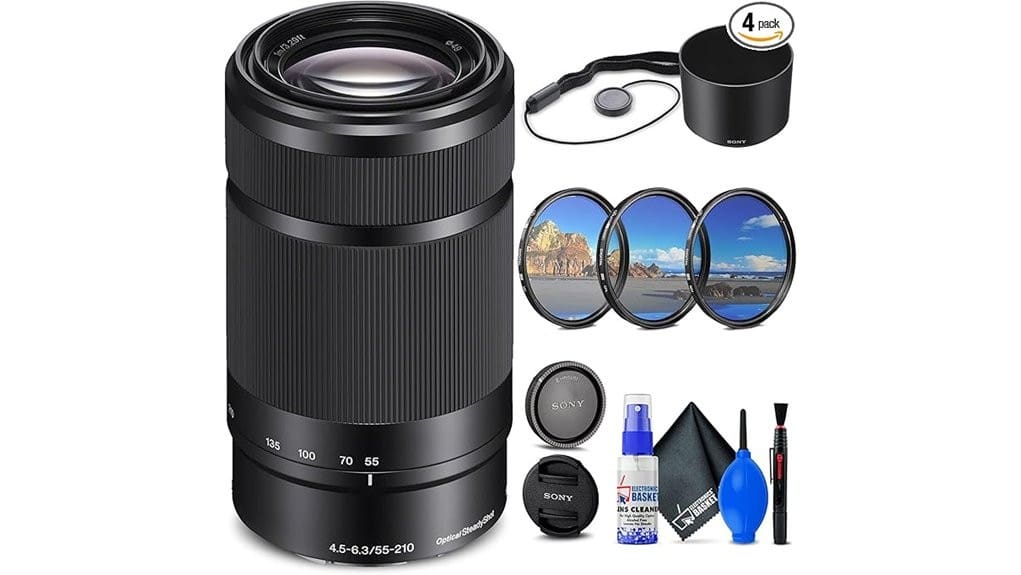
You’ll find the Sony E 55–210mm f/4.5–6.3 OSS is a compact, lightweight APS‑C telephoto that gives you extended reach and effective OSS for handheld long‑lens work. Build quality is utilitarian but solid, with smooth controls and secure mounts. Center sharpness is strong near 55mm and usable through mid‑tele; edges soften wide open toward 210mm but improve stopped down. AF is reliable for casual subjects. Keep going and you’ll get more on performance, handling, and buying tips.
Some Key Takeaways
- Lightweight, compact telephoto for APS‑C Sony E bodies, weighing ~1.46 lb and balancing well on small bodies.
- Good center sharpness at mid focal lengths (around 55mm); edges improve noticeably when stopped down.
- Narrow max aperture and diffraction limit ultimate resolution at long focal lengths, with mild chromatic fringing in high‑contrast areas.
- Reliable internal AF and OSS provide quick acquisitions, predictable tracking, and about 2–3 stops of handheld stabilization.
- Excellent value for hobbyists and travel shooters seeking reach, portability, and stabilization over pro‑level speed and sharpness.
Build Quality and Handling: What the Renewed Sony 55–210 Feels Like in Hand
Sony’s renewed 55–210mm feels light and deliberately utilitarian in hand, weighing about 1.46 pounds and balancing forward on APS‑C bodies rather than feeling top‑heavy. You note a textured finish on the barrel that aids grip without adding bulk. Controls are minimal: a smooth zoom ring and a modestly damped focus ring; both offer predictable resistance. Mount and zoom mechanisms operate without play, and the supplied hood and caps fit securely. Stabilization and autofocus switches are clearly labeled and reachable. Overall balanced ergonomics prioritize straightforward handling and portability for telephoto use on E‑mount APS‑C cameras. The straightforward design makes it a good match for photographers shopping for tripods and accessories, especially when paired with compact support for improved stability.
Optical Performance: Sharpness, Bokeh, and Aberration Control Across 55–210mm
After noting how the renewed 55–210 feels in hand, you can evaluate how that handling supports real-world image results across the zoom range. Center sharpness is strong at 55mm and remains usable through mid-tele; diffraction and the narrow maximum aperture reduce ultimate resolving power at longer focal lengths. You’ll notice some edge softness, particularly wide open toward 210mm, which tightens by stopping down a stop or two. The seven-blade diaphragm yields a creamy bokeh for subject separation, though highlights can show mild outlining. Chromatic fringing is well controlled by the ED elements but can appear in high-contrast edges at extreme telephoto. Keeping the camera sensor clean with proper tools like sensor swabs and cleaning kits helps maintain image quality and minimize artifacts from dust and spots sensor cleanliness.
Autofocus and Stabilization: AF Speed, Accuracy, and OSS Real-World Results
How well does the 55–210mm lock onto moving subjects and hold steady at long focal lengths? You’ll find reliable AF responsiveness from the internal focus motor: acquisitions are quick on modern APS-C bodies, with predictable tracking for moderate-paced subjects. Accuracy is good center-to-edge at typical shooting distances, though low-light and very fast action expose limits. OSS provides measurable stabilization impact, enabling 2–3 stops of handheld use at longer reaches and smoothing panning. Combined with compatible in-body stabilization, subject blur is reduced further. For demanding sports or fast wildlife, expect occasional hunting; for general telephoto work, performance is solid. If you want to integrate motion control into your workflow, a dedicated camera slider can help create smoother, repeatable pans and pushes.
Who This Lens Is For: Use Cases, Camera Compatibility, and Value vs Alternatives
If you’re looking to extend reach on an APS-C E‑mount body without breaking the bank, the 55–210mm f/4.5–6.3 OSS is a practical, lightweight telephoto option that balances reach, stabilization, and image quality for hobbyists and content creators. You’ll find it suits wildlife snippets, casual sports, portrait compression, and travel companions packing light. Compatibility covers most E‑mount APS‑C bodies (A5000–A6600, ZV‑E10) and remains usable on full‑frame bodies in crop mode. As a budget telephoto, it trades maximum aperture and ultimate sharpness for affordability, OSS, and portability—good value if you prioritize reach and convenience over pro performance. It’s particularly appealing for those focused on wildlife and sports photography who need a lightweight, stabilized telephoto solution.
Buying Checklist for Renewed Units: What to Inspect, Included Items, and Warranty Considerations
Moving from use cases and compatibility to buying a renewed Sony E 55–210mm, you’ll want a focused checklist to verify condition, completeness, and warranty terms before purchase. Inspect optical surfaces for scratches, haze, or fungus; test autofocus and OSS on a compatible body; verify zoom and focus rings move smoothly with no play. Confirm included items: hood, front/rear caps, 49mm filter kit, cap keeper, cleaning kit. Check cosmetic grading and high-resolution photos for dings. Review return policy checks and the 90‑day limited warranty scope. Request serial number and service history if available. Also consider memory card compatibility for fast burst shooting and video work with a cfexpress memory card to ensure your camera can fully utilize the lens for demanding photography.
Some Questions Answered
Does This Lens Accept Teleconverters or Extenders?
No, it generally doesn’t support teleconverters; teleconverter compatibility is limited due to physical mountations and optical design. You’ll find no official Sony A-mount or E-mount teleconverter endorsement for this lens, and attaching third-party extenders often causes focal plane, AF reliability, and vignetting issues. If you attempt one, expect degraded sharpness, reduced maximum aperture and slower autofocus; measure performance carefully and prefer native longer focal-length lenses instead.
Can It Be Used for Video Autofocus on Sony Full-Frame Bodies?
Yes — you can use it for video autofocus on Sony full-frame bodies, but expect limitations. The lens provides autofocus performance via the E mount and internal focus, and will focus in crop/super35 modes reliably. Full frame compatibility is technically present, but on full-frame sensors you’ll need to shoot in APS-C crop mode or risk vignetting; AF speed and tracking won’t match native full-frame lenses, especially in low light.
How Weatherproof Is the Lens for Outdoor Shooting?
It’s not weather sealed and offers limited environmental durability, so you shouldn’t rely on it in harsh conditions. You’ll get no official weather sealing or dust/moisture gaskets; the renewed package lacks protective coatings. For casual outdoor use in light breeze or brief mist you’ll be fine, but avoid rain, heavy dust or prolonged humidity. Use protective covers, rain sleeves, or seek alternative lenses with robust weather sealing for demanding shoots.
Are There Firmware or Electronic Compatibility Issues With Newer Sony Cameras?
You shouldn’t encounter major firmware quirks with modern Sony bodies; the lens uses standard E-mount communication and autofocus, and most features work normally. Rare issues can include slower AF or stabilization interactions on very new bodies until a camera firmware update appears. If you use third-party mount adapters, test AF/OSS compatibility first—some adapters pass electronic signals flawlessly, others introduce latency or disable features.
Can the Lens Be Micro-Adjusted or Calibrated for AF Accuracy?
Yes — you can’t perform in-lens AF fine tuning, but you can correct AF errors via your camera. You’ll use body-level AF fine tuning or Back focus correction (depending on model) to adjust for front- or back-focus. Run calibration at various distances and focal lengths, save custom lens profiles if your camera allows, and re-check accuracy. Internal focus design prevents user micro-adjustment on the lens itself.