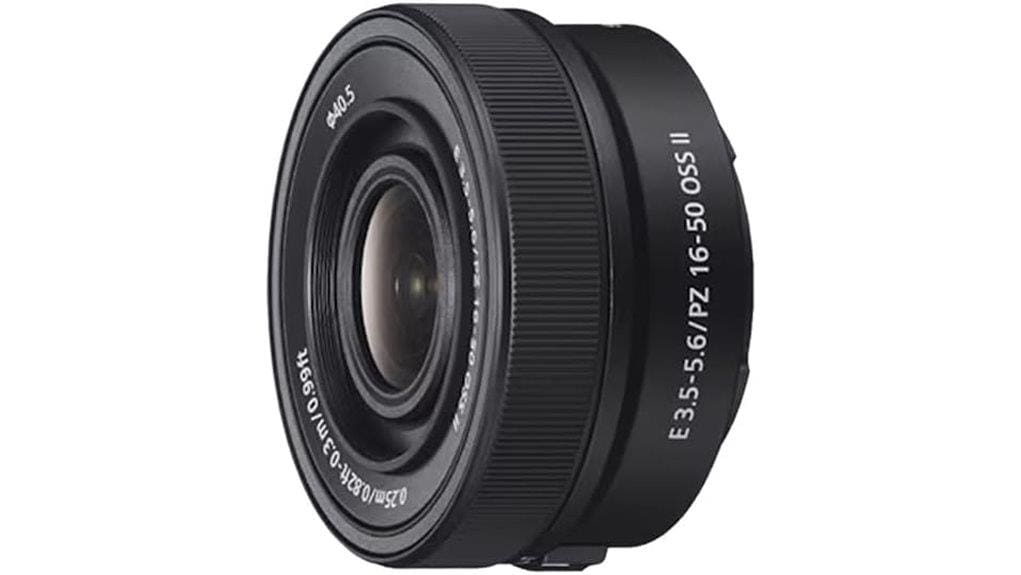
You’ll get an ultra‑compact, pocketable power‑zoom that favors convenience and smooth video over pixel‑level image quality. It’s featherweight and collapsible, with useful OSS and near‑silent AF for run‑and‑gun vlogging, but plastic build and a slow variable aperture limit low‑light and edge detail. Sharpness is best at 16–35mm, falls at 50mm; moderate distortion and vignetting persist wide open. It’s a practical travel/video tool—keep going to see where it compromises.
Some Key Takeaways
- Ultra‑compact, collapsible zoom ideal for casual shooters and vloggers prioritizing pocketable size and convenience.
- Optical SteadyShot delivers effective handheld stabilization for stills and run‑and‑gun video.
- Smooth power‑zoom and quiet AF make it well suited for video, though AF can hunt in low light.
- Image quality: good center sharpness at 16mm, softer edges and weakest resolving at 50mm.
- Tradeoffs: slow variable aperture, plastic build, no weather sealing; choose if size and video ergonomics matter most.
Quick Verdict and Who This Lens Is For
Although it’s aimed at casual shooters, the Sony E PZ 16–50mm F3.5–5.6 OSS II delivers a precise balance of portability and functionality for everyday stills and video. You get a featherweight, collapsible zoom that suits compact travel and quick run-and-gun shoots, with OSS helping steady handheld framing. Optics are competent for web and social output but limited by a slow aperture and modest edge resolution at longer focal lengths. You’ll appreciate refined AF and power-zoom support if you’re a beginner vloggers or a content creator prioritizing size and convenience over ultimate image quality or low-light reach. Perfect Portrait Lenses is a good place to explore other portrait-focused optics and portrait lens options.
Build, Handling, and Power-Zoom Controls for Stills vs. Video
Feel the difference the moment you pick it up: the SELP16502’s collapsed, 31.3 mm chassis and 107 g mass make it exceptionally pocketable and unobtrusive on APS‑C bodies, yet its plastic, non‑weathersealed construction feels budget‑grade compared with higher‑tier lenses. You’ll appreciate compact controls that keep operation minimal—power‑zoom rocker and small focus ring—but they’re plasticky with light throw and limited tactile feedback. For stills you’ll snap quickly, though manual focus feels fiddly. For video the motor delivers smooth shifts and controllable zoom speed, but lack of damped, professional feel and occasional hunt under AF expose its consumer orientation. It’s a handy option for action camera photographers seeking portable gear who want minimal bulk without sacrificing basic zoom functionality.
Image Quality at 16mm, 35mm, and 50mm (Sharpness, Distortion, Vignetting)
When you frame at 16mm the SELP16502 delivers good center sharpness straight from wide open, but edges soften noticeably and resolution climbs only modestly by f/8–f/11; at 35mm sharpness evens out across the field with better microcontrast, while 50mm shows the lens’ weakest resolving power—centers remain usable but corners drop and detail gets mushy, especially wide open. You’ll notice pronounced edge sharpness variation at extremes and moderate barrel distortion at 16mm that straightens toward 50mm. Vignetting is visible wide open at 16mm, reduced stopped down. Lateral chromatic aberration is present in high-contrast edges, requiring correction. For photographers shooting lots of high-resolution images, consider using large capacity memory to ensure uninterrupted capture and adequate storage.
Autofocus, Optical SteadyShot, and Movie Performance (Breathing and 4K Use)
While compact, the SELP16502’s autofocus system is deliberately tuned for quiet, steady operation, giving you reliable subject acquisition in both stills and video without drawing attention. You’ll find AF speed adequate for routine subjects, with autofocus consistency good in contrast-rich scenes but less assured in low light or fast action. OSS reduces handshake effectively, yet stabilization latency becomes noticeable during sudden pans—expect a brief lag before correction settles. Movie use benefits from power-zoom smoothness and breathing compensation on compatible bodies, though residual focus shift and modest rolling focus remain. Overall, reliable for run-and-gun video, not for demanding cinematic work. For creators who shoot product or studio setups, consider adding RGB lighting for flexible color control and mood creation Vibrant RGB Lighting.
Pros, Cons, Alternatives, and Should You Buy It?
Because it prioritizes compactness and movie-friendly features, the SELP16502 is a pragmatic choice for travel shooters and vloggers who need a lightweight, power-zoom kit lens with OSS and quiet AF. You get affordable versatility: solid stabilization, usable sharpness at normal viewing sizes, and near-silent focusing plus folding convenience for grab-and-go shooting. Cons: limited aperture range, modest edge resolution, no weather sealing, and plastic build that trades durability for travel convenience. Alternatives include the Sigma 16mm f/1.4 (prime speed), Sony 18–135mm OSS (range), or native primes for low-light. Buy it if size and video ergonomics trump ultimate image quality. It’s well suited to enthusiasts who prioritize portability and lens system flexibility with mirrorless cameras.
Some Questions Answered
Is This Lens Weather-Sealed or Water Resistant?
No — it isn’t weather-sealed or water resistant. You’ll get no dedicated sealing details on the mount or barrel, and the spec sheet lists “not water resistant.” That means you shouldn’t expose it to rain, heavy humidity, or dusty environments without external protection. For critical outdoor use, you’ll need a weather-sealed camera body, protective covers, or a different lens with explicit weather resistance and robust sealing details.
Does It Include a Lens Case or Pouch?
No — it doesn’t include a lens pouch or dedicated case in the packaging contents. You’ll get the lens, lens hood, front and rear caps, and standard paperwork; there’s no protective pouch listed. You should plan to buy a small padded pouch or compact case if you need extra protection. That’s a deliberate cost/size tradeoff: Sony keeps the kit minimal to preserve compactness and low weight, but you’ll sacrifice onboard protection.
Is the Power Zoom Compatible With Third-Party Remote Controllers?
No—third-party compatibility varies, so you shouldn’t assume universal power zoom interoperability. The lens uses Sony’s proprietary actuator and controller protocol; controller protocol compatibility depends on the remote maker explicitly supporting Sony E PZ command sets. You’ll need to verify firmware or compatibility lists from the controller vendor, or test directly. For reliable remote zoom control, prefer controllers that advertise Sony E-mount power-zoom support or use Sony’s own accessories.
Can It Be Used on Full-Frame Sony Bodies Without Vignetting?
No — you’ll get vignetting on full-frame bodies. The lens is a crop sensor design with a smaller image circle sized for APS-C, so it won’t cover full-frame sensors edge-to-edge. You can use it via flange focus or with an adapter, but adapter compatibility won’t change the native image circle. You’ll either crop to APS-C mode, accept heavy corner darkening, or use it only on APS-C-format cameras for best results.
What Filters (Filter Thread Size) Does This Lens Accept?
The lens takes 40.5 mm filters; you won’t use 52 mm filters directly. If you need larger glass, you can fit a 40.5→52 mm step-up adapter, but that adds bulk and can interfere with the collapsed power-zoom action. For slim adapters, choose low-profile step-up rings to minimize vignetting and mechanical conflict. You’ll want slim adapters and slim 52 mm filters if you must adapt, though ideal use keeps the native 40.5 mm size.