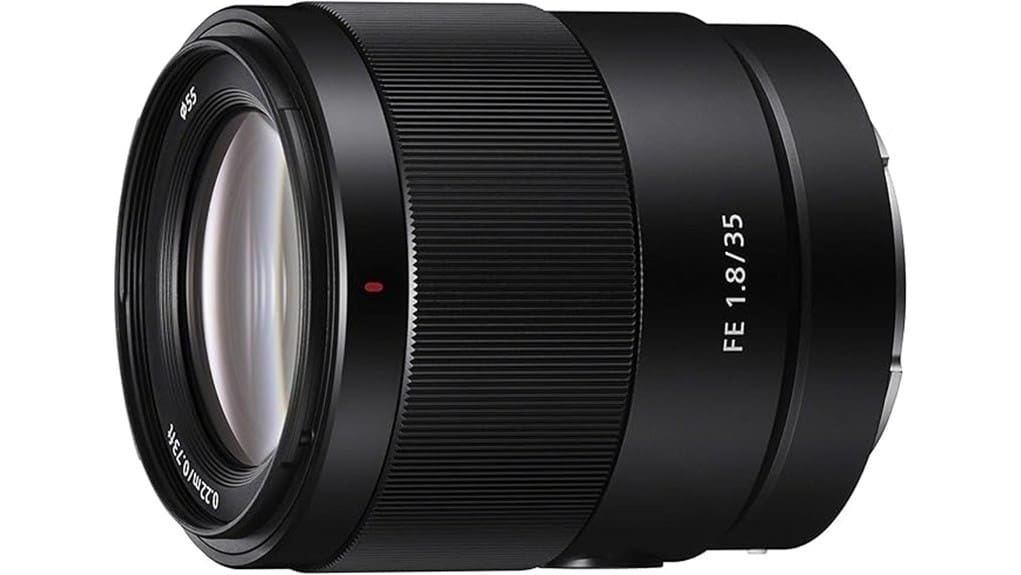
You’ll find the Sony FE 35mm f/1.8 is a compact, high‑resolution prime that gives you fast, quiet linear‑motor autofocus and an f/1.8, nine‑blade diaphragm for smooth background separation. Center sharpness is excellent wide open, edges tighten by f/2.8–f/4 and corners match by f/5.6. Aspherical optics control spherical and coma; chromatic aberration is minimal. Close‑focus to 22 cm and 0.24x magnification add versatility, though no teleconverter support exists—more technical details follow.
Some Key Takeaways
- Compact, lightweight 35mm f/1.8 prime delivers high-resolution images and balances well on mirrorless bodies.
- Fast, silent linear‑motor autofocus offers precise, low‑hunting performance for stills and video.
- Excellent center sharpness at f/1.8; edges improve by f/2.8–f/4 and near-center by f/5.6.
- Smooth nine‑blade bokeh with controlled onion‑ring artifacts and well‑managed chromatic aberration.
- 22 cm close‑focus (0.24x) enables tight environmental portraits but no teleconverter support.
Quick Verdict and Who This Lens Is Best For
While compact and lightweight, the Sony FE 35mm f/1.8 delivers high-resolution images with pronounced bokeh and fast, quiet autofocus, making it a versatile walkaround prime for photographers who prioritize portability and image quality. You’ll find it ideal for street portraits and general travel versatility: the 35mm field balances environmental context with subject focus. The f/1.8 aperture and 9-blade diaphragm let you isolate subjects, while the aspherical element reduces aberration for reliable resolution. The linear-motor AF is swift and silent for candid shooting. Close-focus to 22 cm and 0.24x magnification expand framing options; teleconverters aren’t supported. It pairs especially well with compact mirrorless bodies, reinforcing the site’s focus on prime lenses for photographers.
Image Quality: Sharpness, Bokeh, and Aberration Control
Because the optical formula prioritizes correction and resolution, you’ll see crisp, high-frequency detail across the frame even at wider apertures. Center sharpness is excellent at f/1.8, and stopping to f/2.8–f/4 tightens edge sharpness noticeably; corners approach the center by f/5.6. The aspherical element suppresses spherical and coma, so point sources stay clean and circular. A nine-blade aperture yields smooth, pleasing bokeh with controlled onion-ring artifacts. Chromatic aberration is well-managed in both lateral and longitudinal axes; you’ll need minimal correction in post. Color rendition is neutral and faithful, supporting accurate skin tones and natural hues. These qualities pair well with versatile lighting tools like 5-in-1 reflectors to shape and refine light in portrait and product work.
Autofocus, Handling, and Build for Everyday Shooting
Sharp, high-resolution optics only matter if the lens can reliably capture the moment, and the FE 35mm f/1.8’s autofocus system is built for everyday responsiveness. You get a linear-motor drive that delivers fast, precise, silent operation, reducing hunting in varied light. Ergonomic handling is excellent: the compact, lightweight barrel feels balanced on mirrorless bodies and the focus ring offers a predictable focus throw for manual interventions. Build quality includes durable materials and practical weather sealing for routine outdoor use. Controls are minimal and intuitive, so you can concentrate on composition while the lens performs consistently and quietly. For photographers who tune and maintain their gear, using lens calibration tools can help ensure that autofocus remains accurate over time.
Close-Focus Performance, Magnification, and Teleconverter Note
When you need to get in close, the FE 35mm f/1.8 focuses down to 8.66 inches (22 cm) and yields a maximum magnification of 0.24x, letting you frame tight environmental portraits and detail shots without switching lenses. You’ll appreciate usable macro potential for larger subjects, though it’s not a true macro optic. Working distance is modest, so you’ll need to manage lighting and subject comfort. Focus stacking can extend apparent micro-detail when depth of field is limiting. Subject isolation at f/1.8 remains strong for close subjects. Note: the lens is incompatible with Sony x1.4 and x2.0 teleconverters. Mastering macro lenses involves understanding close-focus limits and lighting to maximize detail capture with non-macro optics and focus stacking.
Value Comparison: Price, Alternatives, and Final Buying Recommendation
Weigh the FE 35mm f/1.8’s cost against its performance: its moderate street price buys you a compact, high-resolution optic with fast, quiet linear-motor AF, strong f/1.8 bokeh from a 9‑blade aperture, and effective aberration control via an aspherical element. You’ll find the price justified if you value portability, close-focus 0.24x reproduction, and consistent sharpness. Consider budget alternatives (older primes or third-party 35mm f/1.8s) if cost is primary; they trade some resolution, AF speed, and coatings. Resale value is solid due to Sony demand. Recommendation: buy if you prioritize image quality and reliability over lowest cost. This lens is an excellent fit for mirrorless camera enthusiasts who prioritize compact, high-performance gear.
Some Questions Answered
Is This Lens Weather-Sealed for Shooting in Bad Conditions?
No — it isn’t fully weather-sealed. You won’t get exhaustive weather sealing; manufacturer specs don’t list full dust and moisture sealing. You can expect some basic moisture resistance from gasketed mount or construction, but you shouldn’t rely on it in heavy rain, sand, or prolonged damp conditions. You’ll need additional protection (rain cover, sealed camera body) for reliable field use in bad weather to prevent damage and maintain performance.
Does It Have an Aperture Ring for Manual Control?
No, it doesn’t provide a dedicated aperture ring for manual control. You’ll use the camera’s control dials for aperture adjustments; the lens supports manual override via camera settings rather than a physical ring. Its electronic aperture operation offers aperture clicklessness when the camera enables electronic click suppression, useful for video. Autofocus and exposure functions remain responsive while you manually override aperture through the camera, maintaining fast, quiet performance and precise control.
What Filter Thread Size Does This Lens Use?
The lens uses 52 mm filters; the Front element accepts 52 mm screw-in filters. You’ll mount standard 52 mm filters directly to the Front element for protective or creative use. This size maintains compactness and balance, minimizes vignetting on full-frame sensors, and supports common filter types (UV, ND, CPL). Remember, teleconverters are incompatible, so filter selection is limited to front-mounted options only for this optical design.
Is It Compatible With APS-C Sensors and What Focal Length Does It Equate To?
Yes — the lens supports APS C compatibility when mounted on an APS-C Sony body. You’ll get an Effective focal length equivalent of approximately 52.5mm (35mm × 1.5 crop factor). This makes the lens behave like a short standard/normal focal length on APS-C sensors. Autofocus, aperture, and image quality remain operational; only the field of view changes due to the sensor crop, producing a tighter framing.
Does It Include Any Image Stabilization in the Lens?
No, it doesn’t include optical stabilization in the lens. You’ll rely on in-body image stabilization (IBIS) or electronic stabilization in-camera or during post. The lens offers a fast f/1.8 aperture and quiet linear-motor AF but contains no built-in optical stabilization elements. For stabilized handheld results, enable your camera’s IBIS or electronic stabilization workflows; otherwise expect stabilization responsibility to remain with the camera system or software.