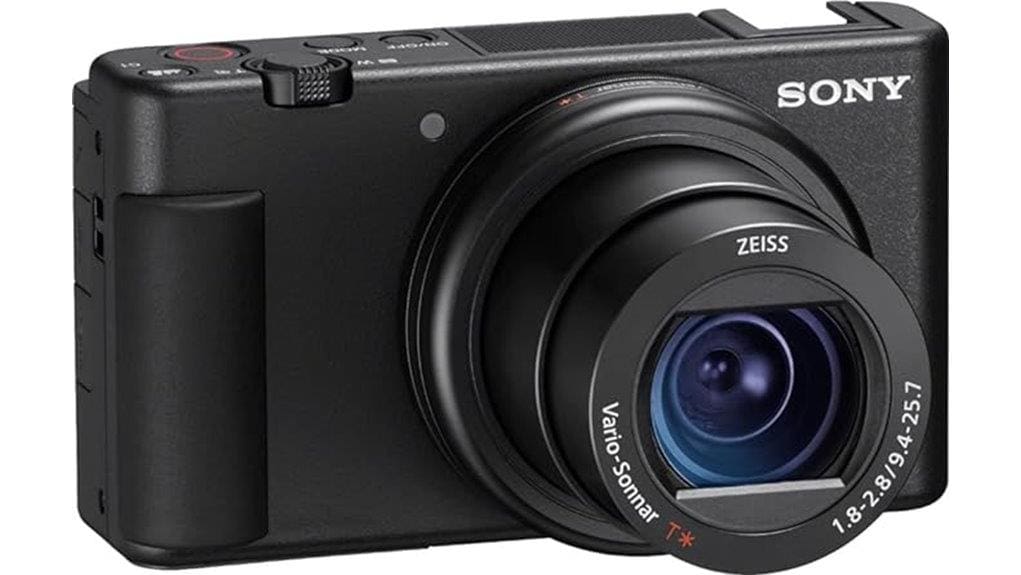

You’ll get a compact, creator-first vlogging camera that nails skin tones, fast AF, and on-board audio while trading interchangeable lenses and deep low-light performance for simplicity and reliable tracking. It’s ideal if you want quick setup, flattering skin rendering, and real-time eye AF with usable S‑Log3/HLG options for grading. Expect modest battery life, rolling shutter in fast pans, and limited zoom. Keep going to see how those trade-offs play out for different creators.
Some Key Takeaways
- Compact, creator-focused camera delivering sharp 4K video, pleasing skin tones, and fast real-time eye AF for reliable vlogging results.
- Built-in forward mic, MI shoe, and 3.5mm input provide strong on-board audio and easy external microphone options.
- Bokeh switch and side flip touchscreen simplify framing and background separation for quick, polished content.
- Trade-offs include fixed 1” sensor, limited zoom, rolling shutter on fast pans, and modest battery life for long shoots.
- Best for solo creators, travel vloggers, and streamers wanting simplicity; consider G7X III, X100V, or A6400 as alternatives.
Should You Buy the Sony ZV-1? Quick Verdict and Who Wins
If you want a compact, creator-focused camera that’s optimized for vlogging and quick video production, the ZV-1 is a smart buy — especially if you prioritize autofocus, skin tones, and on-board audio without hauling a kit. You’ll get a compact powerhouse that balances image quality, fast AF, and creator-friendly controls. It’s an affordable choice for solo creators, streamers, and travel vloggers who want pro-features without micro four-thirds size or complex setups. You won’t get interchangeable lenses or full-frame depth, but you’ll gain simplicity, reliable tracking, and excellent color for skin — a clear win for focused creators. Consider pairing it with on-camera LED lights for consistent, flattering illumination when shooting in variable conditions and tight spaces, especially useful for on-camera lighting.
How the ZV-1 Performs for Video and Photos
Generally, the ZV-1 delivers video-first performance that punches well above its compact size: its 1.0” stacked Exmor RS sensor and fast ZEISS 24–70mm-equivalent lens produce sharp, detailed 4K footage with pleasing skin tones and smooth highlight rolloff, while S-Log3/HLG support gives you usable dynamic range for grading when you need it. You’ll get clean stills for social use, accurate color and fine detail at base ISO, and responsive autofocus that preserves framing. Low light performance is respectable for the class, with manageable noise up to mid ISOs. Dynamic range handling favors practical recovery over extreme latitude, ideal for creators. For creators lighting small shoots, pairing the ZV-1 with compact video panels can significantly improve subject separation and skin-tone rendering.
Vlogging Features That Actually Matter: Mic, Screen, AF, and Bokeh
When you’re vlogging, mic quality, a responsive flip screen, reliable autofocus, and usable bokeh determine whether your footage feels professional or just passable. You get a forward directional mic that captures clear on-axis audio for talk-to-camera shots, and you can add an external mic via the 3.5mm jack or MI shoe when needed. The side flip screen is touch-enabled and stays readable while you frame, reducing retakes. Real-time eye AF locks fast on faces, keeping focus during movement. A bokeh switch (defocus mode) gives instant background separation without complex settings, speeding up shoot-and-upload workflows. For creators who also use remote triggers, pairing compatible camera remotes can streamline hands-free recording and reduce camera shake, especially when vlogging on the go with compact setups and camera remote shutters.
Real Limitations to Expect and Workflow Caveats
You’ll appreciate the ZV-1’s vlogging-focused features, but you should also know where they fall short so you can plan your shoots and post workflow. Expect rolling shutter in fast pans or drone-mounted runs; it won’t match larger-sensor cameras for skew-free motion. Battery life is modest—bring spares for all-day shoots or rely on USB power during seated streams. Limited zoom range and fixed 1” sensor mean low-light performance and background compression aren’t class-leading. Also factor in occasional exposure shifts with mixed lighting; shoot in flat profiles if you’ll grade, and transcode 4K HLG/S-Log carefully for smoother edits. Consider carrying dual battery chargers to keep spare batteries ready for long days of shooting.
Which Creators Should Buy It : and Better Alternatives to Compare
Although compact, the ZV-1 punches above its weight for solo creators who prioritize effortless vlogging, social video, and live streaming thanks to its selfie-ready screen, excellent autofocus, and built-in directional mic. You’ll love it if you’re an entry level creator needing polished footage without complex rigs, a travel vlogger valuing size and stabilization, a tech reviewer who benefits from fast AF and Product Showcase, or a short form creator chasing quick setup and reliable skin tones. Alternatives to compare: Canon G7X Mark III (simplicity), Fujifilm X100V (image quality, fixed lens), and Sony A6400 (interchangeable flexibility). DSLR enthusiasts should also consider pairing the ZV-1 with essential accessories like tripods and extra batteries for longer shoots and improved stability, especially when coming from a background focused on essential gear.
Some Questions Answered
Does the ZV-1 Support External Continuous Power for Long Shoots?
Yes — you can run the ZV-1 on USB power using a Dummy battery. You’ll use a compatible NP-BX1-style dummy battery connected to a USB power bank or wall adapter, letting you shoot longer without swapping cells. It’s trend-aware for creators who stream or record all-day. Just confirm the dummy’s fit and stable 5V/2A USB output, and be mindful of heat and operating temperature during extended continuous power.
Can the Camera Shoot Vertical Video Natively With Framing Guides?
Yes — you can shoot vertical video natively, and the camera offers vertical framing with portrait guides to help composition. You’ll flip the side 3.0” LCD for easy selfie-style portrait orientation, see on-screen guides, and retain autofocus, AE face-tracking, and stabilization. This combination makes producing trend-aware, vertical social content efficient; you’ll get consistent framing and pro features like 4K HDR and log profiles while staying mobile and creator-focused.
Is There a RAW Video or High-Bitrate Internal 10-Bit Option?
No — you won’t get Raw video? or a High bitrate internal? 10-bit internal recording isn’t offered; the ZV-1 records 8-bit internally (XAVC S 4K up to 100 Mbps). For higher color depth or Raw-like output you can use clean HDMI to an external recorder that can capture 10-bit or Raw formats. That’s the practical trade-off: compact vlogging convenience versus pro-level internal codecs.
How Long Does the Battery Last During Continuous 4K Recording?
You’ll get roughly 45–70 minutes of continuous 4K recording on a fully charged NP-BX1, depending on frame rate and settings. Battery endurance trends downward with use of stabilization, autofocus, and external mic; ambient heat can trigger thermal throttling, which may force stops or shorter continuous takes. To maximize runtime, disable unnecessary features, lower screen brightness, use airplane mode, and carry spare batteries or an external power bank for longer shoots.
Is There a Dedicated Headphone Jack for Audio Monitoring?
No, there isn’t a dedicated headphone jack for audio monitoring. You’ll need a headphone adapter or use an external recorder with monitoring output to check audio. For reliable audio workflow, plan for the MI shoe or 3.5mm mic input plus an external monitor/recorder or wireless system that offers headphone output. That keeps you trend-aware and guarantees accurate levels during shoots, especially when recording 4K or streaming live.