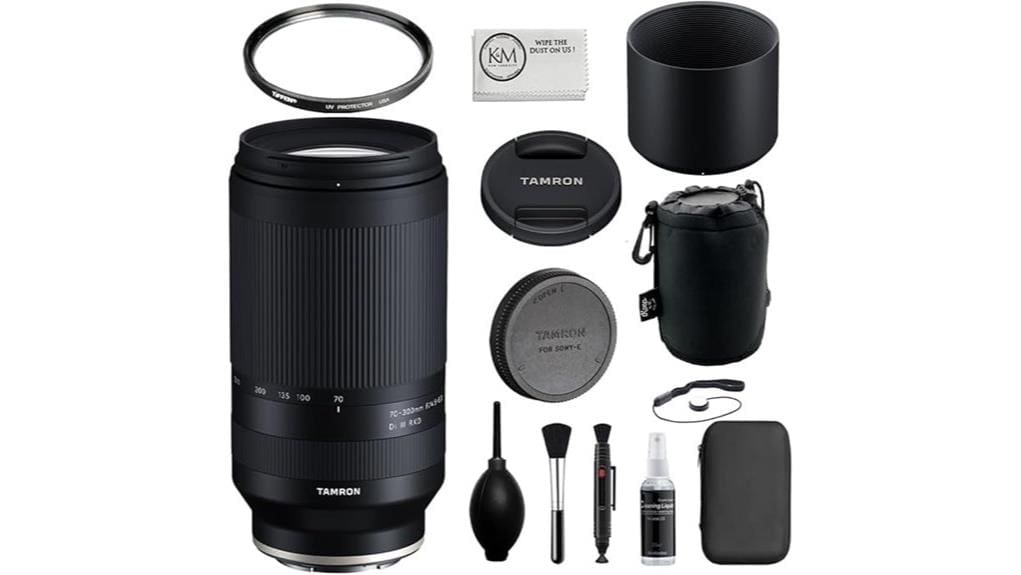

You’ll find the Tamron 70‑300mm f/4.5‑6.3 Di III RXD is a lightweight, value‑focused telephoto for Sony full‑frame E‑mounts that suits travelers and enthusiasts who prioritize portability over pro‑level aperture and reach. You’ll get strong center sharpness, usable edge performance stopped down, controlled bokeh, quiet RXD autofocus, and moisture resistance in a compact package. It’s competitively priced versus Sony and third‑party alternatives and includes useful extras—scroll on to see detailed optics, handling, and real‑world tests.
Some Key Takeaways
- Lightweight, compact 70–300mm for Sony E full-frame bodies ideal for travel and enthusiast use.
- Strong center sharpness across focal lengths; stop down one to two stops to improve edge performance.
- Quiet, responsive RXD autofocus suits static and moderately moving subjects, including wildlife and sports.
- 0.591x close-focus magnification offers convincing subject isolation; bokeh is controlled but not ultra-creamy.
- Good value with moisture resistance, included accessories, and teleconverter compatibility, but not pro low-light performance.
Quick Verdict: Who This Tamron 70-300mm Is Best For
While it sacrifices the absolute reach and fastest apertures of pro telezooms, the Tamron 70-300mm f/4.5-6.3 Di III RXD gives you a lightweight, compact, and optically capable telephoto for Sony E-mount full-frame bodies—ideal if you prioritize portability and value over maximum speed. You’ll find it suits enthusiasts and travelers who need a budget telephoto without bulk. Compared with pro-grade 70–200/100–400 alternatives, it trades top-end speed for size and weight efficiency, offering moisture resistance, RXD autofocus, and useful close-focus magnification. Choose it when travel portability, cost-effectiveness, and competent optics outweigh professional low-light performance. This makes it a great match for photographers looking for camera gear that fits in compact camera backpacks used for hiking and travel.
What to Expect Optically: Sharpness, Bokeh, and Close‑Up Performance
Expect consistently strong center sharpness across the frame at most focal lengths. You’ll notice edge falloff at telephoto settings, improving stopped down by one to two stops. Bokeh is neutral and controlled; out-of-focus highlights render smoothly but lack the creamy separation of faster optics. Close-up capability is notable — 0.591x at tele achieves convincing subject isolation for small subjects. Chromatic aberration is well suppressed in the center, with mild lateral fringing near extreme edges that post-processing corrects easily. Micro contrast rendering is good for a consumer telezoom, preserving midtone detail and perceived punch without the micro-contrast of premium primes. As a versatile option for wildlife and sports shooters, this telezoom offers telephoto performance in a compact, affordable package.
Autofocus, Handling, and Build: RXD, Size, and Weather Resistance
Sharpness and bokeh set the stage, but real-world usability hinges on autofocus, handling, and build—and the Tamron 70-300mm’s RXD system and compact construction address those needs directly. You’ll notice the RXD motor delivers quiet, responsive AF; autofocus performance rivals larger, pricier zooms on Sony E-mount bodies for tracking static and moderately moving subjects. The lens’ light weight enables compact handling and reduces fatigue during extended handheld use, contrasting with heavier telephotos. Moisture-resistant construction provides practical weather sealing for field use, though it’s not fully submersible. Overall build balances durability, portability, and reliable AF in a competitive package. It’s a strong choice for mirrorless camera enthusiasts seeking accessories tailored to their systems and shooting style, especially those focused on compact system cameras.
Real‑World Tests: Wildlife, Sports, Travel, and Low‑Light Samples
Because field performance ultimately determines whether a lens earns your kit-bag space, this section examines how the Tamron 70-300mm f/4.5-6.3 Di III RXD performs across wildlife, sports, travel, and low-light scenarios. You’ll find its RXD AF and compact weight aid wildlife stalking, letting you frame distant subjects quietly and track subtle movements. For sports, contrast and AF responsiveness support panning technique at moderate shutter speeds, though edge resolution softens at longer focal lengths. Travel storytelling benefits from reach and portability, enabling compressed perspectives. In lowlight, use high-ISO and stabilization-aware lowlight strategies; expect usable results but not specialist night performance. Learn how teleconverters can increase reach while preserving portability for travel and wildlife photography.
Should You Buy It? Pricing, Alternatives, and Included Bundle Value
While it won’t replace a pro-grade super-tele, the Tamron 70-300mm f/4.5-6.3 Di III RXD delivers a compelling balance of reach, AF performance, and portability that makes it an attractive buy for users who prioritize compact travel telephoto capability over absolute resolution or low-light speed. At typical street prices it’s competitively positioned in price comparison with Sony’s native 70‑350mm and third‑party 70–200mm alternatives. You’ll get strong bundle valuation: pouch, Tiffen 67mm UV, hood, cap keeper and cleaning kit add measurable retail value. Choose it if size, AF and cost-efficiency matter more than ultimate aperture. Our site also recommends considering compatible slider accessories for easy mounting and smooth motion with camera sliders.
Some Questions Answered
Does This Lens Support In-Camera Lens Corrections for Sony Bodies?
Yes — you’ll get in-camera lens corrections on most Sony E-mount bodies. They apply geometric and chromatic aberration fixes automatically; you may need firmware updates on either camera or lens to guarantee full correction compatibility. Compared to native Sony lenses, corrections are comparable but can lag after major camera firmware changes. You’ll also want to monitor autofocus quirks reported after updates, as calibration and behavior can change with firmware revisions.
Is It Compatible With APS-C Sony E-Mount Cameras?
Yes — you can use it on APS-C Sony E-mount bodies. With APS C compatibility, the lens yields an effective focal length range roughly 105–450mm equivalent thanks to the 1.5x crop factor, so you’ll gain reach compared with full-frame use. You’ll retain autofocus and EXIF communication; however, expect a narrower field of view, increased apparent depth of field, and slightly different vignetting and corner resolution compared to full-frame operation.
Can I Use Third-Party Teleconverters With This Lens?
Yes — you can try third-party compatibility teleconverters, but results vary. You’ll retain autofocus only with certain converters and camera bodies, and image quality will typically degrade: contrast, sharpness, and corner resolution can drop, plus added vignetting. Compared to native or no-teleconverter use, expect reduced effective aperture and potential AF hunting. Test specific TC models with your Sony E body before relying on them for critical work.
What Is the Closest Focusing Distance at Both Ends?
The closest focusing distance is 0.95 m/3.12 ft at the wide end and 1.5 m/4.92 ft at the tele end. You’ll notice the 0.95 m/3.12 ft spec gives higher maximum magnification for close-ups, while the 1.5 m/4.92 ft tele minimum focus limits framing but improves subject isolation. You’ll work within these distances for sharpness and framing, and you can compare performance to other telezooms by referring to their minimum-focus specs.
Does the Lens Have a Programmable Focus Hold Button?
No, it doesn’t include a programmable focus hold button. You’ll rely on camera body focus customization for focus customization features; the lens lacks onboard programmable controls. Button placement is hence a non-issue on the barrel, unlike some competitors that add a customizable button near the focus ring. Comparatively, you get quiet RXD AF and compact construction but must map any focus-hold or back-button functions to your Sony body rather than using a lens-mounted control.