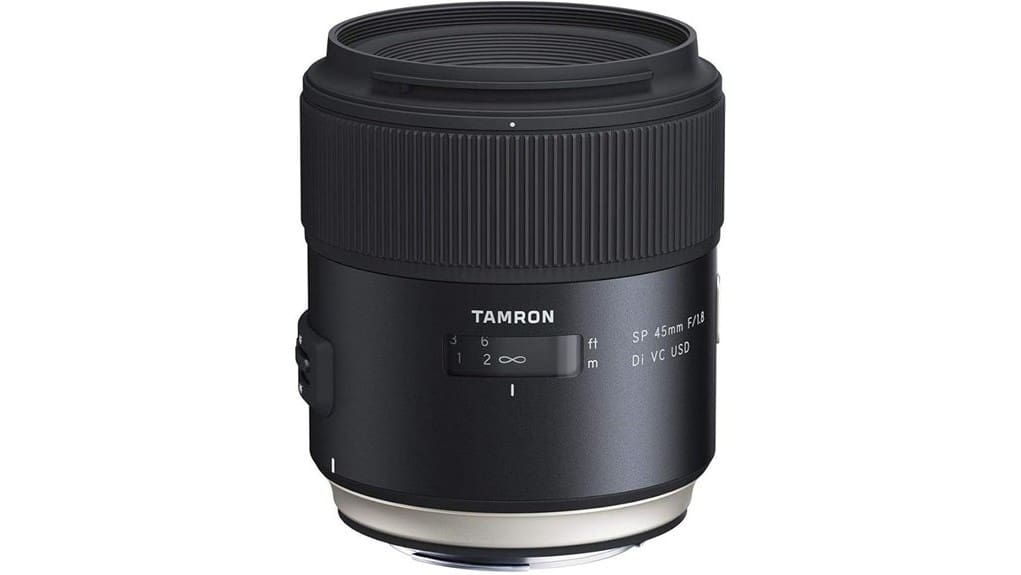
You’ll find the Tamron AFF013N-700 SP 45mm F/1.8 Di VC USD a compelling mid‑tier choice for Nikon FX users who want a fast, stabilized standard prime. It gives excellent center sharpness wide open, low longitudinal CA, smooth bokeh, reliable USD AF on supported bodies, and effective VC for handheld low‑light work. Coatings reduce flare but need care, and close‑focus has limited working distance. If you want specifics on comparisons, quirks and best use cases, keep going.
Some Key Takeaways
- Fast 45mm f/1.8 prime offers excellent center sharpness and pleasing bokeh, ideal for portraits and general use.
- Built-in VC stabilization enables reliable handheld low-light shooting and smoother stabilized video.
- USD autofocus is quick and accurate on supported Nikon bodies, with good subject tracking for most situations.
- Advanced coatings (eBAND, BBAR, fluorine) reduce flare and maintain high contrast, though coating care affects longevity.
- Compact, weather-resistant build with strong resale potential, trading some OEM edge-case AF behavior for superior stabilization.
Verdict: Is the Tamron 45mm F/1.8 Worth Buying for Nikon Shooters?
If you want a fast, sharp standard prime for a Nikon full-frame DSLR without paying top-tier lens prices, the Tamron 45mm F/1.8 is worth serious consideration. You get VC stabilization, fast USD AF, robust coatings, and strong resolving power in a compact package. Its value proposition rests on professional features squeezed into a mid-price bracket, making it practical for shooters who need low-light reach and compositional flexibility. You’ll appreciate handling improvements and water resistance. Consider long term resale: popularity of full-frame Nikon mounts and durable build should preserve used value, so buying feels financially sound. The lens is particularly well-suited for enthusiasts who pair it with mirrorless camera accessories and gear.
Real-World Optical and Autofocus Performance You’ll Notice
Expect the Tamron 45mm F/1.8 to deliver sharp, reliable results straight out of the camera: center resolution is excellent even wide open at f/1.8, and edge performance tightens up quickly by f/2.8–f/4, giving you punchy detail for portraits and general use. You’ll notice low longitudinal CA and restrained vignetting; contrast is high without heavy sharpening. The nine rounded blades yield a smooth bokeh character that’s pleasant without being overly creamy. USD autofocus is quick and precise on supported Nikons, and focus tracking holds well on moving subjects, though you’ll still want a fast body for demanding action. It’s a strong choice for enthusiasts looking for essential lens gear to expand their kit.
Stabilization, Coatings, and Close-Focus: Practical Benefits and Limits
While the Tamron’s VC, advanced coatings, and close-focus design each bring clear benefits, they also introduce practical limits you should know. You get effective vibration compensation that lets slower shutter speeds be usable handheld, but it won’t replace a tripod for critical landscape or micro-detail work. The close-focus capability is flexible, but working distance and distortion at minimum focus limit portrait flattering use. Coatings (eBAND, BBAR, fluorine) improve contrast and reduce flare; however, coating longevity depends on care—abrasion and chemicals will degrade performance. In short: useful real-world features with clear operational trade-offs. Consider adding silica gel packets to your camera bag to help protect lenses and coatings from moisture that can accelerate degradation.
How the Tamron 45mm Compares to Nikon and Third‑Party Alternatives
Because the Tamron 45mm packs VC, USD, and modern coatings into a fast standard prime, it competes differently than Nikon’s native 45–50mm primes and most third‑party options: you’ll get comparable or better stabilization and close‑focus flexibility than Nikon’s older 50mm designs, often superior flare control versus legacy glass, and resolving power that challenges current OEM 45–50mm optics—though you trade off the absolute lowest distortion and brand‑native AF integration that some Nikon primes still offer. You should view Nikon alternatives and Third party comparisons through three lenses: stabilization, optical microcontrast, and AF behavior. Tamron leads on stabilization, equals or exceeds in sharpness, but AF edge cases favor native glass. Many photographers also find that using high-speed memory cards can improve buffer clearing and overall shooting responsiveness when using modern fast prime lenses.
Who Should Buy This Lens and Best Ways to Use It
If you valued the Tamron 45mm for its built‑in VC, strong resolving power, and modern coatings compared with Nikon and third‑party alternatives, you’ll find it suits shooters who want a single, fast, stabilized standard prime that handles both stills and run‑and‑gun video. You should buy it if you prioritize sharpness at f/1.8, reliable VC for low‑light handheld work, and compact handling on Nikon FX bodies. Portrait enthusiasts will like subject separation and close‑focus dynamics; street photographers will appreciate discreet size, quick USD AF, and stabilization for slower shutters. Use it for environmental portraits, reportage, and stabilized video capture. It also pairs well with wide‑angle workflows and accessories for photographers focused on wide-angle lenses and expansive compositions.
Some Questions Answered
Does This Lens Accept Nikon Teleconverters?
No — it isn’t officially compatible with Nikon teleconverters. You’ll find teleconverter compatibility is limited because the lens’s flange distance, electronic coupling and optical design weren’t optimized for TC use. You can physically mount some third-party adapters, but optical performance will degrade noticeably: reduced sharpness, slower effective aperture, more aberrations and possible AF issues. If you need reach, you’re better off using a longer prime or crop-sensor body.
Is It Compatible With Nikon Mirrorless via FTZ Adapter?
Yes — you can use it on Nikon mirrorless bodies via the FTZ adapter, but expect mixed AF behavior. FTZ compatibility is solid mechanically and VC still functions; Autofocus performance depends on your mirrorless model and firmware: high-end bodies (Z6 II/Z7 II equivalents) will autofocus reliably, while older/entry models may show slower or hunt-prone AF. You’ll get excellent optics and stabilization, but don’t assume native-speed AF without testing on your camera.
What’s the Warranty Coverage and How to Register It?
You get manufacturer warranty coverage (check region for specifics) and can pursue Warranty registration online to activate it; Tamron often lists a standard term and offers Extended coverage via registration or promo. You should register at Tamron’s official site with purchase info and serial number, or contact customer service to extend/confirm coverage. I’d recommend scanning receipts and registering immediately to guarantee eligibility for extended coverage and faster claims.
Does the Lens Come With a Hood and Pouch Included?
No — the package typically doesn’t include a lens hood or carrying pouch. You’ll get the lens, caps, and documentation; hoods and pouches are usually sold separately. If you want protection and flare control, you should budget for an official Tamron LH-series lens hood and a padded carrying pouch or third-party case. That gives better fit, weather resistance, and handling than generic accessories, so I’d recommend buying them with the lens.
Is It Suitable for Astrophotography Use?
Yes — you can use it for astrophotography. You’ll benefit from excellent low light performance thanks to f/1.8 and strong resolving power, and VC helps with framing handheld wide-field shots. Coma control is good but not perfect for extreme corners at f/1.8, so stop down to f/2.8–f/4 for pinpoint stars across the frame. It’s a practical, fast option for wide-field nightscapes and milky way work.