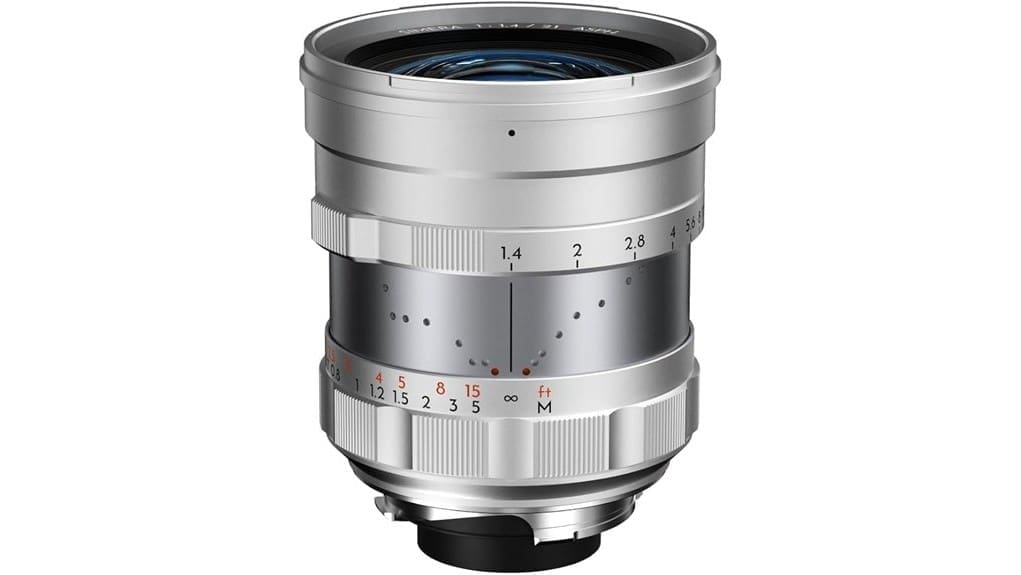
You’ll like the Thypoch Simera 21mm f/1.4 if you want a compact, all‑metal Leica‑M style wide-angle with strong center resolution and high micro‑contrast at f/1.4, but be prepared to focus carefully and calibrate the lens to control softer corners, mild distortion, and subtle lateral CA. The floating focus helps corner performance when stopped to f/2.8–f/4, and the tactile manual controls suit rangefinder users; keep going to see detailed strengths, limits, and workflows.
Some Key Takeaways
- Compact, all-metal 21mm f/1.4 built for Leica M bodies, offering solid fit and durable construction.
- Excellent center sharpness and micro-contrast at f/1.4, with softer corners wide-open.
- Floating focus improves edge and corner consistency; calibration recommended for peak performance.
- Stop down to f/2.8–f/4 for uniform edge-to-edge resolution and reduced aberrations.
- Manual-focus rangefinder-oriented lens with smooth bokeh, ideal for purists but lacks autofocus convenience.
First Impressions and Build: Fit for Leica M Users
Although it’s a third-party optic, the Thypoch Simera 21mm f/1.4 feels like it was milled for Leica M bodies: its full-metal silver finish, compact dimensions and 428 g mass match the tactile expectations of rangefinder users and slide neatly onto M2 through M11 cameras. You’ll notice precise focus throws, firm aperture detents and a well-machined mount that minimizes play. Metal durability is evident in the chassis and lens hood fitment, but you should expect heavier handling than modern alloys imply. Controls are intentionally manual; tolerances are tight, yet you might detect slight cosmetic tool marks under close inspection. Many photographers pair it with ball heads optimized for rangefinder balance to ensure stable support.
Optics and Sharpness: F/1.4 Center-to-Edge Performance
When you shoot wide-open at f/1.4 the Simera resolves impressively in the center, delivering strong micro-contrast and fine detail that suits high-resolution Leica sensors. You’ll notice center sharpness remains authoritative, with microcontrast rendering that separates textures without harshness. Edge performance is weaker wide-open: corners soften and acuity drops, though the floating focus design improves focus-field consistency versus simpler schemes. Lateral chromatic aberration is well controlled, but chromatic lateralization appears subtly at extreme field angles and high-contrast edges, requiring correction for pixel-peeping. Stopping to f/2.8–f/4 tightens corners, increases uniformity, and yields clinically useful edge-to-edge resolution. For photographers aiming for the best results, consider using dedicated lens calibration tools to fine-tune autofocus and maximize sharpness across the frame.
Real-World Use Cases: Landscapes, Astro, Architecture, and Street
Given its ultra-wide field and fast f/1.4 aperture, the Simera is a versatile tool across landscapes, astrophotography, architecture, and cinematic street work, but you must adapt technique to its optical character. You’ll exploit low light landscapes with wide compositions, careful horizon placement, and edge-aware focus to avoid corner softness. For astrophotography techniques, use high-ISO, short exposures and precise collimation to control coma; stop to f/2–f/2.8 for stars. For architectural perspectives, correct tilt/keystone in post and use the lens’ floating elements to keep lines straight. For candid streetshooting, embrace foreground drama but mind distortion and close-focus parallax. Consider pairing the lens with a camera slider to add smooth motion and cinematic perspective to your wide-angle shots.
Handling, Focus, and Bokeh: Manual Rangefinder Workflow
Because the Simera is manual-focus and built for rangefinder use, you’ll rely on tactile control and visual cues rather than autofocus to lock critical sharpness across a wide field. You’ll appreciate deliberate rangefinder ergonomics: firm, well-damped focus ring motions, crisp detents on the aperture switch, and a balance that keeps the viewfinder stable on classic M bodies. Compose with zone focusing at smaller apertures or use focus peaking workflow on digital M hybrids to confirm micro-adjustments at f/1.4. Bokeh is controlled by the 14-blade diaphragm—smooth but not forgiving of framing errors—so precise manual focus remains essential for reliable subject isolation. Tripod heads designed for rangefinder-style shooting can enhance stability and framing when using lenses like this, especially those emphasizing rangefinder ergonomics.
Value Verdict and Who Should Buy the Thypoch Simera
While it’s easy to be drawn in by the Simera’s specs, you should weigh its strengths—fast f/1.4 aperture, exceptional edge-to-edge control via a floating focus system, and a compact, all‑metal Leica M build—against its manual-focus workflow and niche appeal. You’ll get class-leading low-light ability, fine corner resolution, and robust mechanics for rangefinder shooting, but you’ll sacrifice autofocus convenience and expert-level ergonomics. If you’re a manual-focus purist or Leica user prioritizing optical performance, it’s a compelling buy. If you need AF, broader service, or a true budget alternative, consider alternatives; define your target audience before committing. Many enthusiasts consult resources on zoom lens techniques to decide how prime lenses like the Simera fit into their kit.
Some Questions Answered
Does It Require a CLA Before Mounting on Vintage Leica Bodies?
No, it doesn’t require a CLA to mount on vintage Leica bodies, but you should check rangefinder coupling and mount wear carefully. You’ll align the Thypoch Simera’s Leica M mount to the camera’s coupling; if the rangefinder patch and flange distance are off, accuracy suffers. Inspect for mount wear, clean contacts, and verify focus across the frame. If miscoupled, send the lens for optical/mechanical adjustment or have your camera’s coupling serviced.
Is Lens Coatings Resistant to Flare in Backlit Scenes?
Yes — the multi-layer coatings provide good flare resistance and you’ll notice fewer veils in backlit scenes. You should still assess coating durability over time; harsh cleaning or abrasives can degrade the layers and reduce effectiveness. For critical work, test the lens in representative lighting and protect it with a hood or shield. Overall, coatings are effective but not indestructible, so handle and clean the optic carefully.
Can It Be Adapted to Non‑Leica M Cameras With Electronic Focus Confirmation?
Yes — you can adapt it, but expect limits. You’ll need an adapter compatible with Leica M to your camera mount; adapter compatibility determines electronic coupling and whether any focus chip passes confirmation. The lens is manual-focus, so you’ll rely on focus peaking or electronic coupling (if adapter supplies an AFC signal) rather than autofocus. Rangefinder calibration won’t transfer; you should calibrate focusing tools on your body for accurate edge-to-edge results.
How Does Warranty Handle International Repairs Outside Shenzhen?
The warranty covers defects under a 1-year limited international warranty, but it won’t automatically fund cross border repairs. You’ll need to contact Thypoch’s support for authorization; they’ll advise repair location and costs. You’re responsible for shipping, import/export fees and local service charges unless Thypoch explicitly approves and pays. Keep proof of purchase and prior authorization to avoid denied claims; undocumented third‑party repairs can void the warranty.
Are There Available Lens Caps, Hood, or Dedicated Case Included?
No, the package only lists basic Included accessories—typically a rear cap and a front cap; a hood or dedicated case aren’t guaranteed. You’ll want Aftermarket options for a proper metal or collapsible hood, padded zip cases, and protective caps sized to the 21mm front element. Choose rigid hoods for flare control and cases with form-fit padding for transport. Verify seller listings before purchase to confirm any extra items.