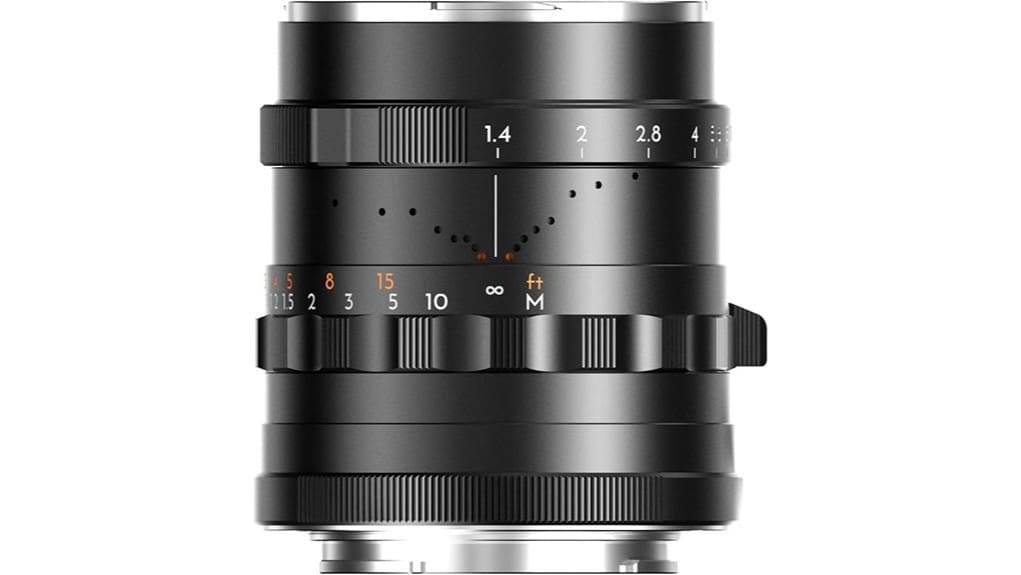
You’ll get class-leading center sharpness wide open, strong edge resolution stopped to f/2.8–f/4, and creamy, characterful bokeh from a 14-blade diaphragm with no onion rings. Chromatic aberration’s well controlled and correctable in RAW, flare resistance is good, and the bright f/1.4 gives excellent low-light performance and subject separation. The compact manual-focus body has smooth throw, a crescent tab, and infinity‑lock for repeatable operation—keep going to see handling, close‑focus use, and ideal pairings.
Some Key Takeaways
- Exceptional center sharpness wide open with strong edge resolution when stopped to f/2.8–f/4.
- Bright f/1.4 aperture delivers generous subject separation and excellent low‑light performance.
- Creamy, characterful bokeh and rounded highlights from a 14‑blade diaphragm with minimal onion‑ring.
- Manual‑focus ergonomics include smooth throw, tactile 0.7 m cue, crescent tab, and infinity‑lock for repeatable use.
- Recommended for Sony E users: pair APS‑C bodies (ZV‑E10) for run‑and‑gun, or A7 IV for full‑frame resolution and IBIS.
Quick Verdict and Summary
While it’s technically a manual-focus, 28mm f/1.4 designed for Sony E-mount, the Thypoch Simera punches well above its class: you get a full-frame-ready wide-angle with a bright f/1.4 aperture, advanced optical formula (including aspherical, ED and HRI elements) and a floating group that keeps images sharp from infinity down to 0.4 m, delivering creamy bokeh, strong subject separation and reliable edge-to-edge resolution for environmental portraits, street work and low‑light scenes. You’ll appreciate precise manual focus ergonomics, robust build quality and consistent color rendition; it’s compact, mechanically refined and tuned for professionals who demand predictable, high-utility optics. Ideal for enthusiasts, it’s a great fit for shooters using mirrorless cameras.
Optical Performance: Sharpness, Bokeh, Chromatic Aberration, and Low‑Light Behavior
Regularly, the Simera 28mm f/1.4 delivers the kind of optical performance you expect from higher‑end wide‑angle primes: exceptional center sharpness wide open, strong edge resolution when stopped to f/2.8–f/4, and consistent microcontrast across the frame thanks to its aspherical, ED and HRI elements working with the floating group. You’ll get creamy, 14‑blade bokeh that remains characterful at short focus distances without nervous onion‑ring artifacts. Chromatic aberration is well controlled, with minimal lateral and axial fringing corrected in RAW with little intervention. Low‑light behavior is excellent: generous transmission, accurate color rendition, and good flare resistance for night scenes. For critical color work and accurate skin tones, pairing the lens with a color checker helps ensure reliable color reproduction.
Handling and Focusing: Manual‑Focus Feel, Tactile Resistance, Crescent Tab, and Infinity Lock
Grab the Simera 28mm f/1.4 and you’ll immediately notice a mechanical design built for deliberate manual use: the focus ring offers a smooth, well-damped throw with a defined tactile resistance point at 0.7 m to cue the change from rangefinder-coupled framing to fine EVF adjustments, while the crescent-shaped tab lets you steer focus with a single finger for fast, repeatable pulls. You’ll appreciate the restrained gear aesthetics and compact profile that signal precision. Focus ergonomics prioritize predictable torque, short but informative travel, and an infinity-lock that prevents rotation during mount changes, improving stability and workflow speed. This lens pairs well with sturdy support gear like quick release plates to streamline hands-on shooting workflows.
Close‑Focus and Creative Control: Minimum Focus Distance, Depth of Field Examples, 14‑Blade Diaphragm, and Starburst Rendering
The Simera’s close‑focus capability shifts its utility from just manual control to tangible creative leverage: with a minimum focus distance of 0.4 m you can frame intimate foreground details while retaining a wide environmental context, and the f/1.4 aperture produces extremely shallow depth of field for subject separation at that short distance. You’ll exploit Close range storytelling with decisive foreground-to-background relationships; the floating group maintains sharpness across focus range. The 14‑blade diaphragm yields rounded highlights for refined Bokeh sculpting and crisp 14‑point starbursts stopped down, enabling controlled night‑scene flare and practical creative micro‑contrast. This makes the Simera an excellent match for photographers using follow focus systems who want precise, smooth manual focus control.
Compatibility and Practical Fit: Suitable Sony E‑Mount Bodies and Recommended Pairings for Portraits, Street, and Video
Because Sony’s E-mount lineup spans compact APS-C bodies to professional full-frame workhorses, you’ll want to match the Thypoch Simera 28mm f/1.4 to a camera that complements its optical character and manual-focus workflow. For APS-C run-and-gun or vlog setups, the Sony ZV E10 gives lightweight balance, accessible ergonomics, and usable crop-equivalent reach for environmental portraits and street shooting. For full-frame stills and hybrid video, pair with the A7 IV to exploit resolution, dynamic range, and IBIS for stabilized handheld takes. Choose bodies with focus peaking and high-resolution EVFs; prioritize ergonomics and battery life for extended manual-focus use. Consider adding a sturdy camera strap to improve comfort during long shooting sessions.
Some Questions Answered
Does This Lens Support Autofocus With Third‑Party Adapters?
No — it won’t provide autofocus through third‑party adapters. You’ll rely on manual-focus mechanics; adapter compatibility is limited to passive mounts that transmit flange alignment but not motor control. You can, however, use camera focus aids: focus peaking and electronic focus confirmation where supported. That focus confirmation helps you achieve accurate focus with the lens’s tactile resistance point, but true AF operation isn’t available via adapter on this manual‑focus design.
Is the Lens Weather‑Sealed or Resistant to Dust and Moisture?
No — the lens isn’t fully weather‑sealed; it lacks thorough environmental sealing for heavy exposure. You’ll get basic resistance to incidental dust and light moisture from its build, but it’s not rated for sustained rain, heavy dust, or submersion. You should use a protective cover or camera weather sealing when shooting in harsh conditions. For critical outdoor work, choose a lens with specified weather resistance and manufacturer IP or ingress protection details.
What Is the Filter Thread Size for Front Filters?
The front filter thread is 52mm; you’ll mount standard 52mm filter threads directly. If you need to use smaller 46mm filters or accessories, you’ll use a 46mm adapter to step down, but be aware of potential vignetting on full-frame. You’ll avoid cross-threading by aligning threads and using the infinity-lock tab during installation. For consistent optical performance, prefer high-quality slim 52mm filters to minimize edge shading and preserve corner sharpness.
How Heavy Is the Lens and Will It Unbalance Small Mirrorless Bodies?
It weighs about 420 grams, so you shouldn’t have a major lightweight concern mounting it on compact mirrorless bodies. Balance tests show a slight front-heaviness on the smallest A-series and ZV models, but the tactile design—crescent tab and infinity-lock—helps stabilize handling. You’ll get consistent ergonomics with handholding; for extended work, a small tripod or handgrip corrects any forward bias without adding bulk or compromising control.
Are There Firmware Updates Required for Optimal Camera Communication?
No, you typically won’t need camera firmware updates for basic manual operation, but check for firmware compatibility if you want enhanced communication. Some bodies receive updates to address communication quirks like EXIF tagging or focus-assist signaling. You should verify Sony E-mount camera firmware notes and install manufacturer updates when recommended. Doing so guarantees optimum metadata, focus confirmation behavior, and stable interfacing between the lens and camera.