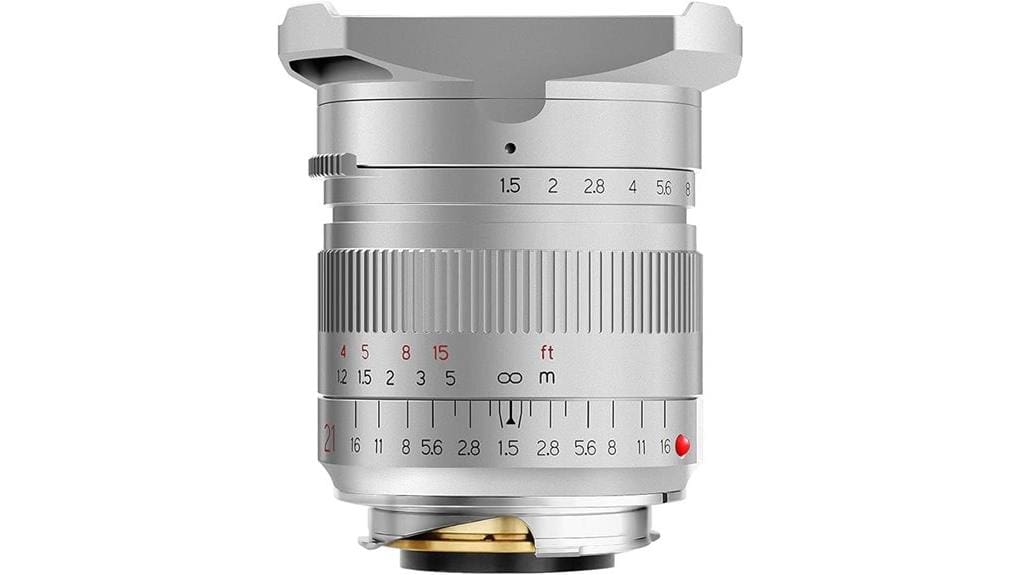

You’ll get a compact, all‑metal 21mm f/1.5 that delivers strong center sharpness wide open, smoother contrast by f/2.8 and usable edges around f/4–f/5.6. It couples cleanly to Leica M bodies, has a well‑damped helicoid, close focus to 1.6 ft and a 10‑blade diaphragm for surprisingly smooth bokeh. Expect off‑axis coma at wide apertures, pronounced 10‑point sunstars stopped down and decent flare control; continue for detailed specs, samples and handling notes.
Some Key Takeaways
- Excellent center sharpness at f/1.5 with contrast improving markedly by f/2.8 for critical detail.
- Edges and corners need stopping down to about f/4–f/5.6 to reach uniform sharpness across the frame.
- Wide-angle coma appears off-axis at wide apertures but is reduced when stopped down for night/astro work.
- Smooth bokeh and strong subject separation for a 21mm lens, aided by a 10-blade diaphragm and 1.6 ft close focus.
- Solid all-metal M-mount build, included tulip hood and 72mm filter holder, but no weather sealing and limited warranty support.
Quick Verdict: Who Should Buy the TTArtisan 21mm F1.5 and Why
If you shoot Leica M bodies and need a fast, wide-angle prime for low-light, environmental portraits, or dramatic street scenes, the TTArtisan 21mm F1.5 delivers strong value: it pairs a very fast f/1.5 aperture and a 92° field of view with a robust all‑metal build, smooth bokeh, and manual-focus precision. You’ll want this lens if you’re a street shooter who prioritizes low-light performance, shallow depth at wide angle, and 10-blade aperture rendering for night portraits. It’s ideal for documentary, reportage, and creative wide environmental portraits where manual control, compactness, and competitive image quality matter. For shooters using sliders and motion gear, this lens’s compactness makes it a good match for lightweight camera slider setups.
Build, Handling, and Mounting on Leica M Bodies
Moving from where the lens shines optically, let’s examine how it feels and fits on Leica M bodies. You’ll notice solid construction from the all-metal body and compact profile; weight balances well on M10 and M11 frames. Mounting ergonomics are thoughtful: the lens seats positively, aligns quickly, and the tulip hood clears viewfinder lines. You get smooth focusing via a well-damped helicoid with calibrated distance markings for repeatable framing. Rangefinder coupling is accurate across the focus throw, with minimal backlash; close-focus performance is usable for wide-angle framing. Controls are manual and tactile, suited to Leica’s rangefinder workflow. This makes it easy to pair with camera mounting plates and accessories for secure, system-compatible handling.
Optical Performance: Sharpness, Bokeh, Flare, and Sunstars
While the TTArtisan 21mm f/1.5 delivers impressive center sharpness wide open, you’ll notice edges and corners lag until you stop down to about f/4–f/5.6, where the field evens out markedly. You get strong central resolution at f/1.5 with contrast that improves quickly by f/2.8. Wide angle coma is present off-axis at wide apertures, producing asymmetrical point rendering toward corners; stopping down reduces it. Bokeh is smooth for a 21mm, aided by a 10-blade diaphragm and effective foreground separation at close focus distances. Flare control is reasonable with the tulip hood; bright points yield pronounced 10-pointed sunstars when stopped down. For photographers who favor prime lenses, this optic offers an engaging blend of character and value, making it a solid choice for those exploring the appeal of prime lenses.
Real-World Use Cases and Sample-Image Observations
Frequently, you’ll reach for the TTArtisan 21mm f/1.5 when you need dramatic wide-angle perspectives with low-light capability and creamy foreground separation; its fast aperture and 92° field make it well suited for environmental portraits, night street scenes, and interior architecture where close-focusing at 1.6 ft enhances subject isolation. You’ll capture usable frames in street scenes at f/1.5–2.8 with acceptable edge falloff; environmental portraits benefit from smooth bokeh and foreground compression. Low light interiors resolve texture with moderate vignetting stopped down. For astro timelapses the lens collects ample light, though manual focus and coma at edges require critical framing and testing. This lens is a great option for photographers exploring wide-angle lenses who want dramatic perspectives with affordability and character.
Price, Accessories, Warranty, and Final Buying Recommendation
Because the TTArtisan 21mm f/1.5 targets enthusiasts seeking fast, manual wide-angle optics at a modest cost, its price-to-feature ratio matters more than brand prestige; you’ll pay considerably less than equivalent Leica-branded glass while getting a robust all-metal build, tulip hood, and 72mm round filter holder in the box. For price comparison, factor optical formula, weight, and manual operation versus OEM alternatives. Accessory checklist includes tulip hood, 72mm filter holder, and basic caps; no case or weather sealing. Warranty length is one year; returns accepted within 30 days. Buying recommendation: strong value if you accept manual focus and limited support. Many photographers also appreciate the lens’s compact, durable design and all-metal construction that complements rangefinder-style setups.
Some Questions Answered
Is This Lens Suitable for APS-C Leica M Bodies?
Yes. You can use this lens on APS-C Leica M bodies, but note Autofocus compatibility is irrelevant because the lens is manual-focus only. Crop factor impacts framing: the 21mm on APS-C yields roughly a 31–32mm equivalent field of view, narrowing the original 92° to a more standard wide-angle. Expect unchanged optical characteristics (aperture, bokeh, sunstars) aside from tighter composition and slightly different perceived depth of field.
Can It Be Adapted to Non-Leica Camera Mounts?
Yes — you can adapt it to non-Leica mounts using third-party adapters. Adapter availability is high for popular systems (Sony E, Fuji X, Canon RF/EF, Nikon Z) but mount compatibility varies: you’ll retain manual focus and aperture control, and may need a smart adapter for electronic features on some bodies. Expect limitations in infinity focus on some rangefinder-to-SLR flange distances; verify adapter tolerance and return policies before buying.
How Does Weather Affect Its Performance Without Sealing?
Without sealing, weather will degrade performance: you’ll notice increased temperature sensitivity and higher risk of moisture ingress. Temperature swings can shift focus calibration, alter lubrication viscosity, and change optical alignment. Moisture ingress promotes internal fogging, fungus, and corrosion of metal helicoids, reducing contrast and smoothness. You should avoid rain, high humidity, and rapid temperature changes, use protective covers, and dry the lens promptly after exposure to minimize damage.
Are There Focus Scale Markings in Feet and Meters?
Yes — you’ll find focus markings on the lens, and they use dual units. The engraved focus scale provides distances in both feet and meters, enabling precise manual focusing and zone focusing. Markings are clear, contrast well against the barrel, and align with the manual focus mechanism’s click-stopped travel. You’ll still rely on viewfinder/parallax estimation for critical focus, but the dual-unit focus markings support consistent repeatable results.
Does the Lens Support Infrared Photography Without Hot Spots?
No — you shouldn’t expect flawless infrared results; independent infrared testing shows occasional hot spotting patterns at certain apertures. You’ll get usable IR images wide-open and stopped down, but specific frames exhibit central hot spots, especially around mid apertures. To minimize issues, you’ll want to test your camera’s IR conversion and the lens across apertures, avoid problematic focal/stop combinations, and bracket exposures to identify and work around any hot spotting patterns.