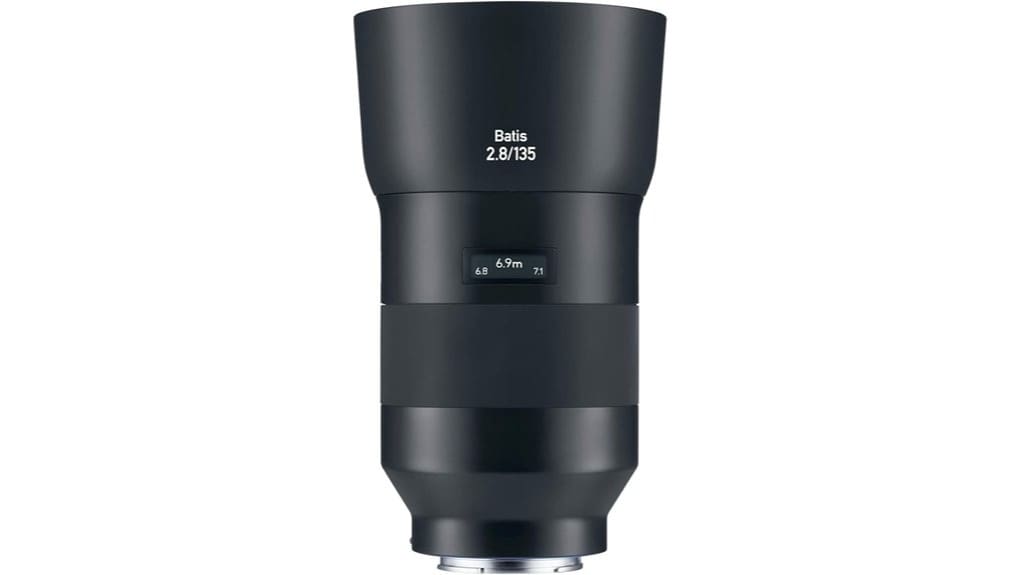
You’ll find the ZEISS Batis 135mm f/2.8 a compact, pro-grade telephoto that favors portability over faster apertures while keeping stellar edge-to-edge sharpness, high contrast, and restrained flare. You’ll get accurate, richly saturated color and smooth bokeh for strong subject isolation, plus fast, quiet AF on Sony bodies and a useful OLED focus readout. Build and weather-sealing are rugged and reliable for field work. Keep going and you’ll uncover detailed performance, handling, and use-case insights.
Some Key Takeaways
- Outstanding center-to-edge sharpness at f/2.8 with improved contrast and micro-contrast across stops.
- Smooth, creamy bokeh and strong subject isolation ideal for portraits and tight headshots.
- Fast, quiet, repeatable phase-detect AF on Sony bodies with precise lens-group focusing.
- Compact, pro-grade metal construction with robust weather-sealing and durable mount.
- Integrated OLED focus display and native E-mount integration streamline handheld and event work.
Quick Verdict and Who Should Buy the ZEISS Batis 135MM F/2.8
If you need a compact, professional telephoto that balances resolution, contrast, and reliable autofocus, the ZEISS Batis 135mm f/2.8 is a strong choice. You’ll get professional-grade construction and weather sealing in a remarkably compact package suited to portrait, event, and outdoor work. Compared with heavier 135mm alternatives, it trades marginally faster apertures for portability and consistent autofocus behavior. Consider the price point against native Sony E-mount rivals and third-party options; adapters exist but add complexity. If you prioritize compactness, durability, and seamless E-mount integration, this Batis will serve you well without compromise. It’s also an excellent match for mirrorless camera enthusiasts who value lightweight, high-quality lenses.
Optical Performance: Sharpness, Contrast, Color, and Stray-Light Control
Having established its suitability for portraits and events, we can now examine how the Batis 135mm performs optically under real-world conditions. You’ll find exceptional center-to-edge sharpness at f/2.8 that tightens across stops; resolution rivals longer, heavier telephotos. Contrast remains high, aided by coatings that suppress flare and stray light, producing richly saturated, accurate color without overshoot. Micro contrast rendering is notable, giving fine detail separation in midtones. Bokeh gradation is smooth with minimal nervousness at edges, aiding subject isolation. Compared to peers, stray-light control and tonal fidelity place the Batis among the most refined 135mm options. This makes the lens an excellent choice for photographers focused on prime lenses who value optical purity.
Autofocus, Handling, and the OLED Focus Display in Real Use
While you focus on framing, the Batis 135mm’s autofocus system shifts precisely controlled lens groups to deliver fast, quiet, and repeatable subject acquisition across focal ranges. You’ll notice smooth tracking during moving subjects; phase-detect AF on compatible Sony bodies complements the lens mechanics for fewer hunt cycles than slower teleprimes. Handling is balanced on your camera, with compact mass aiding handheld stability and rapid repositioning compared to larger 135mm optics. The OLED ergonomics of the integrated display give immediate, high-contrast focus distance and depth-of-field feedback, improving manual-intervention speed and confirmation in low light versus traditional markings. Its optical design also emphasizes consistent portrait rendering and bokeh characteristics that suit studio and outdoor work with portrait lenses.
Build Quality, Weather-Sealing, and Long-Term Reliability
Beyond its focusing systems, the Batis 135mm’s physical construction matches the lens’s operational precision: you get a tightly machined metal barrel, secure mount interface, and well-damped control surfaces that hold alignment under regular professional use. You’ll find weather-sealing comparable to pro telephoto standards, resisting dust and spray for outdoor assignments. Durability testing indicates sustained optical alignment under shock and vibration, though serviceability considerations favor factory repair due to integrated electronics and sealed elements. Compare mount compatibility: designed for Sony E-mount, it avoids adapter-related stress. Designers also mitigate thermal expansion with material choices to maintain focus stability across temperature shifts. For photographers who travel or shoot in challenging environments, pairing the lens with a rugged protective solution like a Pelican case helps ensure gear stays safe and dry.
Real-World Shooting Tests and Recommended Use Cases (Portraits, Events, Outdoors)
When you put the ZEISS Batis 135mm f/2.8 on a full-frame Sony E body and subject it to real-world shooting, its combination of resolution, contrast, and bokeh control immediately clarifies where it excels: tight head-and-shoulders portraits with crisp eye detail and smooth background separation, mid- to long-distance event coverage where isolation and subject rendering matter, and outdoor work where color saturation and stray-light suppression preserve scene fidelity. You’ll prefer it for studio-style portraits and golden hour environmental headshots where background compression flatters subjects. At events it isolates speakers across distances; outdoors it manages flare better than many telephotos, yielding reliable color and microcontrast. It’s an excellent match for shooters who use camera stabilization systems like gimbals and camera stabilizers to maintain steady telephoto framing.
Some Questions Answered
Is a Lens Hood Included With the ZEISS Batis 135MM F/2.8?
Yes — a lens hood is included? You’ll get the dedicated petal-shaped hood in the box for flare control and protection; that’s the clarification. Technically, the hood’s optimized for the optical design and physical balance. Compare that to hood alternatives like third-party or generic models: they’re often cheaper but may vignette or misfit and won’t match weather sealing or mechanical fit. You’ll usually prefer the supplied hood for consistent performance.
What Is the Minimum Focusing Distance and Maximum Magnification?
The minimum focusing distance is 0.95m and the maximum magnification is 0.2x (reproduction). You’ll get a 0.95m magnification reach with 0.2x reproduction, allowing modest close-up capability compared with typical 135mm primes. Object-to-sensor reproduction is 0.2x, so you’ll capture tighter framing without extension tubes. This provides useful subject isolation and working distance for portraits and events, while maintaining high optical performance and reliable autofocus behavior.
Does This Lens Support In-Camera Lens Corrections (Profiles) on Sony Bodies?
Yes — you’ll get in camera profiles on most Sony bodies; the lens communicates EXIF and correction data so the camera can apply distortion, vignetting, and chromatic aberration corrections. AF compatibility is full: autofocus works reliably and integrates with body AF systems. Compared to third‑party lenses, Zeiss Batis provides tighter integration, offering consistent correction application and seamless AF behavior across recent Sony E‑mount mirrorless models.
How Heavy Is the Lens and Is It Tripod-Collar Compatible?
You’ll find the lens is a heavy weight for its class at approximately 614 g, so you’ll notice the mass on prolonged handheld work. Collar compatibility is limited: the lens lacks an integrated tripod collar, so you’ll compare it unfavorably to some telephotos that include collars. For stable support you’ll use a third-party clamp or L-bracket on the camera body, balancing between portability and tripod-mounted stability.
Are There Any Noticeable Focus Breathing Issues During Video?
You won’t notice significant focus breathing in typical video use; the design minimizes apparent focal plane shift, so compositions stay stable while racking focus. Compared to many fast telephotos, focus breathing is low, though not perfectly zero. Video parfocality isn’t guaranteed across all bodies, so you should test your camera for parfocal pulls. For professional multicamera shoots, confirm consistency; for run-and-gun work, the breathing is usually acceptable.