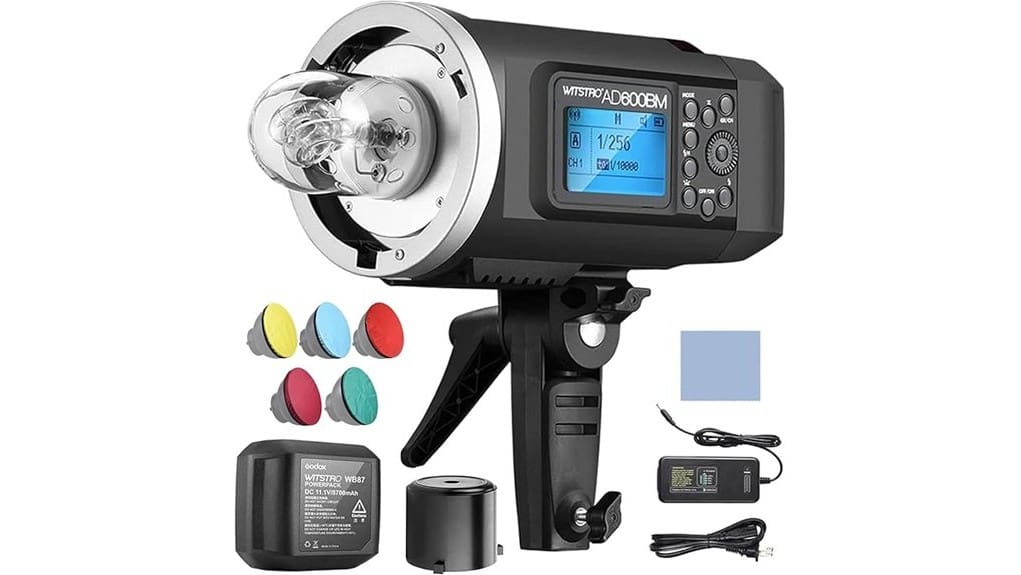
The Godox AD600BM gives you 600 WS of reliable, predictable output with GN87 and nine power steps, plus HSS to 1/8000s for fast-sync needs. Its 9000mAh battery supports long shoots and ~500 full-power cycles, while recycle times span ~0.01–2.5s depending on power. You get built-in 2.4G X-system radio for integrated wireless control, a compact magnesium/aluminum body, but no weather sealing and limited bundled accessories — continue for full test details and usage notes.
Some Key Takeaways
- 600 WS portable strobe with GN87 and nine power steps (1/256–1/1) for predictable exposure control.
- Built‑in 2.4G X‑system radio and compatibility with common triggers for integrated wireless control.
- HSS up to 1/8000s works reliably, enabling high‑speed sync without exposure inconsistencies.
- 9000mAh battery (~500 full‑power cycles, ~500 minutes runtime) supports multi‑hour outdoor shoots.
- Compact magnesium/aluminum body is durable and travel‑friendly but not weather‑sealed and somewhat heavy.
What the Godox AD600BM Is and Who It’s For
Meet the Godox AD600BM: a portable 600WS outdoor strobe built for photographers who need high output, fast recycle, and reliable wireless control. You’ll get a 600 WS unit with GN87, nine power steps (1/256–1/1), 2.4G X-system radio, and a 9000mAh battery delivering roughly 500 full-power cycles. It’s aimed at budget shooters and hybrid photographers who mix location and studio work, requiring portable TTL-compatible manual control and HSS to 1/8000s. The unit’s 5600K output, 2″ display, and accessory set suit practical deployment. It’s not weather-sealed; verify environmental needs before field use. Many photographers pair portable strobes like this with flash diffusers to achieve softer, more flattering light.
Real-World Performance: Output, Recycle, and High-Speed Sync Tests
Having covered what the AD600BM is and who it’s for, let’s examine how it performs in practice: output consistency, recycle timing, and HSS behavior. You’ll see reliable peak brightness at 600WS across the mid-to-low power range; measured output steps are predictable and repeatable, useful for exposure planning. Recycle times span quoted 0.01–2.5s depending on power, and you’ll get near-instant reuse at 1/16 or lower. High-speed sync up to 1/8000s functions cleanly with stable exposures, though continuous firing elevates thermal behavior: the unit warms noticeably under prolonged bursts, triggering longer cool-down intervals. It’s a strong match for photographers who need portable, powerful lighting on location, especially when paired with sturdy light stands for reliable outdoor setups.
Battery Life, Build, and Portability for Outdoor Shoots
Because the AD600BM uses a 9000mAh Li‑ion pack and a compact magnesium/aluminum body, it balances high-capacity runtime with manageable weight for location work. You’ll get roughly 500 full-power cycles and an average battery longevity of 500 minutes, which covers multi-hour shoots without swapping cells. The chassis resists dings while keeping mass low; controls sit intuitively for quick adjustments. Its travel friendly design fits most gear bags and airline carry constraints when packed correctly. You’ll still want protective padding and spare diffusion, but for outdoor assignments the unit delivers predictable endurance, ruggedness, and portability. External camera monitors can further improve outdoor shooting workflows by providing a clearer view of composition and exposure on portable displays.
Connectivity, Compatibility, and Flash Control in Mixed Setups
After you’ve confirmed the AD600BM’s battery and build suit location work, you’ll want to verify how it integrates with the rest of your kit. You’ll use the built‑in 2.4G X system for reliable triggering; radio channel management lets you assign groups and channels to avoid interference. The unit interoperates with Godox flashes and compatible Nikon/Canon hot‑shoe transmitters, enabling multi brand integration when you standardize on Godox radio triggers. Control is manual on the head, with 9 power steps and HSS support to 1/8000s; you’ll mix TTL units only if you maintain system compatibility and matching trigger firmware. Consider adding a flash bounce card to improve outdoor fill and soften shadows when using the AD600BM.
Pros, Cons, and Buying Verdict: When to Choose the AD600BM
While the AD600BM isn’t the cheapest option, it delivers a strong balance of portable power and modern triggering, making it a solid choice if you need 600 WS output, reliable 2.4 GHz X-system radio control, and HSS to 1/8000s in a single battery-powered head. You’ll get consistent GN87 output, fast recycle, and a 9000mAh battery that supports extended shoots. Downsides: no waterproofing, relatively heavy, and fewer accessories in-box. If you prioritize long term reliability and integrated radio control, pick the AD600BM. If cost or lighter travel rigs matter, evaluate budget alternatives before buying. Consider pairing it with continuous LED photo lights for mixed lighting setups and improved on-set previewing with perfect LED lighting.
Some Questions Answered
Does the AD600BM Include a Protective Carry Case?
No — the AD600BM package doesn’t include a protective case or travel pouch. You get the AD600BM unit, 9000mAh battery, flash tube, charger adapter, power cable, user manual and five diffusers. If you need a protective case or travel pouch, you’ll have to buy one separately; look for padded, form-fit options rated for studio strobes and compatible with the AD600BM’s dimensions to protect the head, battery and accessories during transport.
Can the Flash Be Used Indoors With Studio Monolights?
Yes — you can use it indoors with studio monolights. You’ll operate the AD600BM as a manual or TTL triggering slave within the Godox 2.4G X system, and it’ll integrate with other Godox units for coordinated output. For mixed-brand monolights, guarantee Sync compatibility via optical triggering or a sync cable/trigger; note the AD600BM doesn’t natively convert monolight TTL, so you’ll control exposure manually when needed.
Is There a Built-In Modeling Light and How Bright Is It?
Yes — it has a built-in modeling light. You’ll get an LED modeling brightness intended for framing and previewing shadows rather than continuous studio illumination. The LED temperature is rated near 5600 K to match flash color. You can adjust modeling output for composition; it’s not specified in lumens but is moderate, designed for short-term use and battery efficiency. It won’t replace powerful continuous monolights.
What Are the Exact Battery Charging Times and Charger Specs?
The battery charges in about 2.5–3.5 hours using the supplied charger and adapter; exact time varies with remaining capacity. The 9000mAh Li‑ion battery gives ~500 minutes average runtime and ~500 full charge cycles (Battery lifespan noted). Use the included charger specs: compatible adapter, standard mains input to charger unit, output matched to the battery pack (proprietary voltage/current). You should follow manufacturer charging recommendations.
Does the Unit Support Firmware Updates via USB or Wireless?
No, it doesn’t support firmware updates via USB or wireless. You’ll rely on firmware methods limited to Godox service repair or authorized dealers; update limitations mean end-user updating isn’t provided through a USB port, OTA radio, or app. You should contact Godox support for firmware revision status or send the unit to an authorized center for firmware installation. Keep firmware methods and update limitations in mind when planning compatibility or feature upgrades.