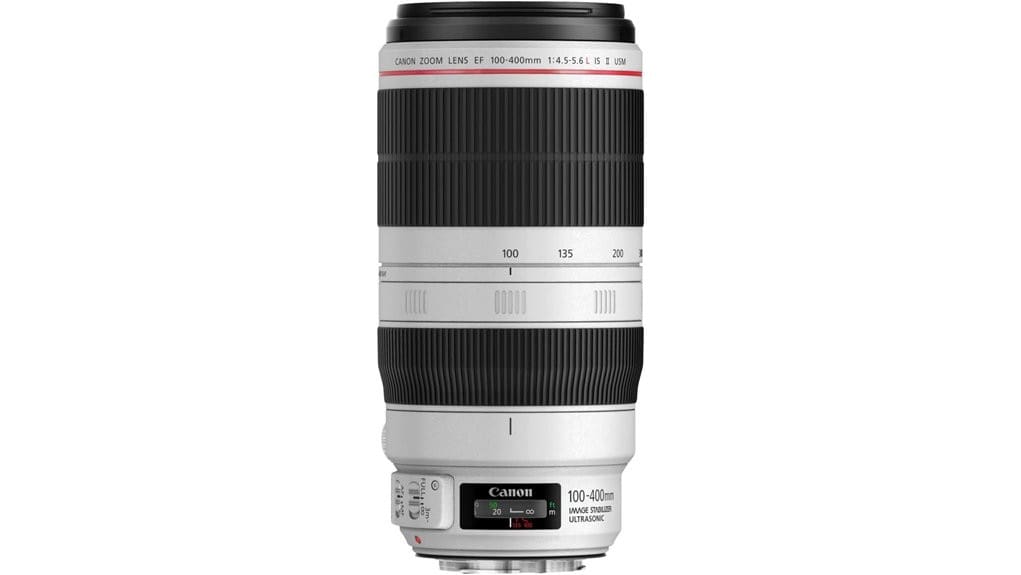
You’ll get a weather‑sealed L‑series 100–400mm f/4.5–5.6 tele zoom that’s aimed at sports and wildlife shooters who need reach and reliability. Center sharpness is strong stopped to f/8 across the range, edges soften at 400mm compared with primes, and the Air Sphere Coating controls flare well. USM AF is fast and quiet, IS gives multi‑stop stabilization, and the adjustable zoom torque aids handheld work. Keep going and you’ll find deeper notes on handling, durability, and alternatives.
Some Key Takeaways
- Canon EF 100–400mm f/4.5–5.6 L (9524B002-IV) delivers strong center sharpness, especially around f/8, with slightly softer edges at 400mm.
- Creamy bokeh and effective background separation at long focal lengths make it well-suited for wildlife and sports subject isolation.
- ASC coating and optical design mitigate flare well, though extreme sun angles can produce subtle veiling.
- Compact rotation-type zoom with adjustable torque, USM AF, and built-in IS provide fast handling, silent tracking, and multi-stop stabilization.
- Robust weather sealing and durable construction favor outdoor use, but consider adapters and AF differences on mirrorless systems.
What the Canon 9524B002-IV EF 100-400mm Is and Who It’s For
While its focal range and build clearly mark it as an L-series super-telephoto zoom, the Canon 9524B002-IV EF 100-400mm f/4.5-5.6L IS II USM is a purpose-built lens for sports and wildlife shooters who need reach, durability, and reliable image quality in challenging conditions. You’ll find a 100–400mm range, ASC coating, USM AF, and built-in IS that suit paced action and distant subjects. Its compact, rotation-type zoom and adjustable torque let you compose handheld with control. It’s overkill for many beginner photographers, yet travel enthusiasts who prioritize reach and weather resistance will value its robust, mission-focused design. The lens is a strong example of what makes prime lenses prized among serious photographers.
Real-World Image Quality: Sharpness, Bokeh, and Flare Control
Now that you know what this lens is built for, let’s look at how it performs on the image level: sharpness across the frame, the character of out-of-focus areas, and how well the Air Sphere Coating and optical design manage flare. You’ll find center sharpness strong from 100–400mm stopped to f/8; edge sharpness trails slightly at 400mm, useful in a sharpness comparison with primes. Out-of-focus rendering gives a creamy bokeh with smooth gradations and effective background separation at longer focal lengths. ASC and element layout provide reliable flare mitigation in backlit scenes, though extreme sun angles can still induce subtle veiling. For photographers using off-camera lighting, pairing the lens with dedicated flash triggers can help maintain consistent exposures in mixed lighting.
Handling, Autofocus, and Stabilization When Shooting Sports and Wildlife
Get a feel for the Canon 100–400 II quickly: its compact, balanced barrel and rotation-type zoom ring let you recompose fast and maintain stability during handheld tracking, and the improved zoom-tension collar lets you lock in the exact resistance you prefer for rapid focal changes. You’ll notice fast tracking performance from the USM-driven AF coupled with responsive camera-body metering, delivering reliable subject acquisition across the range. Silent focusing reduces audio disturbance and minimizes hunting. Built-in IS provides multi-stop compensation, helping steady framing during panning and high-zoom shots. Adjust zoom torque to match shooting style; it directly affects balance and follow-focus smoothness. This makes the lens particularly well-suited for wildlife photography and action shooting where reach and handling are critical.
Build, Weather Resistance, and Practical Durability in the Field
Because Canon engineered the 100–400 II with rigorous sealing and robust materials, you’ll find it stands up well to adverse field conditions without adding unnecessary bulk. You’ll notice rugged ergonomics: the rotation-type zoom ring, textured focus ring, and balanced weight distribution let you operate handheld for extended periods with minimal fatigue. Sealing effectiveness is evident at joints and switches; resistance to dust and splashing is reliable in rain or dusty environments. Construction uses high-grade polymers and metal mounts for impact tolerance. In practice, routine knocks, wet conditions, and extended outdoor use produce predictable, serviceable durability without compromising performance. Many photographers pair these lenses with Pelican cases for secure transport and storage.
Should You Buy It? Price, Alternatives, and Final Verdict
Having seen how well the 100–400 II holds up in rough conditions and how its ergonomics aid long handheld sessions, you’ll want to weigh that real-world durability against its price and competing options. You should compare price comparison figures for international (no-warranty) units versus domestic models, factor typical buying timeline for seasonal sales, and assess resale value for later upgrades. If you use Canon EF or adapter-friendly bodies, alternative mounts are viable but add cost and AF nuance. Buy if you need reliable reach, weather sealing, and IS; wait if budget, AF speed on adapted bodies, or prime sharpness matter more. For mirrorless photographers, consider how lens compatibility and adapter use affect performance with mirrorless camera bodies.
Some Questions Answered
Is This International Version Compatible With All Canon DSLR Bodies?
Yes — you can use this international EF 100–400mm on all Canon DSLRs with an EF mount; it communicates fully for AF, IS, and exposure. Be aware of firmware differences across camera bodies that might affect AF microadjustment behavior or feature compatibility. Also note warranty implications: international versions typically lack local warranty coverage, so you’ll assume service responsibilities or pay import/service fees if repairs are needed outside the original region.
Does the Lens Include Image Stabilization Modes for Panning?
Yes — it includes stabilization modes that help with panning. You’ll get a standard multi-mode IS and a dedicated panning mode that prioritizes horizontal tracking, improving panning effectiveness by stabilizing only the perpendicular axis. That reduces correction in the panning direction to avoid fight against intentional motion. You’ll still need proper technique and shutter speed choices, but the lens’ IS and ASC coatings combine for reliable, technically sound stabilization during tracked subjects.
What Accessories Are Included in the Package?
You get a full accessory set: lens body, removable tripod collar, zoom and focus caps, lens hood, soft pouch, front and rear caps, and instruction manual listed in the box contents. It’s noted as an international version, so a warranty card typically isn’t included or carries no local warranty; verify seller specifics. You’ll also find the padded packaging and documentation for optical/IS operation and care instructions for weather sealing.
Can the Front Element Accept 77MM Filters?
Yes — the front element accepts 77mm filters. You’ll thread screw-on filters onto the lens’s front when the lens hood is removed; the package typically includes a front cap that protects those threads. With the hood attached in shooting position, you can’t mount a filter directly, so you’ll remove or reverse the hood for filter use. Make sure you use high-quality, thin 77mm filters to avoid vignetting at longer focal lengths.
Is This Lens Compatible With Canon Teleconverters?
Yes — you can use Canon 1.4x and 2x teleconverters, but teleconverter performance varies. You’ll gain focal length but lose light and AF reliability: with 1.4x you typically retain autofocus behavior for many subjects (effective aperture reduced ~1 stop), while 2x often drops you below AF limits and slows focusing or forces manual focus in low light. Expect increased aberrations, reduced stabilization effectiveness, and slightly altered AF speed/accuracy.