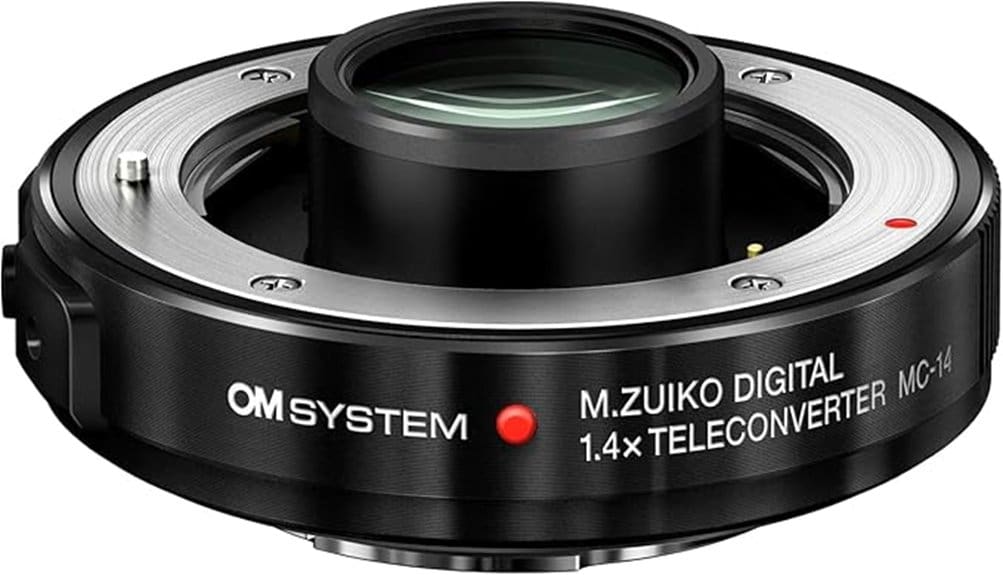
You’ll get 40% more reach with minimal compromise: the MC-14 turns a 40–150mm into a 56–210mm (and a 300mm F4 into ~420mm), preserving razor-sharp edges and excellent close-focus while costing far less and weighing much less than buying a longer tele. Autofocus stays fast and stable, stabilization remains effective, and the metal, weather-sealed mount feels pro-grade. It’s ideal if you want added reach and portability; keep going to see full performance and use-case comparisons.
Some Key Takeaways
- Converts focal length by 1.4× (e.g., 40–150mm → 56–210mm; 300mm → 420mm) with about one-stop light loss.
- Maintains high sharpness and edge-to-edge resolution better than many converters, preserving OM optics character.
- Autofocus remains fast and reliable with PRO lenses, showing minimal hunting and consistent acquisition.
- Compact, metal build with weather sealing matches PRO lenses and stays balanced on 40–150mm, heavier on 300mm.
- Ideal for sports, wildlife, and travel photographers needing extra reach and portability; skip if you need maximum aperture or prime-only optics.
Hands-on Verdict: Is the MC-14 Worth Buying?
Wondering if the MC-14 is worth adding to your kit? You’ll find its compact build, metal bayonet and weather sealing justify the cost for pros who value durability. Compare its ultra-fast focusing and stabilization benefits against buying a heavier tele lens; price considerations favor the MC-14 when you already own the 40–150mm F2.8 or 300mm F4 PRO. You’ll keep razor-sharp edges and excellent close-focus performance without replacing glass, so long term compatibility with those two PRO lenses makes it a smarter investment than a new tele. If you need magnification efficiency and portability, it delivers. The MC-14 pairs especially well with prime lenses commonly featured on Mastering Prime Lenses for Stunning Photography.
How the MC-14 Changes Reach and Image Quality (1.4× Effects)
Having decided the MC-14 can be a smarter, lighter alternative to buying a longer tele lens, let’s look at exactly what that 1.4× factor does to reach and image quality. You gain 40% more focal length—40–150mm becomes 56–210mm—so subjects fill the frame faster and angle compression increases noticeably, improving background separation without changing perspective. Resolution stays high; OM’s optics preserve edge sharpness better than many converters. Expect a modest light loss (about one stop) and slightly increased diffraction impact at smaller apertures, so you’ll prefer to stop down cautiously. Overall, reach improves with minimal, predictable optical trade-offs. The MC-14 is a product aimed at photographers who want to make the most of teleconverters for better photography.
Real-World Performance: Autofocus, Stabilization, and Close-Focus Results
Although the MC-14 adds just 40% more reach, you’ll notice its real-world behavior in autofocus, stabilization, and close-focus far outperforms what you might expect from a compact teleconverter. You get impressively fast AF acquisition and consistent autofocus consistency across the supported PRO lenses, with minimal hunting compared to other extenders. Stabilization remains effective; the camera-lens VC combo delivers reliable handheld sharpness even at longer equivalent focal lengths and modest shutter speeds. Close-focus capability stays strong, enabling tight tele-macro frames without sacrificing edge-to-edge detail. In side-by-side shoots the MC-14 preserves responsiveness and usability rather than degrading handling. For photographers using heavier setups, pairing with heavy-duty light stands can improve stability and make prolonged shoots more comfortable.
Build, Weather Sealing, and Mounting With 40–150mm PRO and 300mm F4
When you mount the MC-14 between either the 40–150mm PRO or the 300mm F4, you immediately notice OM System stuck to the same premium construction standards as their PRO lenses: a solid, compact barrel with a metal bayonet that feels secure and tight in your hand. You’ll appreciate the tight tolerances and balance—adding the MC-14 barely shifts handling on the 40–150mm but feels more front-heavy on the 300mm. Weather sealing matches the lenses, so you won’t hesitate in damp conditions. The metal mount mates precisely, minimizes play, and endures repeated attachment in professional use. This accessory is a natural fit for photographers who prefer using tripod heads to stabilize long lenses and teleconverters.
Who Should Buy the MC-14 and When to Skip It (Use Cases and Alternatives)
If you shoot sports, wildlife, or travel and already own the 40–150mm PRO or 300mm F4, the MC-14 immediately extends your reach with minimal image-quality compromise and is worth adding to your kit; its 1.4× boost turns the 40–150 into a versatile 56–210mm and the 300 into a 420mm workhorse without forcing you to carry a separate heavy tele. You should buy it when reach and portability matter, when autofocus speed and edge-to-edge sharpness are priorities, or when wildlife priorities demand closer framing. Skip it if you need absolute maximum aperture, prefer prime-only optics, or seek affordable alternatives like used longer primes. The MC-14 is designed to complement OM System’s lineup by maintaining high optical performance with compatible lenses such as the M.Zuiko PRO series.
Some Questions Answered
Is the MC-14 Compatible With Other Olympus/Om Lenses Beyond Those Listed?
Yes — but selectively. You’ll find mount compatibility limited to specific Olympus/OM lenses designed for the Micro Four Thirds system and optimized for the MC-14’s optics. You shouldn’t expect full functionality with every lens; optical performance, autofocus speed, and image stabilization remain excellent only with the two recommended PRO telephotos and a few compatible zooms/primes. Compare lens specs and manufacturer compatibility lists before relying on the MC-14 for critical work.
Does the Teleconverter Affect Lens Maximum Aperture Exposure Metering?
Yes — the teleconverter reduces the lens’s maximum aperture and your camera reports that change for aperture reporting and metering. You’ll get 1.4× less light (one full stop is 1.414×; MC-14 reduces light accordingly), so exposure compensation or auto-ISO will be applied by the camera to maintain correct exposure. Compared to using the lens alone, you’ll need to account for the smaller effective aperture when judging depth of field and exposure.
Can the MC-14 Be Used With Extension Tubes or Adapters?
Yes — you can use the MC-14 with some extension tubes or adapters, but you’ll need to check extension compatibility and beware of flange adjustments. You’ll maintain autofocus and metering with compatible Olympus/OM System adapters, yet third-party tubes may disable electronics or require flange adjustments that change focus range. Compared to using tubes alone, combining the MC-14 narrows effective aperture and increases sensitivity to focus and aberrations. Always test specific combos.
Will Firmware Updates Be Needed for Camera/Mc-14 Compatibility?
Yes — you should expect occasional firmware updates to guarantee compatibility. You’ll run compatibility checks against your camera body support list before mounting the MC-14, and update camera and lens firmware when release notes indicate fixes or new features. Compared to older converters, modern teleconverters rely more on matched firmware for AF and stabilization, so staying current prevents performance gaps and maintains reliable autofocus, sharpness, and video stabilization.
What Accessories Are Recommended for Transport and Protection?
Use a compact transport case with padded dividers to carry the teleconverter and lenses; it beats soft bags for shock protection. Add a snug protective pouch for quick handling and dust resistance. Keep lens caps on both ends when not mounted and store a soft lens wrap for extra padding or separating items. Compare options: hard case for flights, padded backpack insert for daily shoots—choose based on travel type and weight limits.