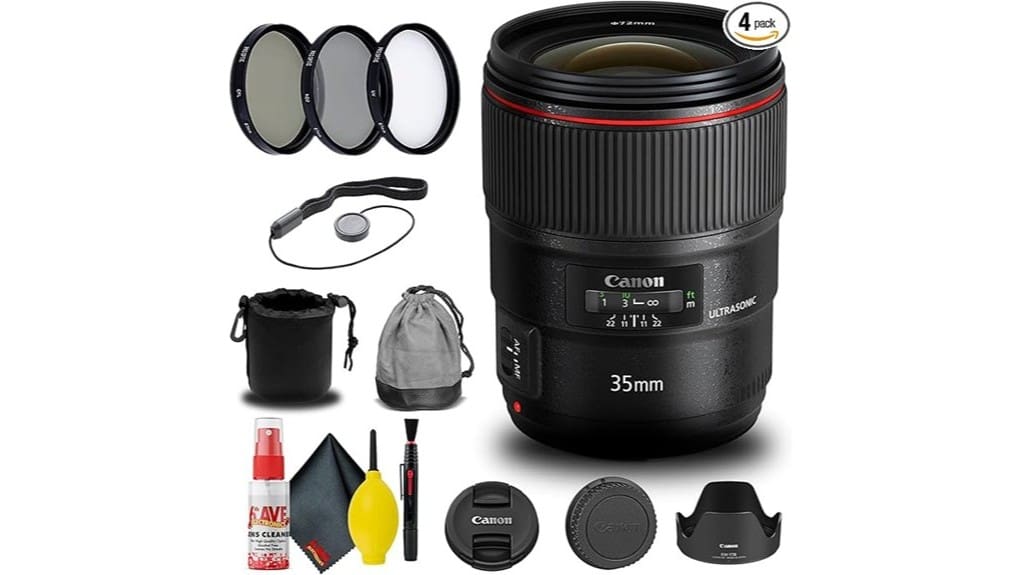
You’ll find the Canon EF 35mm f/1.4L II USM delivers class-leading center sharpness, excellent corner improvement by f/2.8–f/5.6, and neutral color with faithful saturation. Its BR and BD‑RE elements, plus aspherical and UD glass, control lateral and longitudinal CA and yield smooth, rounded-9‑blade bokeh. Ring‑type USM provides fast, quiet AF with full‑time manual override, and robust L‑series sealing aids field use. Keep going and you’ll uncover detailed performance, handling, and setup guidance.
Some Key Takeaways
- Exceptional center sharpness at f/1.4 with peak resolution around f/4 and usable corners by f/2.8–f/5.6.
- Advanced optics (BR, two aspherics, UD, BD-RE) minimize chromatic aberration and deliver neutral, accurate color.
- Fast, quiet ring-type USM autofocus with full-time manual override for reliable stills and video focusing.
- Durable L-series build, dust/moisture sealing, smooth controls, and a rounded 9-blade diaphragm for pleasing bokeh.
- Ideal for low-light events, environmental portraits, and cinematic use on full-frame and EF-mount cinema bodies.
Optical and Build Highlights: What’s New in the EF 35MM F/1.4l II USM
While Canon retained the classic 35mm f/1.4 focal length, the EF 35mm f/1.4L II USM introduces distinct optical and build refinements that improve image quality and field reliability. You’ll note Optical innovations: a Blue Spectrum Refractive element, two asphericals, one UD element, subwavelength and fluorine coatings — all aimed at reducing chromatic aberration and improving transmission. You’ll appreciate Build improvements: L-series construction, dust- and moisture-sealing, durable mount, and refined mechanical tolerances for consistent AF performance. Autofocus uses a ring-type USM with full-time manual override, delivering fast, quiet operation suited to professional workflows and demanding shooting conditions. Essential lens accessories like filters and cases help protect and extend the life of your gear, making them a smart add-on for any Essential Lens Gear.
Real-World Image Quality: Sharpness, Bokeh, Color, and Aberration Control
Assess sharpness, bokeh, color rendition, and aberration control by examining how the lens performs across apertures and real shooting scenarios. You’ll find center sharpness excellent wide open at f/1.4, with usable corners improving by f/2.8–f/5.6; resolution peaks near f/4. Bokeh is smooth thanks to the rounded 9-blade diaphragm and BD-RE element, producing clean subject separation. Color rendition stays neutral with faithful saturation and minimal tint. Lateral chromatic aberration and fringing are well controlled; longitudinal CA is modest at wide apertures. Contrast rendition and micro contrast preservation remain strong, delivering textured, three-dimensional images across conditions. This review is tailored for photographers who enjoy creative perspectives with fisheye lenses, drawing on experience with gear-focused shooting and product usage.
Autofocus, Handling, and Weather Sealing in Everyday Shooting
When you engage the Canon EF 35mm f/1.4L II USM, its ring-type Ultrasonic Motor drives fast, quiet autofocus with immediate acquisition and reliable tracking for both stills and video; full-time manual override lets you fine-tune focus without switching modes. You’ll experience consistent focus performance across subjects and light levels, with minimal hunting and quick recovery. The lens’ weight and balanced center give tactile handling that’s predictable during handheld work; focus and aperture rings provide positive detents and smooth travel. Robust L-series construction includes dust- and moisture-sealing, so you can continue shooting in adverse conditions without compromising reliability or function. This makes it an excellent choice for photographers using lens mount adapters to pair legacy or third-party lenses with modern camera bodies.
Who Should Buy This Lens: Use Cases, Camera Compatibility, and Alternatives
If you shoot low-light events, environmental portraits, street scenes, or cinematic EOS/EF-mount video and need fast, wide-angle reach with exceptional optical correction, the Canon EF 35mm f/1.4L II USM is a strong choice. You’ll benefit if you prioritize lowlight events, travel photography, street shooting, or landscape portraits that demand sharp central resolution and controlled aberrations. It pairs natively with full-frame EOS DSLRs and EF-mount cinema/Blackmagic bodies; on APS-C it yields ~56mm equivalent. Alternatives include faster-width primes or lighter 35mm options with simpler optics if you want reduced weight or lower cost; consider focal-length-specific tradeoffs before choosing. For mirrorless shooters looking to adapt legacy glass, consider the benefits of EF-mount compatibility when planning your kit.
Final Verdict and Buying Tips: Value, Recommended Setups, and Accessories
Although the Canon EF 35mm f/1.4L II USM carries a premium price, you’ll get class-leading sharpness, superior aberration control and durable L-series build that justify the cost for pro shooters and serious enthusiasts who need fast wide-angle performance. Value depends on your workload: prioritize it if you shoot low-light, event, or editorial assignments; otherwise weigh budget considerations against high-quality third-party or used alternatives. Recommended setups: full-frame 5D/1D bodies for peak resolution, APS-C bodies for tighter framing. Include the supplied 72mm filters and cleaning kit; add a solid tripod (sturdy ballhead) per tripod recommendations and a lens cap keeper. For stabilization and consistent framing during long exposures, pairing this lens with a sturdy tripod from Perfect Tripods is highly recommended.
Some Questions Answered
Does This Lens Accept Third-Party Teleconverters for Longer Reach?
Yes — you can use third-party teleconverters, but you’ll run into limitations. Teleconverter compatibility depends on optical design and electronic coupling; many third-party TCメーカー support the Canon EF mount and will physically mount to this lens but may reduce autofocus performance, lower effective aperture (e.g., f/2.8 with a 2×), and increase aberrations. Use compatible mount adapters cautiously, verify AF confirmation and image quality with your camera body, and prefer tested TC/lens combinations.
Is the Lens Suitable for Video Autofocus Tracking Performance?
Yes — but with limitations. You’ll get fast, quiet AF from the ring-type USM and reliable continuous AF in many EOS bodies, yet stabilization limitations mean you shouldn’t expect in-body or optical stabilization from this lens. For tracking moving subjects in video, performance depends on camera AF system and settings; use compatible EOS bodies with advanced Dual Pixel or continuous AF modes and steady camera technique to maximize results.
Can the Front Element Accept Standard 72MM Screw-On Lenses Accessories?
Yes — the front element accepts standard 72mm screw-on accessories. You’ll attach filters to the filter thread and the included lens cap fits over the front to protect elements when not shooting. The lens uses a 72mm filter thread, so circular polarizers, ND filters, and protective filters screw on securely. The design retains access for the lens cap and preserves coatings; take care when swapping to avoid touching exposed optics.
What Is the Warranty Coverage and Service Center Availability?
You get a Canon limited warranty that covers defects in materials and workmanship for a specified period from purchase; it won’t cover accidental damage or cosmetic wear. You should register the product and keep your proof of purchase. Service and repairs must be performed by an authorized service center to maintain warranty validity; unauthorized repairs void coverage. Contact Canon support or local dealers to locate authorized service centers and confirm regional warranty terms and duration.
Does the Lens Exhibit Focus Breathing During Video Recording?
Yes — you’ll notice modest focus breathing when recording video; the lens shifts slightly in framing as you rack focus. That behavior is typical for many fast primes and stems from optical design priorities for image quality rather than video-centric parfocal performance. There’s no built-in image stabilization to mask breathing or smooth focus shifts, so you’ll rely on careful focus pulls, external stabilizers, or post-crop adjustments to manage framing and perceived motion.