You’ll get a portable, battery-powered 600W-equivalent monolight that’s ideal for event, portrait, and location work. It delivers stable color, fast recycle (0.01–0.9s), HSS support, and short flash durations for freeze action, plus built-in R2 wireless and Bowens compatibility for modifiers. Battery life matches ratings at mid power but drops with repeated full dumps, so plan spare packs. Build is lightweight rather than heavy-duty; keep going and you’ll find full test results, comparisons, and practical tips.
Some Key Takeaways
- Portable 600 W-equivalent monolight with Bowens mount ideal for event, portrait, and location shooters.
- Fast recycle (0.01–0.9 s) and short flash duration (1/220–1/10000 s) enable high-speed freeze and quick shooting.
- Native R2 wireless, HSS support, and logical controls provide reliable triggering, TTL/manual remote, and workflow efficiency.
- 28.8V 2600 mAh battery gives near-rated mid-power shots but degrades with repeated full dumps; plan spares and cooling.
- Excellent value with competitive features and performance, but lighter build and limited ruggedness compared to pro metal units.
Quick Verdict: Who the XPLOR 600 PRO Is Best For
While the XPLOR 600 PRO suits a wide range of shooters, it’s especially well matched to event, portrait, and location photographers who need a portable, high‑output monolight with reliable color and fast recycle times. You’ll find it balances power and mobility: 600 W output, battery operation, and Bowens compatibility make modifier use straightforward. Beginners photographers and event shooters benefit from stable color temperature mode and built‑in R2 wireless, simplifying setup and consistency. You can push high-speed sync and expect predictable exposure across settings. It’s pragmatic gear for users who prioritize color stability, portability, and straightforward wireless control. For shooters building a kit around continuous and flash solutions, integrating LED panels can help maintain consistent lighting across stills and video with perfect lighting options.
Real-World Performance: Power, Recycle, and Flash Duration Tested
Testing the XPLOR 600 PRO‘s output and recovery under real shooting conditions shows it delivers the promised balance of power and speed: you get a full 600 W-equivalent burst, reliable mid–to–low power steps, and consistently usable light down to 1/256. You’ll see recycle times between 0.01–0.9 s depending on output, matching spec and keeping pace for most portrait and event work. Flash duration ranges 1/220–1/10000 s, giving freeze capability at high speeds. Trigger latency testing revealed responsive firing with minimal lag. Short term overheating was controlled; prolonged high-rate bursts require modest cooldowns to avoid thermal protection. This makes it a strong choice for photographers who use wireless flash triggers and portable lighting systems in varied shooting environments.
Battery Life, Charging, and Flash-per-Charge Reality
Having confirmed the head’s power and recovery, it’s worth looking at how the battery performs in real use and what “up to 360 flashes” means for a working session. You’ll find that the 28.8V, 2600 mAh pack delivers close to rated flashes at mid power but falls short at sustained full power. Measure real world longevity with cycle testing: repeated full dumps heat the pack and reduce counts. Adopt sensible battery maintenance and charging habits—avoid deep discharge, cool between runs, and use the supplied charger. Expect variation by power setting; plan swaps or spares for commercial shoots. For photographers using multiple lights, consider investing in dual battery chargers to keep packs ready and minimize downtime.
Controls, Connectivity, and Accessory Compatibility (Bowens + R2)
Because the XPLOR 600 PRO pairs a straightforward layout with a full-featured wireless system, you’ll get fast, reliable control both on the unit and remotely. The top-panel dials and LCD are logical; you’ll set power, modeling lamp, and modes quickly. R2 integration means native radio triggering, TTL and manual remote control, and broad camera compatibility without adapters. Bowens compatibility gives you instant access to standard modifiers, from softboxes to reflectors, simplifying kit building. Physical ports are minimal but adequate: sync, USB for firmware, and charger contacts. Overall, controls and connectivity prioritize efficiency and ecosystem flexibility for working photographers. Brighten your photography with on-camera LED lights using the XPLOR 600 PRO to complement flash setups and continuous lighting for versatile lighting.
How It Compares to Rivals and When to Buy or Skip It
While it doesn’t reinvent the category, the XPLOR 600 PRO nails the essentials—power, battery endurance, and R2/Bowens compatibility—that most photographers need from a portable monolight. You’ll find its price positioning aggressive versus legacy brands, offering strong feature parity with rivals at a lower cost. Build quality feels solid for location work, though pros used to metal-bodied units might note lighter materials. Choose it if you prioritize HSS, fast recycle, and wireless integration without paying premium. Skip it if you need ruggedized construction, exhaustive service support, or bleeding-edge color fidelity beyond this model’s stable output. It’s a solid choice for photographers who shoot on location and need reliable, portable lighting with video light kit compatibility.
Some Questions Answered
Does It Include a Protective Carrying Case for Travel?
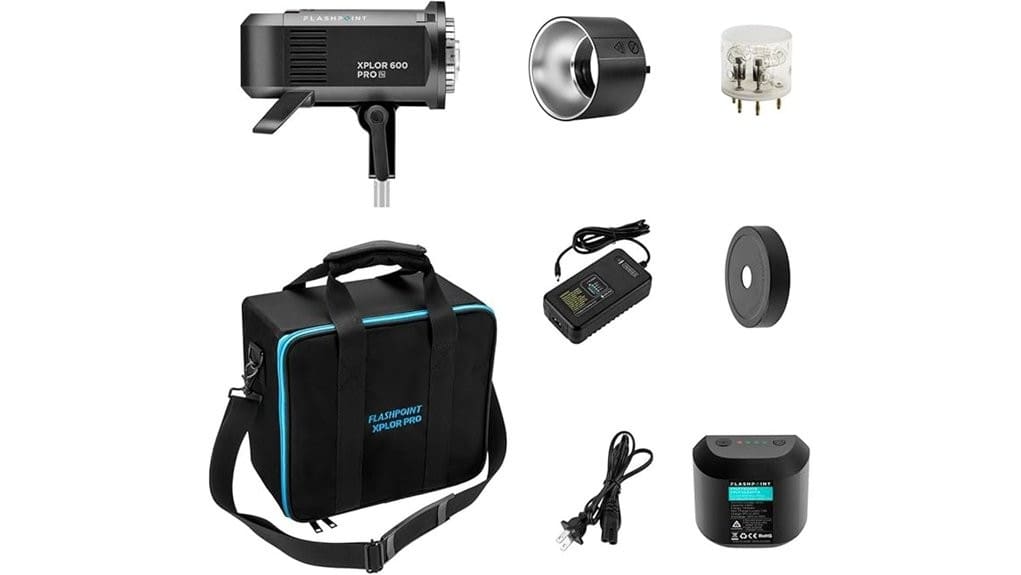
Yes — it includes a compartment case as a protective accessory, so you can pack it for travel. You’ll get the rechargeable battery, charger, flashtube, reflector and cap alongside the protective accessories designed to improve travel durability. The compartment case offers organized storage and basic impact protection, but you may want a hard case or extra padding for rough handling or frequent air travel to maximize long‑term durability.
Can It Be Used Handheld for Long Portrait Sessions?
Yes — you can use it handheld for long portrait sessions, but plan ergonomics. The included battery offers many flashes per charge, and a battery grip improves handling and weight distribution, reducing fatigue. At 600W output recycling and high‑speed sync help workflow, though overall weight still matters for multi‑hour shoots. Consider a battery grip, balanced camera mount, or a light stand swap to maintain comfort and consistent framing.
Is There a Modeling Light and What Type Is It?
Yes — it includes an LED modeling light. You’ll get an LED modeling lamp with variable intensity so you can preview lighting and shadow control. The lamp’s brightness is adjustable, letting you fine‑tune exposure and subject placement without firing the flash. That Variable intensity feature aids consistent composition and faster workflow, and it works well with the unit’s Stable Color Temperature Mode to maintain color accuracy during setup and shooting.
Are Firmware Updates User-Installable via USB or Wireless?
You can install firmware updates yourself; the firmware procedure uses USB connection to the unit rather than wireless. You’ll connect, run the Flashpoint updater, and follow on‑screen prompts to flash firmware. You should check update frequency from the manufacturer and apply releases when they address bugs or add features. Keep battery charged and avoid interrupting the process to prevent corruption; follow release notes and backup settings before updating.
Does It Support Optical Slave Triggering Modes?
Yes — you can use optical triggering; the unit supports optical slave modes alongside its radio sync. You’ll be able to choose sync modes that include optical slave triggering for simple setups, while the built‑in R2 radio offers more reliable wireless control. That means you can trigger the flash optically when needed, but for consistent performance and advanced features you’ll likely prefer the radio sync modes.