You’ll get a competent, budget-friendly DX DSLR with a 24.2MP sensor, EXPEED 3 processing, and twin VR lenses (18–55mm and 200–500mm) that cover wide to super-telephoto needs. Noise is controlled to ISO 6400 with careful NR, AF is 11-point and fine for static subjects, and burst speed is 4 fps. The kit’s accessories and Guide Mode aid learning and portability, and the kit suits beginners—keep going for detailed lens, exposure, and upgrade notes.
Some Key Takeaways
- 24.2MP DX sensor with EXPEED 3 delivers detailed images and accurate colors, good for prints and cropping.
- Dual-lens kit (18–55mm VR and 200–500mm VR) covers wide-angle to super-telephoto for travel, portraits, wildlife.
- Moderate noise control to ISO 6400; use noise reduction above ISO 1600 for cleaner results.
- 11-point AF and 4 fps continuous shooting handle static subjects well but lag for fast action.
- Excellent beginner value with Guide Mode, accessories, and upgrade path via Nikon F-mount.
What’s Included in the Nikon D3200 24.2MP Kit and Why It Matters
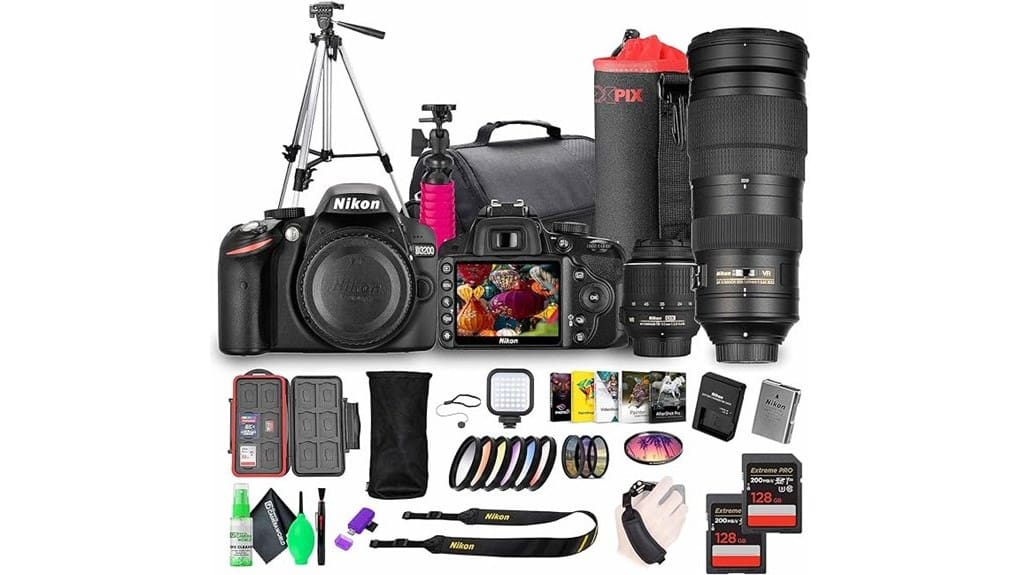
Packed with accessories and two complementary lenses, the Nikon D3200 24.2MP kit gives you a ready-to-shoot system that covers most entry-level to enthusiast needs. You get the D3200 body, 18-55mm VR and 200-500mm VR lenses, filters (52mm/95mm), two tripods, LED light, 128GB card with reader, cleaning kit, software, straps and protective bags. This assortment guarantees broad shooting capability and accessory compatibility with standard filter threads and tripod mounts. Included documentation outlines warranty coverage and service channels. By supplying essential capture, stabilization, protection and post-processing tools, the kit minimizes immediate additional purchases and setup time. Find the ideal carrying solution for these components with a camera bag designed for photography enthusiasts.
How the D3200 Performs: Sensor, Autofocus, Speed, and Image Quality
Image quality on the D3200 stems from its 24.2MP DX-format CMOS sensor paired with the EXPEED 3 processor, delivering high-resolution stills with good detail retention and moderate noise control up to ISO 6400 (expandable to 12800). You’ll find sensor readout and processor handling provide accurate color rendering and usable detail for prints and crops. The 11-point AF system is competent for static subjects; continuous 4 fps shooting limits action coverage. In calibrated low light performance you’ll need noise reduction above ISO 1600. Dynamic range testing shows respectable midtone latitude but reduced shadow recovery compared with newer sensors. As a camera aimed at enthusiasts it pairs well with a variety of interchangeable lenses for creative flexibility and system expansion, making it a solid option for enthusiast photographers.
Lens Breakdown: 18–55mm Vs 200–500mm – Real-World Uses and Limits
The 18–55mm f/3.5–5.6 VR covers wide-angle to short-telephoto perspectives suited for landscapes, environmental portraits, and everyday walkaround shooting with optical stabilization to help handheld low‑light shots. You’ll use it for travel practicality: compact, versatile focal range, modest weight, and adequate sharpness center-to-edge at mid apertures. The 200–500mm f/5.6E ED VR delivers extended reach for wildlife and sports, requiring tripod or high-ISO handheld technique. Compare bokeh comparison: 200–500mm yields stronger background separation; 18–55mm produces limited blur. For portrait suitability, 18–55mm is usable at longer end; 200–500mm compresses features but demands distance and careful wildlife techniques for ethical framing. Consider mastering zoom lens techniques with variable apertures to get the best results across focal ranges.
Usability and Features for Beginners: Guides, Video, Stabilization, and Portability
After comparing the two lenses’ handling and reach, you’ll appreciate how the D3200’s user-focused features support both learning and practical shooting. You get guided tutorials via Guide Mode that present step-by-step settings and example images, reducing trial-and-error and accelerating exposure, focus, and composition understanding. Video capabilities include Full HD 1080p at multiple frame rates, continuous autofocus and external stereo mic support for clearer capture. Both kit lenses offer Vibration Reduction; VR plus steady shutter technique minimizes blur at long focal lengths. Compact, lightweight body and supplied accessories deliver effective pocket portability for travel and fieldwork without sacrificing control. For photographers who want precise light measurement, pairing the camera with a spot meter can greatly improve exposure accuracy.
Who Should Buy This Kit (And Who Should Skip It): Value, Alternatives, and Final Verdict
If you’re weighing cost, capability, and long-term upgrade paths, this D3200 kit offers strong value for beginners and hobbyists who want a versatile starter system without breaking the bank. You’ll get competent 24.2MP imaging, dual lenses covering wide to super-telephoto, stabilization, and accessories that reduce immediate extra purchases. Buy if you need reliable optics, RAW/JPEG flexibility, and an affordable entry into Nikon F-mount ecosystems. Skip if you require fast AF, high ISO performance, or mirrorless compactness. Use this as a buyer’s guide baseline: consider aftermarket bodies or newer mirrorless alternatives when planning advanced upgrade paths. This seller specializes in products for mirrorless camera enthusiasts, so you can also find complementary accessories and advice.
Some Questions Answered
Can the D3200 Connect to Modern Smartphones Without the WU-1A Adapter?
No, you can’t pair the D3200 directly with modern smartphones natively; Nikon only supported wireless tethering via the optional WU-1a adapter. You can, however, use third‑party dongles or Wi‑Fi-enabled memory cards to add connectivity, or transfer files via USB card reader to your phone or computer. Those workarounds enable remote control or image transfer but require additional hardware and may offer limited functionality compared with native app integration.
Is the Battery Life Sufficient for Full-Day Shooting and How Many Shots?
Yes — the battery longevity generally supports full-day shooting if you manage power. You’ll get about 540 shots per CIPA rating with moderate use; continuous Live View or video drops shooting stamina markedly (often under 200–300 shots). Carry a spare EN-EL14a battery for extended sessions, limit LCD use, and disable Wi-Fi adapters. Use airplane mode and conservative review habits to maximize battery longevity and overall shooting stamina on long shoots.
Are the Included Filters Compatible With Both Lenses Without Step-Up Rings?
No — they won’t all fit without step-up rings. The 18-55mm typically has 52mm filter diameters and matching lens threading, while the 200-500mm uses a larger 95mm thread. Because filter diameters differ, you’ll need step-up rings or separate filters to mount smaller filters on the larger lens or vice versa. Verify each lens’s lens threading stamp before purchasing rings to confirm correct thread-to-thread compatibility.
Can I Use Current Nikon AF Lenses and Retain Autofocus on This Body?
Yes — you’ll retain autofocus with AF‑S and AF‑I lenses; the D3200 lacks a mechanical screw drive so AF without a built‑in motor won’t work. AF S compatibility is full for lenses with internal motors, including AF‑S and AF‑P (firmware permitting). Metering limitations: non‑CPU or older AI lenses will require manual exposure or limited metering modes; exposure metering and EXIF lens data may be incomplete for those lenses.
Does the Kit Support Intervalometer or Time-Lapse Out of the Box?
No, it doesn’t include a built‑in intervalometer or dedicated time‑lapse function out of the box; you’ll need an external intervalometer or tethering app. You can achieve basic time‑lapse by using an external trigger or the optional WU‑1a wireless adapter with third‑party apps. For advanced sequences requiring exposure ramping and shutter smoothing across changing light, use external controllers or interval‑capable software to control exposure steps and ramp shutter settings smoothly.