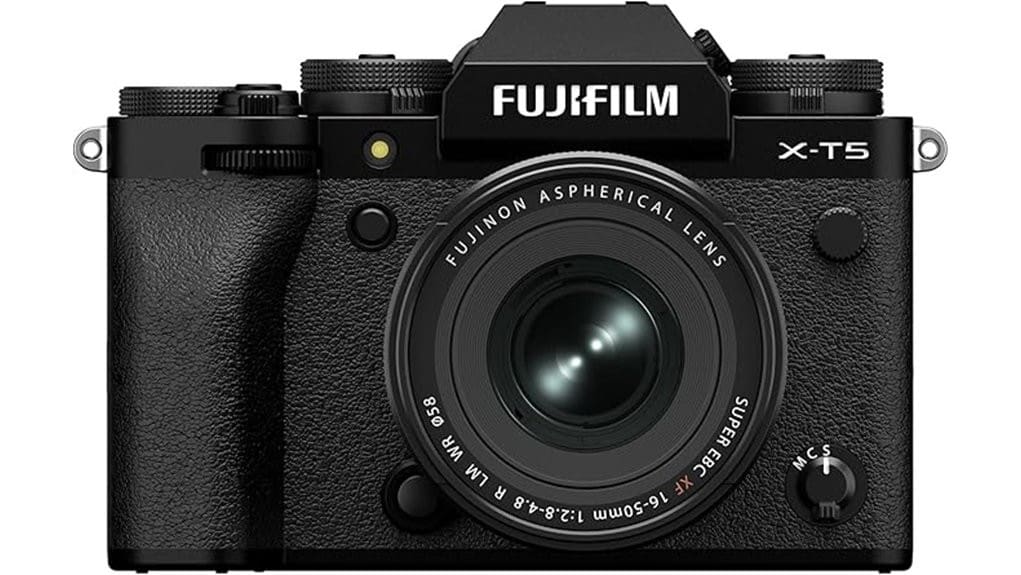
The X‑T5 with the XF16‑50mm kit gives you class‑leading 40.2MP stills, robust up to 7‑stop IBIS, and Pixel Shift for ultra‑high‑res static work, all in a compact, weather‑resistant body. Autofocus and 15fps burst serve hybrid shooters well, but the f/2.8–4.8 kit zoom limits low‑light reach and telephoto brightness, with softening wide open and corner issues that need stop‑down correction. Expect large RAWs, heat limits in 6.2K, and workflow demands — more specifics follow.
Some Key Takeaways
- X-T5’s 40.2MP APS-H sensor delivers exceptional still detail, ideal for landscapes and portraits when paired with the XF16‑50mm kit.
- IBIS up to 7 stops and 15 fps burst enable stabilized handheld shooting, though low-light performance is limited by the kit lens’s aperture.
- XF16‑50mm is compact and weather‑resistant, sharpest at 16–28mm stopped to f/5.6–8 but softer and prone to field curvature at tele end.
- Autofocus is reliable with 425 phase‑detect points and good subject tracking, but struggles with erratic motion or low‑contrast targets.
- Video options (6.2K/4:2:2 10‑bit, ProRes RAW) are strong but constrained by heat, rolling shutter, and heavy storage requirements.
Who Should Consider the Fujifilm X-T5 With XF16-50mm Kit?
If you shoot landscapes, portraits, or travel and want high-resolution stills plus a compact, weather-resistant kit, the X-T5 with the XF16-50mm is worth considering. You’ll benefit from a 40.2MP APS-H sensor, strong IBIS, and 6.2K internal video if you need detail and stabilization in mixed shooting. Travel vloggers will like the tilt screen, compact zoom, and robust connectivity for on-the-go capture. Studio beginners can exploit high resolution and controlled lighting, though the kit lens’s variable f/2.8–4.8 limits low-light reach. Professionals needing fastest glass or ultimate low-noise performance may look elsewhere. For those building a mirrorless setup, consider essential gear like filters, spare batteries, and a protective bag.
Quick Verdict: Strengths and Trade-Offs at a Glance
While it packs industry-leading resolution and up to 7 stops of IBIS into a compact, weather-resistant body, the X-T5 with the XF16-50mm kit forces a few compromises you should know about. You get exceptional resolution, refined color science, fast autofocus and versatile video codecs, yet battery performance is middling for travel or long shoots. The kit lens is lightweight and sharp across much of the range but limits reach and maximum aperture at tele. Operational controls are tactile and precise, but high-resolution files demand fast cards and more storage. Overall: powerful, portable, but not without practical trade-offs. Consider pairing it with a sturdy tripod for improved stability and composition when shooting high-resolution images with tripods.
Image Quality and Stabilization: 40.2MP Sensor, Pixel Shift, and IBIS Performance
Because Fujifilm packed a 40.2MP X‑Trans CMOS 5 HR sensor and up to 7 stops of IBIS into the X‑T5, you get exceptionally detailed stills and a practical stabilization envelope for handheld work—when you pair it with fast glass and UHS‑II/U3/V90 cards to handle the files. The sensor resolves fine detail for high resolution landscapes; dynamic range and 10‑bit capture are competent but highlights clip sooner than full‑frame competitors. Pixel Shift multi‑shot delivers staggering 160MP composites for static subjects, though workflow and tripod exigencies limit use. IBIS is effective for low light portraits, but rely on lenses and technique. For long-term performance and to protect that high-resolution sensor, regular maintenance with proper sensor cleaning practices and kits is recommended.
XF16-50mm Lens Real-World: Sharpness, Aperture Limits, and Focal-Range Use Cases
Although compact and weather‑resistant, the XF16‑50mm f/2.8–4.8 kit zoom forces compromises: it’s sharpest from 16–28mm stopped to f/5.6–8 for peak acutance, softens noticeably at the long end and wide-open apertures, and shows moderate field curvature and corner falloff that you’ll need to correct or avoid for critical landscape work. You’ll get usable detail across the frame for general travel and street use, but expect corner softness at wide apertures and longer focal lengths. Careful stopping down improves contrast; be mindful of visible lens breathing during focal changes and moderate chromatic aberration that needs correction. For heavy outdoor use, consider a sturdy support like a heavy‑duty tripod to stabilize the camera and mitigate softness from camera shake.
Autofocus, Burst Shooting, and Video Features for Hybrid Shooters
Pushes a lot of performance into a compact body: the X-T5 pairs a 425-point phase-detect AF with contrast-assisted algorithms and fast AF-C tracking to deliver reliable subject acquisition, and its 15 fps mechanical burst (with IBIS active) makes it a competent tool for action sequences. You’ll appreciate phase detection across most of the frame; lock times are short and focus recovery is predictable. Continuous tracking does well on faces and subjects with clear edges but struggles with erratic motion or low-contrast targets. Video options are strong — 6.2K/4:2:2 10-bit and ProRes RAW — but rolling shutter and heat limits merit caution. For photographers concerned with exposure accuracy when switching between natural and artificial light sources, consider using a dedicated light meter to ensure consistent readings.
Ergonomics, Battery Life, Ports, and Workflow (Cards, Codecs, and Connectivity)
Having covered autofocus, burst shooting, and video performance, let’s look at how the X-T5 handles ergonomics, power, and the physical connections that shape real-world workflow. You’ll appreciate solid build materials and tactile button placement—controls are logical but compact, which can cramp large hands during long shoots. Battery life is decent for stills but you’ll need spares for extended 6.2K recording. Ports are minimal; port durability seems adequate but repeated HDMI/USB use merits care. Heat dissipation under heavy video loads limits continuous runtime. For workflow optimization, prioritize fast cards, strict card management, and reliable wireless transfer routines. Keep Shooting recommends having spare batteries and accessories like reliable chargers to maintain uninterrupted shooting with mirrorless cameras, especially for extended sessions with high power draw from video and connectivity features, so consider investing in spare camera batteries.
Buy-or-Skip Checklist: Price, Alternatives, and Who This Kit Best Serves
If you need a high-resolution, compact APS-H mirrorless that excels at stills and high-bit-rate video, the X-T5 is worth serious consideration—but only if its price and workflow demands match your shooting priorities. You’re buying a 40.2MP sensor, up to 6.2K/10‑bit internal, IBIS, and a versatile XF16‑50mm kit. Factor in large RAW sizes, fast cards, and editing overhead; price sensitivity matters if you don’t leverage the resolution or codecs. Consider alternative bodies (X-T4, X-S20, full-frame rivals) if you need better low‑light, lower data rates, or a cheaper entry point. Buy if you’ll use it. For photographers handling big files and high-bitrate footage, choosing the right large capacity memory cards is essential to maintain workflow efficiency and avoid recording or transfer bottlenecks.
Some Questions Answered
Does the X-T5 Support In-Camera Focus Stacking With the XF16-50MM Lens?
Yes — the X-T5 offers in camera stacking, and you can use it with the XF16-50mm. You’ll get focus bracketing and automated stacking, but optical limitations from the kit zoom (field curvature, resolving power edge softness, variable aperture) reduce micro-detail compared with prime glass. You should critically assess results at longer focal lengths and wide apertures; stop down, use stable tripod, and expect better output with higher-quality optics for true micro-focus stacking.
Can the Camera Charge and Power Accessories via USB-C While Shooting?
Yes — you can use USB power to run the camera and charge accessories while shooting, but there are limits. The X-T5 accepts USB‑C power delivery for camera operation and battery trickle charging; accessory charging via the same port is possible only if the connected hub/device supports power pass‑through and sufficient wattage. Don’t expect fast simultaneous charging; high-draw accessories may exceed supply and cause shutdowns or limited performance.
How Well Does the Kit Lens Perform for Astrophotography at Native ISO?
You’ll find the XF16-50mm kit lens usable but limited for astrophotography at native ISO. Sharpness is adequate center-to-midframe, but you’ll see increased high ISO noise from the sensor and softer corners. Coma correction is modest — bright stars show slight tails toward edges, requiring tight crops or stacking. For critical wide-field work you’ll want a faster, astro-rated prime; for casual nightscapes it’s acceptable with careful processing.
Are There Weather-Sealing Caveats When Using Third-Party X-Mount Lenses?
Yes — you’ll face caveats. Third-party X-mount lenses often lack the same mount seals and full weatherproof tolerances as Fujifilm originals, so water/dust ingress risks rise. If you use lens adapters you’re adding additional potential failure points and sealing gaps. You should verify manufacturer dust/water ratings, prefer adapters with gasketed mounts, and test reliability in controlled wet conditions before trusting critical shoots in adverse weather.
What Firmware Updates Improved Autofocus or IBIS Since Launch?
You’ll see AF firmware and IBIS improvements in early post‑launch updates: Fujifilm refined subject detection, expanded AF‑C tracking profiles, and reduced focus hunting (AF firmware). They also tuned gyroscope algorithms and added stabilization modes to improve handheld sharpness and subject lock (IBIS improvements). Updates were incremental—better low‑light phase detect performance and smoother roll compensation—so you’ll want the latest firmware for noticeably improved autofocus reliability and steadier in‑body stabilization.