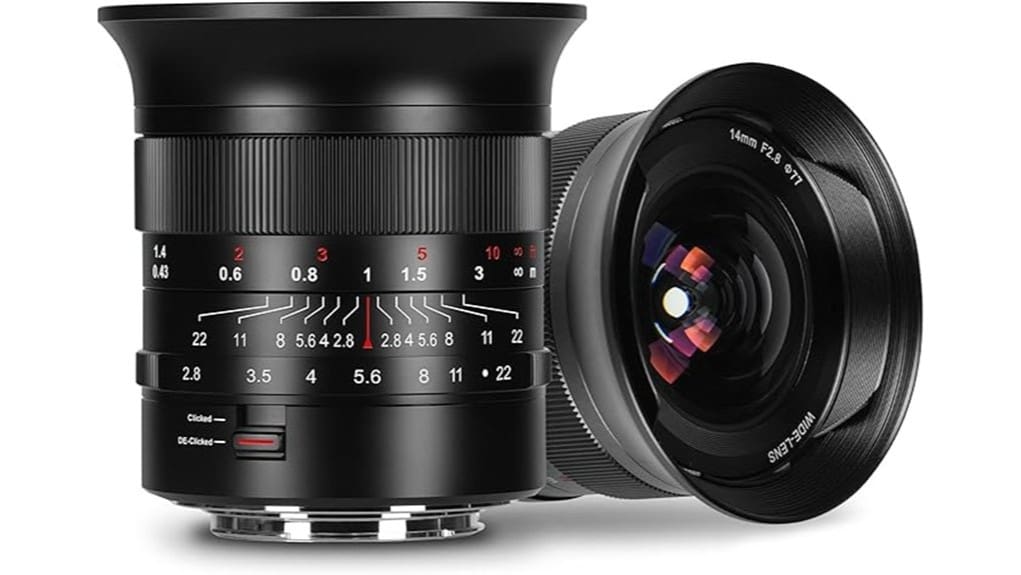
You’ll get a compact, manual ultra‑wide prime that gives full‑frame coverage, a 14mm/114° view, and an F2.8 aperture for low‑light and astrophotography. It uses a 10‑element design with aspherics, HR and LD glass, plus multi coatings to hold center‑to‑edge sharpness and control wide‑angle distortion. Focus is manual with clear distance marks and stepless aperture options; front filters fit despite a fixed hood. If you want optical consistency and practical tradeoffs, more specifics follow.
Some Key Takeaways
- Manual-focus 14mm F2.8 prime delivers 114° field of view for architecture, interiors, landscapes, and astrophotography.
- Optical formula (10 elements, 2 aspherics, 5 high-refractive, 3 low-dispersion) yields strong center-to-edge sharpness.
- Manageable barrel/pincushion distortion and effective multi-coatings reduce flare and preserve contrast.
- Usable corners at F2.8 with moderate vignetting; focus stacking recommended for peak edge detail.
- Budget-friendly alternative to Samyang/Laowa, trade autofocus and weather sealing for optical consistency and value.
What the 7artisans MF14mm F2.8 Is and Who It’s For
What makes the 7artisans MF14mm F2.8 distinct is its purpose-built design as a manual-focus ultra-wide prime for full-frame cameras, delivering a 14mm focal length and a 114° field of view. You’ll operate it exclusively in manual focus, relying on precise focus throw and scale markings for critical focusing in architecture, interiors, and astrophotography. Its bright F2.8 aperture and full-frame coverage target photographers who prioritize wide perspective and control over autofocus convenience. The target audience includes experienced landscape, cityscape, and night-sky shooters who accept manual operation for optical consistency, creative filter use, and predictable mechanical behavior. It’s especially useful for photographers learning to master wide-angle lenses and how perspective and composition change at extreme focal lengths.
Optical Build: Glass Formula, Sharpness, and Distortion Control
Having outlined who benefits from the MF14mm’s manual-wide approach, we can examine how its optical construction delivers that performance. You get a 10-element formula with 2 aspherics, 5 high-refractive and 3 low-dispersion elements arranged to maximise sharpness across the frame. Tight manufacturing tolerances keep element spacing consistent, reducing field curvature and maintaining center-to-edge resolution. Multi-layer glass coatings minimise flare and ghosting while preserving contrast with bright apertures. The optical design also controls barrel/pincushion tendencies typical of extreme-wide optics, yielding predictable distortion that’s easily corrected in post or managed in-camera without sacrificing resolution. This balance of performance and compatibility makes the MF14mm a strong choice for shooters who use lens mount adapters to expand their creative options.
Real-World Performance: Landscape, Architecture, Interiors, and Astrophotography
When you push the MF14mm into real-world shoots, its optical strengths translate into reliably usable images across landscape, architecture, interiors and astrophotography. You’ll capture low light landscapes with usable corner detail at F2.8, managing edge vignette in post when necessary. Creative foregrounds benefit from the 114° view and sharp center-to-edge rendering; focus stacking methods tighten apparent depth when you need micro detail. For urban nightscapes and starry skies, the fast aperture aids exposure; employ star trailing techniques conservatively to avoid coma. Interior perspective remains controlled for architecture; consider tilt shift comparisons when absolute linearity is critical. For stability and consistent framing during these shoots, using a quality tripod designed for photography, such as products from Perfect Tripods, is highly recommended.
Handling, Controls, and Filter/Accessory Compatibility
Assess the MF14mm’s handling by noting its compact-but-solid build, smooth manual controls, and accommodation for front-mounted filters. You operate a precise manual focus ring with damped resistance and clear distance markings, enabling repeatable focus pulls. The aperture ring offers stepless/click modes via a switch, giving predictable stops for stills and silent adjustments for video. The integrated lens hood is fixed, reduces flare, and limits direct access to the front element while still allowing dedicated front filters. A tripod foot interface isn’t integral; you’ll mount to the camera plate or use a third-party foot for improved balance when shooting on a gimbal or tripod. For transporting and protecting the lens between shoots, consider a purpose-built lens pouch to prevent bumps and scratches.
Value and Alternatives: Price, Pros/Cons, and Competitors
Beyond handling and controls, value hinges on how the MF14mm’s optical performance, build, and feature set stack up against its price and rivals. You get excellent edge-to-edge sharpness from 10 precision elements (including aspherical, high-refractive, and low-dispersion glass) and robust construction at a budget-friendly MSRP. In a price comparison, it undercuts branded ultrawides while delivering comparable distortion control and F2.8 low-light capability. Pros: full-frame coverage, filter compatibility, stepless aperture. Cons: manual focus only, limited weather sealing, mount-specific availability. Competitors include Samyang/Rokinon and Laowa; check alternative mounts for compatibility before buying. For photographers focused on zoom systems, pairing ultrawide primes with a zoom lens can expand creative options without replacing their main kit.
Some Questions Answered
Does It Have Weather Sealing?
No, it doesn’t have official weather sealing. You should inspect build quality closely; the metal barrel and precision glass elements feel solid, but there’s no manufacturer-rated gasketing. You shouldn’t assume splash or dust resistance without sealing tests. If you need reliable protection, plan to use a weatherproof housing or protective cover and avoid heavy exposure. For critical outdoor work, choose a lens with documented sealing and verified field-tested results.
What Is the Minimum Focusing Distance?
The minimum focusing distance is 0.2 meters (20 cm). You can get very close for dramatic close up composition while keeping wide context; that lets you emphasize foreground interest with strong perspective. You’ll need careful framing to avoid edge softening and vignetting at extreme close range, and manual focus control helps fine-tune subject plane. Use small apertures for greater depth of field when foreground and background elements both need to be sharp.
Is Autofocus Available or Planned?
No, autofocus isn’t available and there’s no official plan announced to add it. You’ll use manual focus for all shooting; the lens’s optical design, focus throw, and mechanical helicoid prioritize precision over AF integration. While a firmware update can enable electronic enhancements on some lenses, adding true autofocus would require hardware changes to the mount and focus mechanism, so a firmware update alone is unlikely to introduce AF functionality.
How Heavy Is the Lens?
The lens weighs approximately 520 grams, so you’ll notice its solid build but not be overburdened. For weight comparison, it sits heavier than many compact primes yet lighter than larger professional ultra-wides. For handling tips, you’ll brace the camera with your left hand under the lens and use a sturdy strap or tripod for extended shoots. You’ll also balance body choice versus lens mass for comfortable all-day use.
Does It Support Lens Correction Profiles in RAW Editors?
Yes — you’ll find lens correction profiles available for many raw editors, though availability can vary by platform. Profiles typically address vignetting control and chromatic aberration, plus distortion. You should get automatic corrections in Lightroom, Capture One, and some camera manufacturer software; open-source tools (Darktable, RawTherapee) may offer manual or community profiles. If a profile’s missing, you can apply manual corrections for vignetting, CA and distortion.